
The Tongil Group Newsletter for August 1, 2011
Tongil Group Newsletter for July 21, 2011
A Country that Values Inner Peace -- members of the True Family respond to an invitation from the Malaysian parliamentarians
Kook Jin Moon
July 2011
From Tongil Foundation chairman Kook Jin Moon's speech
I have long admired Malaysia as a moderate Muslim country where Islam exists in harmony with other religions. I believe that the invitations extended to my parents, who are religious leaders known throughout the world for their emphasis on harmony among religions, give clear evidence to this admirable aspect of Malaysian society.
Prime Minister Najib Razak in his address to the United Nations last autumn called for a "global movement of the moderates" of all religions to combat religious extremism. The prime minister's effort, which he repeated at the University of Oxford just last month, is very much in keeping with the teachings of my father and deserves the support of religious persons everywhere...
Many people are surprised on visiting the Unification Church World Headquarters Church in central Seoul to find that we have a special room to honor the prophet Mohammed, Jesus, Buddha and Confucius, whom we refer to as the Four Great Saints. The Unification Church maintains friendly relations with the major orders of Korean Buddhism. The leaders of both faiths regularly attend each other's religious events.
There are conflicts in every country. The fundamental causes of these conflicts lie in the hearts of the people. It is the responsibility of religions to remove that cause, but religions cannot do that unless they inherit God's true love and relate to each other in harmony. Malaysia is showing the world a model for religious harmony, and I look forward to seeing your continued development in this area.
Adapted from the Malaysian headquarters' report
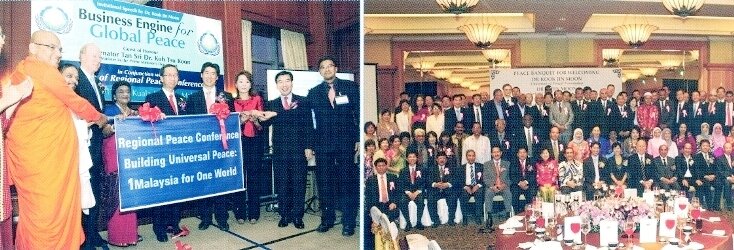
Left: In-jin nim, Kook-jin nim and others with Tan Sri Dr. Koh Tsu Koon, minister of the Prime Minister's Office, at the dinner and invitational speech, June 20; Right: With members of the House of Representatives at the Peace Banquet, June 19
Religious freedom is guaranteed under the constitution in Malaysia, a nation where the state religion is Islam. Sixty percent of Malaysians are Muslim, yet the Malaysian government makes much effort to foster harmony among the various religious and ethnic groups in the country. In recent years, some members of the Malaysian House of Representatives have taken an interest in the Unification Church's inter-religious activities. In that pursuit, they were troubled to learn of the abuse of church members' human rights in Japan. Taking steps to under- stand the situation more fully, some members of parliament have actually visited Japan, where they expressed their concerns to members of the Japanese government. More recently, they went to the United States to speak to members of Congress to discuss what might be done about the situation.
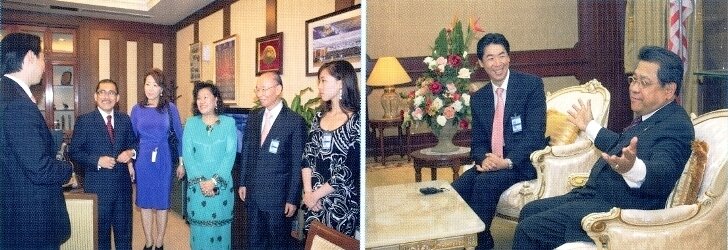
Last year, forty Malaysian members of parliament attended True Parents' birthday celebration (at their own expense), and a delegation also participated this year. Having experienced True Parents' hospitality, a group of seventy Malaysian MPs recently sent Father and Mother, plus sons Kook-jin nim and Hyung-jin nim, an invitation to visit their country. Although True Parents were unable to go personally, in mid-June, Kook-jin nim and Ja-yea nim and In-jin nim and her daughter Ariana visited Malaysia for three days and met members of parliament and others from that nation's government. They also made great efforts to inspire the Malaysian movement and uplift its members. In fact, the official schedule began with breakfast at the Malaysian Unificationism headquarters on Sunday, June 19. Reports were presented on developments taking place in a number of Asian countries, such as the continuing Original Divine Principle broadcasts on Nepalese national television. Kook-jin nim offered his thoughts on establishing and maintaining peace through nations having economic and military strength, a theme he has often spoken on in recent months. If Abel had had a gun, he said, Cain could not have attacked him.
Afterward, those at the headquarters joined other members at a nearby hotel where Lovin Life Ministries held their first Sunday service in Asia. In-jin nim spoke about True Parents as the model giving us the opportunity to live a religious life that includes marriage and family, and that through True Mother women can learn the roles of a true mother, wife, sister and daughter. Kook-jin nim also spoke of his father's life as a living crucifixion and of how True Mother and Hyung-jin nim are attending True Father every day; he credited Mother with being the reason True Father is still alive. Sonic Cult -- an integral part of every Lovin' Life Ministries service -- was there to provide the music. (They also played at the UPF invitational the following day.) At the close of the service, each family was invited to take a personal photograph with the True Family members.
That evening, a Peace Banquet was held for members of parliament and other dignitaries, to whom Kook-jin nim testified boldly about True Father's mission. Many of the seventy members of the Malaysian House of Representatives who had signed the invitation for True Parents were present. The following morning, a UPF delegation including the members of the True Family and Rev. and Mrs. Yoo (the boon-bong-wangs to Malaysia, who have actively developed relations with the parliamentarians), were invited to visit the Malaysian Parliament, where the speaker of the house hosted a luncheon for them and a delegation of MPs.
That evening, UPF Malaysia hosted a dinner and invitational speech at the Bankers' Club in downtown Kuala Lumpur, under the banner "Business Engine for Global Peace." The guest of honor at the occasion was Tan Sri Dr. Koh Tsu Koon, minister of the Malaysian Prime Minister's Office. Describing his country as multi-racial, multi-religious, multi-cultural and multi-linguistic, he explained that all Malaysians are involved in the campaign to build "1 Malaysia" and participate in community creation. In 2008, Malaysia was in thirty-eighth position on the Global Peace Index,' while this year, 2011, it is nineteenth, he said. He went on to say that there are more than five thousand "neighbor circles" in Malaysia, and that the government gives its citizens training as community moderators who solve problems at the local level -- and that they earn the respect and credibility to do that.
Both In-jin nim and Kook-jin nim spoke. In-jin nim emphasized the value of marriage and family, and the power of true love to create in us the heart to think of the well-being of others first. She upheld her parents as examples that she wants to share with the world. In-jin nim then introduced her brother. As he came to the stage, Kook-jin nim hugged his older sister. In a reflection, the Malaysian national leader Rev. Yeoh Koay Seng (Sam) wrote, "From the bottom of my heart, I could see bright hope in the True Family when I witnessed the scene where In-jin nim and Kook-jin nim hugged each other during the event. At that moment, I realized the real meaning of 'Business Engine for Global Peace,' that it signifies true love that brings us together as a family."
Kook-jin nim again testified unequivocally to his parents' mission and read from True Father's autobiography on the subject of harmony between faiths. The event concluded with an official invitation being extended to the guest of honor, and others, to accept the title of ambassador for peace.
To Members of Malaysian Parliament
Chairman Kook Jin Moon Visits Quake Zone and Encourages Members
Strong Korea
Kook Jin Moon
February 27, 2011
Cheon Bok Gung, Yongsan Seoul Korea

Sermon PPT Slide: www.slideshare.net/tcelder/strong-korea-cbg-110227
Main Sermon:
(Greets everyone in Korean then switches to English)
(Showing slides) This is on March 26, 2010. It is the Cheonan boat that was sunk. Forty-six sailors lost their lives. In November 2010, Yeongpyeong Island was bombed. Two Marines and two civilians were killed. The Chinese response to these attacks against the sovereignty of Korea was that both North and South Korea should calm down. They failed to acknowledge who was the aggressor and who was the victim. As a rising world power and a rising super power, it is very unfortunate that China is taking such an irresponsible position. Of course, the US condemned the attacks against the Cheonan and Yeonpyeong Island, but you must understand that in these days America is facing a great deal of difficulties and challenges.
(Next slide) This graph shows the twin deficits of the US. This year the fiscal deficit is expected to be over 1.6 trillion dollars. That fiscal deficit is bigger than the entire GDP of Korea. Of course, America continues to run a very significant trade deficit as well.
(Next slide) This chart comes from the Congressional Budget Office. It shows US Federal Public Debt held from 1790 and projected out for 2035. The interesting point to recognize is that as of 2010, the US has the highest level of public debt since World War II. The Congressional Budget Office projection on the direction of US public debt, based on expected changes in US law, is that it is expected to exponentially increase.
Since 1970 to this day, the US has maintained its world share of GDP. However, Europe has declined quite significantly and Asia has risen. The Asian increase of GDP is of course driven by the Chinese economy. This is where the concept and the talk of the relative decline of the US come in. Whereas in the past the US and its allies held the dominant position economically and militarily, today there is definitely a new power that is rising both economically and militarily. Since the growth of that power is so rapid relative to the US, the US is relatively declining vis-à-vis that power.
The interesting thing to notice is that we have come to an inflection point now. If you project these trends then Asia's share of GDP will rise past US share of GDP. From this point the US share of GDP will continue to decline.
(Next slide) These polls show public opinion in the US. The first question asked whether or not the US should intervene to help other nations who find themselves in trouble. For the first time since 1964 most people in America do not feel that America should help anyone. That trend will continue to increase.
The second question looks at whether or not people in America feel America should focus on its own problems or get involved in international problems. Seventy-six percent (76%) of the American public think that America should focus on its own problems from now; and that trend will continue to increase in that direction, too.
One thing that we need to understand here in Korea is that American public opinion continues to move away from being the world's policeman. America does not want to pay for world security anymore. I had a chance to see Donald Trump in an interview on CNN and he made a very interesting comment. The interviewer asked Donald Trump what he thought about America's situation and what America's problems were. What he said was very interesting because I felt that it really reflected the current mood of America. One of the problems he stated was that he asked as to why the US sent its carrier group to Korea after it was attacked. His point was that it cost a lot of money because it is a very advanced piece of technology. Why should America send its armed forces to defend somebody else's security for free? But if America no longer protects Korea, where will our security come from?
(Next slide) This chart shows the exchange rate base conversion of GDP and national defense spending. As of today, the US still has the largest GDP and their defense spending is the largest, at $741 Billion. As of today, China is the second largest country in terms of GDP with almost Six (6) Trillion dollars in GDP. Their defense spending is at nearly $100 Billion. There are a number of things to point out in this defense debate. For instance, the $741 Billion includes over approximately $120 Billion spent on the Iraq and Afghanistan wars. And so, even if we say the US defense spending on normal terms is $600 Billion, well, America still spends six times more than China -- so what do we have to worry about, right?
But these figures are a little bit misleading because the conversion of these figures is based on Exchange Rates. They are not based on the real cost of commodities within the respective nations. If you used the CIA method of conversion by Purchasing Power Parity, then these numbers look quite a bit different.
(Next slide) These numbers are based on Purchasing Power Parity. As you can see the US stays the same GDP and the military spending is still on $741 Billion. But look what happens with the Chinese GDP figures. On the Purchasing Power Parity basis, the Chinese GDP is estimated to be nearly $9 Trillion. And Chinese military spending is estimated to be at $400 Billion. Actually on the Purchasing Power Parity basis, Japan's GDP is smaller than the Exchange Rate basis and their military spending is quite a bit smaller. You can see what happens to South and North Korea's defense spending as well. This is the problem.
There is one more thing that we have to understand about the US defense spending. America's defense spending is not concentrated in any one area. The US has military commitments in Europe and in the Middle East, as well as in Asia. Their military spending is dispersed throughout the whole world, including having to maintain a certain defense presence in their own country. But Chinese defense spending is not. It is focused 100% here in Asia.
The other thing we should concern ourselves with is that Russia is on China's borders, and if you look at how Russia and China both vote on the UN Security Council, they are always on the same side.
(Next slide) You can see the growth of Chinese defense spending. Next year it is growing again, probably at the same rate.
An interesting thing about Korea's defense strategy and defense planning is that it seems to develop primarily its defense capability, rather than to deal with the problems of North Korea. One point I want to make is that there is a flaw in this thinking of our nation that our defense preparation should be set to just counteract North Korea. Korea's defense strategy needs to consider all of the relevant threats in this region, as well as what its allies will contribute realistically in an event that there is a war. That means it has to consider in its defense planning the rise of Chinese defense spending. This does not even exist in Korea's defense strategy.
But even if we look at the Korean defense strategy vis-à-vis North Korea there are blatant holes in Korea's defense structure. On the Purchasing Power Parity basis, we do spend more than North Korea on defense; our weapons systems do have higher technology than North Korean weapons systems, in general. But we have to ask ourselves this question: what if in a hypothetical situation where there are only two nations on earth -- North and South Korea -- in that case, can we be confident that we would win the war if a war would break out? That's the question we have to ask. The problem is that the answer to that question is not clear. We can't answer confidently that we would win. The reason for that is that there are asymmetric differences in power of North Korean weapons and South Korean weapons.
For example North Korea has nuclear weapons; North Korea has chemical weapons; North Korea has biological weapons; and North Korea has delivery systems for all those weapons. We don't. That's why we can't confidently say that we can deter or even beat North Korea in war. We wonder why our diplomacy is always so weak. That's because we are weak. We are rich but we are weak. In issues of warfare money does not make you superior. A poor man with a gun can kill you just the same as a rich man with a gun can.
North Korea's weapons are not entirely low tech. They've recently purchased over forty high tech SU-25 Soviet fighters -- state of the art equipment. You saw what happened in the Yeongpyeong Island incident. Their artillery bombing seemed more accurate than ours, and ours was supposed to be high tech! The government says that they must have used electronic jamming, well if they did that then they must have some high tech capability.
I hate to be the one to point out the fact. I know we are all cheering the rise of Asia these days, but if you look at history: whenever China was strong, Korea suffered a lot of damage. One question is that with a strong China spending so much money on defense and America (our protector) retreating, what will happen to Korea? Why is China spending so much money to build up their military power? Can we believe from China's actions that their intentions are just peaceful? We got bombed by North Korea and basically they [China] didn't think that there was anything wrong with it! This does not bother you? Seriously, it does not bother you?
Geo-politically, Korea is in a very dangerous area and Korea has only two fates. One is to be strong and to maintain the nation; the second is to choose weakness and to be conquered. That's it! The only options Korea has.
My concern is that today we have already decided as a nation what we will be. We have already chosen weakness over strength. That means only one thing. In the future we will loose our independence and our republic. But we still have time to change. The question is: what we will do from now? What choice will we take as a nation going forward? We don't have to be weak.
If you look around the world you can find examples of democracies that have chosen strength over weakness. A good example of that is Israel. They have a very small population -- about seven (7) million people. Their GDP is about $217 Billion with only about $16 Billion in Exchange Rate GDP spending and they are outnumbered 500:1 by the surrounding Arab nations. Yet they are able to maintain their freedom and their independence, and they are able to win any conflict which may happen with an Arab state. As a nation they are able to field 19 combat divisions. In comparison the US field only 16. They are able to fly 3,000 sorties a day. During the Gulf War, the US flew about 1600 sorties a day. Qualitatively and quantitatively they maintain an absolute superiority over all of their neighboring countries. It's widely known but never mentioned that they have nuclear weapons. They have developed a culture where they can mobilize and maintain a very strong military force to preserve their independence.
We have a choice which we can make. I don't know which choice Korea will make. In my opinion this country should choose to be strong so that it can maintain its peace and freedom.
Thank you.