The truth is our church is on a good path

Kook Jin Moon
December 19, 2010
Lovin' Life Sunday Service
New York, NY
Unofficial Notes: Andrew Compton
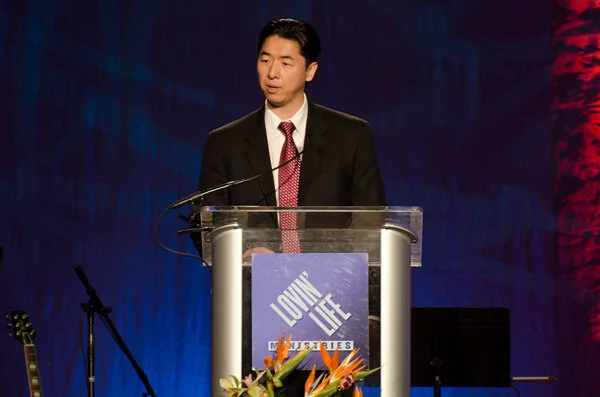
1) Kook Jin Nim began by telling us what a fantastic job his sister has been doing here in the USA. He expressed surprise at our generous and warm welcome. After all the stuff on the Internet about him, he was expecting tomatoes and eggs.

2) He asked us, "Why am I not being sued for paternity? Where are these illegitimate children people are writing about? I would like to know. Sue me. I'm rich. You can get a lot of money."

3) He shared that it is comedic and funny -- because what has been written about him is so atrocious. In the USA we have freedom of speech so it is very difficult to prosecute people for libel. In Korea it's not like that, there are defamation laws and you can be put in jail.

4) With all this unfortunate, despicable propaganda that has been distributed in the US, Korea, Japan, and throughout the world, we could not let that situation stand and so we filed a criminal lawsuit against the postings on the Internet. Of course these postings were posted anonymously. But one of the benefits of filing a criminal lawsuit is that the government prosecutor can act and investigate to find the true names of the people who are posting these things on the Internet. So that's what we did and they did come back and tell us who's doing this, and we have the names. (He mentioned 3 names -- all Korean. I don't know how to spell them properly so I will not try to put them here)

5) Who are these people? They work for the chairman of UCI [Hyun Jin Moon] and for Rev. [Chung Hwan] Kwak. "Do you want to know where all these rumors are coming from? That's where they're coming from." And so these individuals are wanted for questioning in Korea. Kook Jin Nim suggested they go to Korea and answer the questions, but from what he understands they are not willing to go to Korea. If they didn't do anything wrong, why don't they go and talk to the police?

6) Kook Jin Nim's knows we are educated people, we have a system of law and there is a good reason why the courts do not allow hearsay, because that's exactly what hearsay is, it's hearsay. Why are we as individuals and members of this community so eager to believe hearsay? Kook Jin Nim understands that the writer of this fiction may be a good novelist and writes a good story, but that's all it is, it's fiction.

7) Brothers and sisters we are still a young community. Our True Parents started this church 50 or 60 years ago, not too long. We have not had a great deal of time to develop our traditions such as the Catholic Church has, and so we have some growing pains to deal with. And organizationally throughout the world we have had difficulties in our church.

8) Did you know that the Korean Foundation [Tongil Group] and the Korean church in 1997 went bankrupt. He asked if we knew about that. At that time it had billions of dollars in liabilities. "Do you know who the chairman was when it went bankrupt. Do you know who led the foundation into bankruptcy? It was Rev. Kwak. From 1992 until it went bankrupt the foundation was under the leadership of Rev. Kwak. You didn't know about this? I guess he hasn't been telling you much about the real stuff he's been doing."

9) Kook Jin Nim got the job in 2005. When he was put in charge of the Korean foundation, among the organizations he was made responsible for there were quite a bit of losses, both reported and unreported. This is because there were many problems with their accounting system.

10) If you look at some of the losses, the reported losses were nearly 50 million dollars, but if you look at Sae Gae Ilbo [newspaper] in 2004 they reported that there were no losses, but that is because they recorded $30 million of donations from our brothers and sisters in Japan as income. If you look at this kind of accounting irregularities the actual total losses were in excess of $100 million. Again, Rev. Kwak had led our church into bankruptcy once and we were headed in that direction again because he was the chairman when Kook Jin Nim first started there in 2005.

11) Personally, before Kook Jin Nim began his public mission in 2005, he had no problems with Rev. Kwak. He got along well with him. And Kook Jin Nim was close to his brother who is the current chairman of UCI [Unification Church International], longer than anybody. He loves his brother. Now, the problem Kook Jin Nim has with him, is that he hates what he is doing. For years he told him, "What you're doing is not right. Don't do it."

12) Because his brother didn't like that advice he doesn't talk to Kook Jin Nim. He has offered his hand to him, asking his brother to come and talk with him, but he refuses. Even today he is extending this invitation to him, if he wants to come talk, he's ready to talk to him any time. Kook Jin Nim will not agree to something he feels is not right. He will call a spade a spade.

13) Kook Jin Nim understands that in this world, being straightforward and calling things as you see them, is not the popular thing to do. But Kook Jin Nim has his five rules of management and the second rule is to choose accountability over popularity. So, pursuing popularity has never been one of Kook Jin Nim's agendas.

14) We did a lot of difficult reforms in Korea. We restructured all the businesses in Korea, in 2005. There were nearly 34 businesses when Kook Jin Nim started and about 70% of them were losing money. Today we are down to about 12 businesses and basically they have all become profitable or have improved substantially and that is the fact.

15) One case in point, if you look at the newspaper Sae Gae Ilbo. We have a newspaper here in America, the Washington Times -- well, we got it back from UCI. We bought it back (you heard about that, right?) And, the Washington Times has lost about $30 million a year for the last 20 years. In Korea, with Sae Gae Ilbo, it has been about the same thing, losing almost $30 million a year. How much is it losing today? We are down to about $3 million losses a year from $30 million. Our subscriptions are about the same, our revenues did not decline, the newspaper has a brand-new building (Dr Tom Walsh saw it. It's beautiful, right?) We are printing newspapers everyday.

16) There are other companies, some were losing $10-$20 million a year, when we purchased it, it was losing money as well, but now it is profitable. But it is not just one or two businesses, every business has improved substantially. And there was a lot of hard work to get those organizations to work properly. And they had to do corporate restructuring, not a popular thing to do, but the result is that our businesses are now successful and they have a good foundation to build more success in the future. That's a fact.

17) And since that's a verifiable fact that can be accounted for, the media has come and taken a look at what we've done with the Tongil Group, and they have verified it. "It was pretty bad before but now it runs okay. Now it has hope -- that is why we are now getting so much positive press coverage. Because the results are there." You can visit the website tongilgroup.org, dozen of articles are there -- in English.

18) In 2005 the Unification Church in Korea was not popular. We were maligned by the press consistently. Now the press is quite positive towards us. Why? If we are making this stuff up why is the press so positive towards us? Is Kook Jin Nim fooling all the newspapers in Korea? They weren't fooled before. Kook Jin Nim must be some kind of a magic man!

19) "Come on, let's be real." These businesses weren't running well and now they are running well, the press coverage was very bad and now the press coverage is good. But that is not the only thing Kook Jin Nim (and his team) worked on.

20) When Kook Jin Nim was in Korea his job was to manage the businesses and manage the church assets, but it was also his job to hand out the money to everyone. There was a long line of people waiting outside his office every day wanting money -- from people in the businesses, the church related institutions, the NGO organizations, and even our church in Korea was not profitable for the last 20 years.

21) This was the other job of the chairman of the foundation, to distribute the money. On one hand they were working really hard to make the money and on the other hand they had to give it away to organizations, and Kook Jin Nim was thinking to himself -- "I don't know exactly what they are doing with this money." He had a hard time to understand why our church needed to be subsidized. Why can't the church make money considering that every other church in the world makes money.

22) That was a problem he had worked on. And so he spent one year visiting 120 churches in Korea. He visited them personally, nearly 1/4 of all our churches. And he talked to the members, saw the facilities, talked to the ministers, heard their stories, and saw the situation with his own eyes. Based on that research, together with his professional team, they set up a restructuring strategy to make the Korean church prosperous again -- in terms of donation growth, tithing growth, church growth, and maintenance of facilities. They made a restructuring strategy, and with the cooperation of our world chairman, his younger brother, they implemented the plan. It was not easy to do, but it was successful.

23) The number of church buildings was reduced by almost half, but overall Sunday service attendance grew 70%. Registered membership went up by nearly that much. Tithing went up 120% since the reforms started. And now the church continues to grow. Every year tithing and membership is growing. It's been successful.

24) By restructuring and reducing the number of buildings we were able to take that money and renovate the ones that we kept. The whole environment of the Korean church is being renovated, from a ghetto church to a modern newly renovated church. What's wrong with that? How is that wrong?

25) Did Kook Jin Nim do something bad here? Figure it out. The businesses are all profitable, the media that once hated us likes us now, the church which wasn't growing and was always asking for money is now profitable -- "sounds like Kook Jin Nim is really destroying the Korean church." It's kind of funny -- you have to laugh about this kind of stuff, because it is funny. The propaganda which is being produced by certain actors is despicable. There's no other word for it, despicable.

26) The truth is our church is on a good path. If we continue on this path we will fulfill the promise that God has given to our church. Why would we not want to realize the promise that God has given us? Because there is a faction in our church which is so rabid in the promotion of themselves and their view of the universe and their lies -- yes they are a bunch of liars. Do you want to give up our victory for God and True Parents for lies, does that make sense? Is it rational? Let's be reasonable. Let's open our eyes and see the truth.

27) About two years ago Kook Jin Nim did a lot of work to renovate and restore organizations in Korea and based upon that he has quite a bit of success under his belt. Why would he need any more qualifications? He has a lot of result. No one in our church has as much result. Name one person, except of course for True Parents. What else does Kook Jin Nim have to prove.

28) Two years ago True Father sent Kook Jin Nim to Japan. He told him to fix the problem there. Basically the police were raiding our church every week. Nearly 130 members had been arrested, but True Father tells him to go there and fix the problem. Could we say, suicide mission? Seriously, who in their right mind would put themselves in such risk.

29) What is there he needs to prove? Kook Jin Nim has been successful his entire life. He graduated cum laude from the best school in this country, he has seven patents, built a successful business, and has millions of dollars -- what does he have to prove? He led the successful restructuring and renovation of our church in Korea. True Father gave him a suicide mission to go to Japan and stand in front while the police were arresting everyone -- he guessed that he would be arrested too. He went.

30) He was there when the police were knocking on the door. He was fighting for our Japanese church. He was fighting for the church members in Japan. When everyone else thought that we were finished, everyone else was turning their backs on them, when leaders thought that father was finished and they were turning their backs on Father -- Kook Jin Nim was there defending the church in Japan, defending True Parents.

31) Kook Jin Nim didn't see Rev. Kwak in Japan, he didn't see his brother, the chairman of UCI, in Japan. Where was the Washington Times? Why didn't they help? Kook Jin Nim asked them for help. He told them -- "We have a serious problem in Japan, with persecution, our brothers and sisters are being kidnapped and tortured, help us, write stories about this, get the attention of the American public." Did the Washington Times write even one story about this issue during this time? No. No help at all. How the hell can you call yourself a leader of this church if you can't even stand up and fight for the members?

32) Kook Jin Nim was there on the front line fighting for our brothers and sisters, putting his life at risk, putting his freedom at risk. Where the hell were they? He didn't see them. Where the hell were they? From what he understands they were very busy writing novels defaming him while he was out there trying to defend us -- spending millions of church dollars to defame him, his father, and his brothers and sisters -- while he is out there in front, putting his life at risk to defend us. Is that fare? Does that sit well with anyone?

33) Kook Jin Nim has grown up in America. He came here when he is three years old. He knows that Americans are just, they're rational, they are righteous people, and he knows that we have been deceived. And he knows if we see the facts in front of us, that we will make a proper judgment. "Just look at the facts. Look at who is fighting for you and who is not. Who is just talking the talk and producing lies. And who is actually making results? If you see the truth, if you see the reality, there is no confusion."

34) Every day at Kook Jin Nim has done his job here for the church he has spent every day to make a result. There isn't a day that he has worked for the public service when he did not think of what result he could make. And one thing that he can say is that he has never worked as hard as in these last six years to make a result for all of us every day and he thinks his results show it. We've done it.

35) But there is still a lot of work to do. Because we have come together as a community worldwide and fought the Japanese government, because we have fought for the freedom of our brothers and sisters, fought against human rights violations, against the kidnappings -- we are winning in Japan now. But the fight is not yet over. There is still a lot of work to do and we need your help and cooperation to continue that fight.

36) At this critical time when our True Parents are setting the stage for the future of our movement, it is a time for our community, all of us, to come together centered on True Parents, our Parents, because they are the reason we are here in the first place. They are the root of our church and it is through them that we received God's revelation and God's blessing. "You have come this far brothers and sisters with our true parents, it seems obvious to me you should go to the end with them."

37) It is time for our movement to start to mature. We need to see things as they are, not as some teenagers imagine them to be, because we as a church and as a congregation have something uniquely valuable to offer all the world. We have insights about the nature of God which no religion on earth offers.

38) Did you know that one of the fundamental teachings of Christianity is that God's divinity is a mystery -- the mystery of God. God Almighty, infinite, omniscient, omnipotent, so vast that He is unknowable to us little human beings. You understand that this is one of the fundamental teachings of Christianity? But have you thought about what that means? What does it mean that God is a mystery? What does it mean that God is on unknowable? If this is true what does God teach us, what does Christ teach us?

39) You have heard of the Trinity -- God the Father, the Son, and the Holy Spirit -- three is one and one is three. Christians are taught that we should be like Christ. But how can you be like Christ if you can't know Christ. How can you love Christ if you can't know him? How can you emulate Christ if he is unknowable to you? How do you solve this theological conundrum of Christianity? You realize that this is a very difficult theological problem for Christians. As a result when many Christians study theology at school, they become atheists -- primarily because of these kinds of theological inconsistencies that just don't make sense.

40) It seems to Kook Jin Nim that the returning Christ should clarify and solve these mysteries. This is the power of the Divine Principle, the power of the message that True Parents have given us, to solve these fundamental problems.

41) True Parents have taught us clearly the essence of God's divinity. They have defined the divine essence of God. What is it? They have defined God's essence as true love. And they have defined true love -- true love is a love that can bring your worst enemy, even Satan, to voluntary surrender and to submit.

42) What does God will of man, of us? It's the same. God wants us to inherit his true love. Each and every single one of us.

43) All the questions of God and the universe are answered. It's that simple. This is the power of the principle. It is the key to all the theological inconsistencies that exist in Christianity. It is the key through which Christians can find God and Jesus. It is a key through which you can enter the Kingdom of Heaven. And who brought us this key, who is the gatekeeper? It is True Parents, True Father and True Mother.

44) The truth is before us. God is with us. If we have faith in God and True Parents there is no obstacle that we cannot overcome. This is Kook Jin Nim's suggestion to all of us. Let's do the right thing. Let us stand up for truth and for principle and show our loyalty to God and True Parents. Thank you very much. 
Kook Jin Moon - A 'Common Sense' Approach To Leadership

Kim Hyung-eun
July 23, 2010
JoongAng Daily

joongangdaily.joins.com/article/view.asp?aid=2923583

History has shown time and again that individual leaders can make people feel as if they strolled through the great pearly gates of heaven or tumbled into the depths of hell.

While that's especially true in politics, it holds water in the world of business as well. A chief executive officer, like a president, can sink a sturdy ship - or salvage one already on the ocean floor.

In the case of Tongil Group, its chairman, Moon Kook-jin, is largely regarded as someone who has done the latter, injecting a youthful, practical and results-based mentality into what was once a debt-ridden, stuffy company that was falling behind the times.

Tongil Group was founded in the 1960s by the controversial Reverend Moon Sun-myung, who created the Unification Church. The group's most prominent businesses today include Yongpyong Resort, a popular leisure complex in Pyeongchang, Gangwon; TIC, which produces axles for armored vehicles; and Segye Times (Segye Ilbo), one of Korea's major daily newspapers.

For decades, the group was something of a mystery to the general public. Its association with the Unification Church muddied up the picture, as many people weren't sure about its true identity and motivations.

But the company began to change shortly after Kook-jin -Moon Sun-myung's fourth son -- was inaugurated as chairman in 2005.

The younger Moon initiated a major move to streamline the group's businesses internally and stabilize it financially, while his external efforts involved sitting down with the press to clear up any questions surrounding the company.

Also known as Justin, Moon was educated in the United States and holds a bachelor's degree in economics from Harvard University and an MBA from the University of Miami.

Aside from stories related to his work as the top executive of Tongil Group, Moon recently made headlines here when Korean media reported on his wife Park Ji-ye, a former Miss Korea, after she posed for a company advertisement wearing a revealing halter-neck dress while holding a shiny pistol.

In a recent interview with the JoongAng Daily conducted via email, Moon - who was in the U.S. at the time -- talked about the changes he's brought to the group, the company's relationship with the Unification Church and his business philosophy.

Question: What are your management principles? Do you believe they have become part of the corporate culture at Tongil Group?

Answer: We have five rules of management that we have been promoting in our group: results, accountability, clarity, productive conflict and trust.

While it's too early to say that they have become part of the culture of the group, the rules have given guidance to our employees on how they should behave and interact with other members of our group.

In that sense, the rules have helped to improve the working habits and performance of our group.

Question: The first thing some people think of when they hear about Tongil Group is Tongilgyo, or the Unification Church. Please explain the relationship between the two.

The Tongil Group is owned by the Unification Foundation, and the mission of the foundation is to support the Unification Church. I am a member of the church and the members of the foundation's board of directors are members of the church. For these reasons, I can not foresee a situation in which the foundation and its business group could be completely separate from the church.

Since the foundation and the church are married to each other, the better area to focus on is how to realize synergies between the two. The growth of the church will greatly support the growth of our business. The church spearheads many educational activities that use our leisure facilities, and our members are a loyal customer base for the consumer products that we produce.

Question: Different people bring different leadership styles to companies. How would you say your style differs from those of other chairmen?

I do, as an individual, have my own leadership style that differs from other chairmen we have had. I tend to focus on results and actual data rather than on personal relationships.

Furthermore, I try to simplify complexity and strive for clarity in the organization. In that sense, my leadership style is quite predictable and "common sense." Given my simple-mindedness, I am grateful that I have people who are much more capable than myself working for me.

Question: You have run businesses both in the U.S. and in Korea. Is there a difference between the two in terms of how people run businesses? Also, isn't it challenging to run a big conglomerate with many affiliates in Korea?

Before I started my work here in Korea, I was told by many that "doing business" in Korea and the U.S. were very different, but from my experience working in Korea I have found that there are more similarities than differences. Business success in both countries is a function of how well the people in the business work together to pursue a common goal and mutual interest.

The business leader's job is creating the environment where employees can fully express their individual talents and creativity for the good of the business. Having run a small business and a group, this principle remains the same. Success is created by empowering and trusting people to do the "right thing."

Question: It's been five years since you were inaugurated as the new chairman of Tongil Group. Tell us about the challenges you've faced as well as your achievements.

We have carried out a successful restructuring of our business. We have assisted in the rationalization of the church's administration. We have successfully led the fund-raising campaign to build our head church. And we have managed to lead our business group through a difficult world economic crisis.

However, we still have issues to overcome. Although our group's performance has improved and stabilized, we still do not have a growth engine that we can look to with confidence. Our leisure business represents the largest share of our business portfolio, but the industry requires a great deal of investment and is very challenging operationally to bring a return on investment.

Nonetheless, I am optimistic and encouraged by the development of our employee's dedication and skill in performing their job duties. It is their conviction and sacrifice that have permitted us to come this far, and it is their efforts that will lead our group to overcome future challenges that we certainly will face.

Question: How was 2009 for Tongil Group? Also, what's down the road?

The year 2009 went as we planned. We focused on improving group liquidity rather than on profits.

As a result, our group has been able to ride out this economic crisis without undue difficulty. As the economy stabilizes, we will be shifting our focus back to profit and growth. We hope that the world economic situation will permit us to make this change soon. 

Open Letter in response to UCI's letter of July 16, 2010

Kook Jin Moon
July 22, 2010

Please feel free to distribute to your Unification Church brothers and sisters.

Dear Unification Church Members:

On July 16 an unsigned open letter from "UCI" went out to all Unification Church members in an attempt to shift blame and seize the moral high ground in advance of their possible closure or sale of The Washington Times. As a result, we are taking this unusual step of setting the record straight so that all church members will understand the wishes of the Founder.

The letter begins by accusing Kook Jin Nim of cutting funding to the newspaper "in direct defiance to the founder's wishes." In fact enough funds were made available in August 2009 for UCI to support The Times operations for several months. However, contrary to expectations, most of those funds were not used for The Times operations. When objections were raised, UCI said it needed to set aside money for shut-down costs. These actions by UCI caused a loss of trust with investors and supporters, who discontinued further funding.

It is not only in financial matters that UCI chairman Hyun Jin Nim stands in defiance of our Founder. In August 2009, Hyun Jin Nim refused to relinquish his chairmanship of the UCI board and wrongfully removed two independent directors from the UCI board (Douglas D.M. Joo and Peter Kim) in order to prevent scrutiny over misconduct uncovered at that time at UCI, and to gain full control of UCI assets, and use them for Hyun Jin Nim's projects, all against the Founder's wishes.

Further, despite the Founder's request that Hyun Jin Nim spend a year working alongside him to fully understand his wishes, Hyun Jin Nim has refused to do so. Hyun Jin Nim has also refused to cease his self-proclaimed providential activities such as the Global Peace Festivals conducted in direct disobedience to the Founder. Instead, he has been actively promoting the illusion that he is cooperating with the Founder and preserving True Parents' legacy.

By early 2010, Hyun Jin Nim added Jinman Kwak and Youngjun Kim to the UCI board without the Founder's approval (making three out of five UCI board members of Chung Hwan Kwak's family). In May 2010, UCI amended its Articles, removing any references supporting the Unification Churches and promotion of the Divine Principle, as well as distancing UCI and its assets from the Founder, and also from you, dedicated Unification Church members. The "UCI" name is now just the three letters and does not stand for Unification Church International. Furthermore, the Articles were amended in order to allow UCI assets to be used as donations to Hyun Jin Nim's own foreign activities such as the Global Peace Festivals, again in defiance of the Founder.

More than the misuse of funds, it is ultimately Hyun Jin Nim's failure to follow the Founder's direction and desires that made it impossible for even the most well-intentioned investors to continue financial support. The letter from "UCI" is disingenuous start to finish, designed to shift blame from "UCI" management for the destruction they have caused to The Washington Times, including damage to its good name and its public value as a defender of freedom, faith, family and service. "UCI" must not close or sell the newspaper in which the Founder has invested his heart and soul.

Ultimately, our faith tells us there are solutions that can be effected amicably among people of good will. Rather than UCI trying to blame others for the paper's financial problems, UCI should simply return The Times to its previous directors and the sponsorship of the Founder, as has been requested repeatedly. The Founder is committed to supporting this great newspaper, that it can continue its original mission of playing a key role in America and throughout the world as a vehicle for journalistic excellence in the protection of democratic and moral principles.

Sincerely,

Dr. Kook Jin Moon
Chairman and CEO, Tongil Group

Dr. In Jin Moon
President and CEO, Unification Church USA

Dr. Joon Ho Seuk
President, FFWPU Korea

Dr. Young Suk Song
President, FFWPU Japan

Dr. Chang Shik Yang
Continental Director, FFWPU North America

Dr. Chung Sik Yong
Continental Director, FFWPU Asia

Dr. Yong Cheol Song
Continental Director, FFWPU Europe

Rev. Chae Hee Lee
Continental Director, FFWPU Canada

Dr. Katsumi Ohtsuka
Continental Director, FFWPU Eurasia

Rev. Hee Sun Ji
Continental Director, FFWPU Africa

Rev. Dong Mo Shin
Continental Director, FFWPU Latin America and Caribbean

Rev. Sang Jin Lee
Continental Director, FFWPU, Middle East

Rev. Dong Woo Kim
Continental Director, FFWPU Oceania

Dr. Peter Kim
Secretary General, Mission Foundation of FFWPU

Dr. Douglas D.M. Joo
former Chairman and President, The Washington Times

Mr. Thomas P. McDevitt
former President and Publisher, The Washington Times

Mr. Keith Cooperrider
former Executive Vice President and CFO, The Washington Times

Dr. Thomas G. Walsh
President, Universal Peace Federation International

Rev. Joshua Cotter
Executive Vice President, HSA-UWC

Dr. Neil A. Salonen
Vice Chairman, Professors World Peace Academy

Dr. Michael Jenkins
Chairman, American Clergy Leadership Conference

Archbishop George Augustus Stallings, Jr.
Co-President, American Clergy Leadership Conference

Bishop Jesse Edwards
Co-President, American Clergy Leadership Conference

Dr. Richard Panzer
President, Unification Theological Seminary

Rev. Angelika Selle
President, Women's Federation for World Peace

Mr. Dan Fefferman,
President, International Coalition for Religious Freedom

Mr. Taj Hamad
Secretary General, World Association of Non-Governmental Organizations

Mr. Jim Gavin
Regional Secretary General and President, Universal Peace Federation USA

(Signatures received as of this date) 

Experience with Kook Jin Nim

Tim Elder
June 7, 2010

A number of people have referred to "making a choice of who to follow," and I feel moved to respond.

Since the beginning of November 2009, I have worked with Kook Jin Nim many hours a day on a daily basis whenever he is in Korea or Japan. That probably works out to about 75 percent of my total weekday work time over the past seven months or so.

Thinking back on this time, I realize that Kook Jin Nim has never once asked me to be loyal to him. Instead, he has asked -- indeed, challenged -- me to elevate my level of faith, love and obedience to True Parents.

He has done this through his own example. Whenever Kook Jin Nim meets a politician or other VIP, for example, he tells them straight out: "My parents are the Savior, Messiah and Lord of the Second Advent." At the end of the meeting, he will say: "Please come worship at Cheon Bok Gung." And a number of them have taken him up on that.

I don't see myself as having chosen to follow Kook Jin Nim over any other member of the True Family. I joined the Unification Church, because I saw that by following True Father I could come closer to God, and the same is true today. Through Kook Jin Nim's example, I have been able to elevate my standard of faith, love and obedience to True Parents. I still follow True Parents, and Kook Jin Nim has taught me how to be a little better at doing that.

There was an incident where I felt Kook Jin Nim's faith, love and obedience to True Parents was demonstrated. It deals with confidential matters, but I think it's important for me to share in a way that doesn't violate confidences.

Father made a decision one morning that directly affected one of the Tongil Group's affiliated companies. It came as a complete surprise to Kook Jin Nim. He wasn't present when Father announced the decision, and at first he found it hard to believe the information was being transmitted to him accurately. He couldn't understand Father's reasoning behind the decision.

It seemed to throw a wrench in this company's business plan.

Kook Jin Nim's initial reaction was an expression of animated frustration, and it took him perhaps a couple of hours to work through this emotion. I was with him for a significant part of that time.

During this time, I noticed some points that I found important. First, thanks to God, I found that Kook Jin Nim is not the type of person to vent such emotions on those around him.

Second, there was not the slightest suggestion that he might try to talk Father out of this decision.

And third, once he had worked through the emotion, he went about executing Father's decision. At the same time, he focused on figuring out a way to continue executing the company's business plan, which is also extremely important in accomplishing the mission of the Foundation.

Today, Father's direction has been carried out, and the business plan is still on course.

In the past seven months, I have found that nothing is done in the Foundation without True Father's approval. As Chairman of Tongil Foundation, Kook Jin Nim has been delegated a certain amount of authority. He is careful to stay within the bounds of that authority. Anything that does not fall within that limit is referred to Father for decision. And Father's decisions are obeyed.

In my observation, Kook Jin Nim does not believe that being a True Child gives him any special right to command members' loyalty. Instead, in my observation, he seems to feel that being a True Child places on him the responsibility to be a better Unificationist that the rest of us and to teach us how to relate to True Parents with greater faith, love and obedience.

I did not know Kook Jin Nim prior to November 2009, so I don't know what he was like then. But this is what I have observed in the time I have spent with him during these seven months.

So I have not chosen to follow a member of the True Family. Instead, I have been fortunate enough to find a teacher who teaches me how to follow True Parents more closely.

I don't normally gush about my bosses -- at least not this much. But in the current context, I felt it important to tell my story. I hope some who read it will find it helpful. 

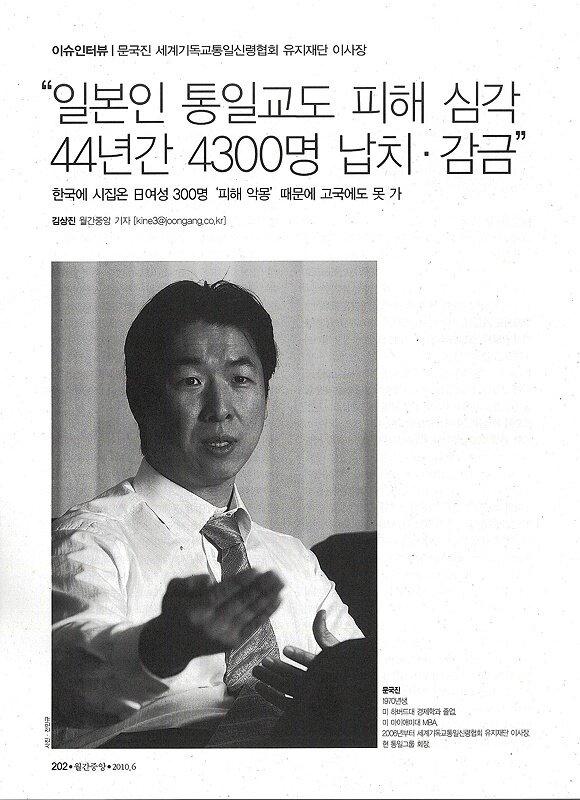
Kook Jin Moon speaks about religious kidnapping

June 2, 2010
Wolgang JoongAng

The following interview of Tongil Foundation Chairman Kook Jin Moon appeared in the June 2010 issue of Wolgang JoongAng, one of South Korea's most widely read monthly news magazines.

Abductions of Japan Unificationists continue over 44-year period

More than 4,300 are victimized

At about 2 pm on March 23, some 50 women dressed in kimono gathered in front of the Japanese Embassy in Korea located in Jongro Gu, Seoul. One of them help up a loudspeaker and began to speak:

"Incidents of abduction and confinement of Unification Church members are occurring in Japan, even though freedom of religion is guaranteed by the constitution. Some Japanese Protestant ministers, business-oriented lawyers and leftists who run a business of forcing people to change their religion are leading this atrocity are targeting Unification Church members for no other reason than that we have a different faith."

Her eyes behind her glasses began to turn red, and tears began to flow as she continued speaking.

"About 300 Japanese women now living in Korea are women who escaped after being abducted and confined. We would like Japan to take action on a government level to help these people who miss their country but are afraid to go home."

These women were members of the "Committee to Support Korean Victims of Human Rights Violations Resulting from the Abduction and Confinement of Japanese Unification Members." Women who identified themselves to reporters as Japanese wives of Korean men living in Korea began walking toward the main gate to the Japanese embassy. Their purpose was to submit a petition signed by 11,857 people urging the Japanese government to investigate the situation and take preventive action.

On April 21, about a month after the demonstration, a news conference was held at the Seoul Press Center to make public the situation regarding abduction and confinement. One of the people present at this event was Touru Goto, 46, who said he was confined for 12 years and five months (October 1995 to February 2008). One photograph in particular drew people's attention. It showed a man sitting in a wheel chair looking so gaunt and thin that his ribs stuck out. The man in the photograph was Goto.

"I was imprisoned in Apartment No. 904 in an apartment building called "Ogikubo Flower Home" located in the center of Tokyo. I was beaten and cursed at daily. The front door and windows were locked with special locks, and people watched over me so that I could not escape. I finally decided that I could not endure such a living hell any longer, so I began to fast. I fasted for twenty days on two occasions and did another fast of thirty days. This caused my weight to go down to 39kg (height 182 cm). After the fasting, they would not give me meals. They only kept pressing me viciously."

According to the Foundation to Support the Holy Spirit Association for the Unification of World Christianity (Tongil Foundation), such incidents of abduction and confinement have been happening for quite some time in all areas of Japan. One person related to the situation said, "The first incident in Japan happened in 1966, and since then there have been some 4,300 Unification Church members (preliminary figure) have become victims of such incidents.

How can such things happen? On April 26, I visited the offices of the Tongil Foundation located in Mapo Gu, Seoul, to get the Unification Church's position on this question. The current head of this foundation is Board Chairman Kook Jin Moon, 40, the fourth son of Rev. Sun Myung Moon.

"I lived my entire life in America until coming to this country in 2005, so I am not yet proficient in Korean," he said, and explained that he would use an interpreter.

Suits and petitions in Japan ineffective

According to Tongil Foundation, there are less than 1 million Christians in Japan today, excluding Unificationists. Meanwhile, the number of adherents to Unificationism is close to 300,000 (among these the core membership is around 100,000).

According to the explanation by the Tongil Foundation, some elements in Japan centered on Christian organizations with fundamentalist tendencies have responded to the growth in the membership of Unificationism by vilifying the church.

Questions and answers from the interview were as follows:

Question: When I look at the content from the two press conferences, these incidents of abduction and confinement have been going on for some time. I am curious to know why are you coming out so strongly on this matter now.

About a year ago, my father (Rev. Sun Myung Moon) told me to go to Japan to look over the situation. Until then, there was no detailed information in Korea about these incidents. In the process of going to Japan and checking things myself, I came to know the real situation. I was very surprised to hear Mr. Goto, whom you saw at the news conference, and other victims talk about their experiences. At first, I felt that something unbelievable was happening. So I asked the leaders why they had not handled this situation properly in the past.

They told me they had tried a number of methods, including filing suit and submitting petitions to the government. (the Japanese police) did not prosecute and (the Japanese government) did not take any measures. This was the result of the negative view of the Unification Church within Japan. So I thought of a different solution to this problem. This is not a situation that can be resolved by fighting only in Japan. We saw that we needed to build international public opinion in order to get justice for the victims."

Question: Please be more specific about how Unificationists are viewed in Japanese society.

"We have gathered numerous examples of people being victimized, and it is so bad that we have to suspect that the position of the Japanese government and media may actually be that they encourage the persecution of Unificationists. In particular, the Japanese media has maintained a critical stance against the Unification Church that one would have to say is excessive. This can be seen in two aspects. The first is that Unificationism is a religion that began in Korea. Unificationism is a religion with a messianic mission, so Japanese Unificationists are loyal to Rev. Moon, who is a Korean. So Japanese nationalists with a dislike for Korea have a strong dislike for Unificationism. Another important point is that Unificationism exercised considerable influence in the anti-Communist movement in Japan during the 1980s. For this reason, the Japan Communist Party has even declared that the destruction of the Unification Church is a matter of policy for that party. We are told that many of the critical journalists are connected to leftist organizations."

Question: Who is doing the abduction and confinement?

"Our understanding is that some Christian ministers who think that Unificationism is a heresy are working with people affiliated with the Japan Communist Party, people who specialize in getting people to change their religious faith and lawyers who are in this for the money. These people contact parents and other family members of Unificationists and give them slanderous information about the church. Then they tell the parents that they will be willing to change their child's faith if the family will pay the costs. Once this negotiation is complete, the abduction process begins. So, in effect, they are using the families."

Question: Do you have proof that the Japanese government is ignoring this problem?

In the case of Touru Goto, he filed a criminal complaint against his abductors soon after he escaped. Yet, the prosecutor's office determined that they would not prosecute the case on grounds of a lack of evidence. It is not just Mr. Goto. Victories have been won in a limited number of civil cases, but in criminal cases the decision by authorities has always been that they will not prosecute. The police are even worse. There have been frequent situations where a person in confinement manages to contact the police. Even if the police respond to the scene, they just walk away. It doesn't matter to them that a person is shouting out 'Please help me.'"

Question: Isn't it because they see this as a family issue?

That makes no sense. These are not minors. An individual who is between 20 and 40 years of age is asking the police for help, but the police pretend not to hear. How can such a thing happen? Even if this involves members of the same family, violence is being used and a person is being confined against his or her will. This is nothing other than a criminal act. Women Unificationists have been raped, they have been told that they should abort a fetus whose father was a Korean Unificationist. One woman Unificationist was put under so much pressure that she finally took her own life while in captivity. This is not just a violation of human rights. It is a crime of violence."

Chairman Moon referred to the situation in the United States. During the 1970s, there were a number instances in the U.S. where Unificationists were confined. The U.S. authorities, however, prosecuted those involved and these instances soon disappeared.

The Korean Embassy in Japan intervened in case of a Korean husband

Question: I heard there was an instance involving a Korean husband and his Japanese wife who were both confined while visiting Japan together.

"Yes. Fortunately, the Korean embassy in Japan intervened on behalf of the husband, because he was a Korean citizen, and he was freed. The interesting thing is that it was only when the embassy went into action that the Japanese police began to move. This shows that the Japanese police can resolve this matter if they want to. The only reason they ignore these crimes is that the victims are Unificationists.

Question: Has the Unification Church taken public stands, either domestically or around the world, on Tokto or any of the other controversial issues between Korea and Japan?

"No, we haven't. In Japan, we carry out a peaceful movement. We have also done activity to oppose communism as a part of our effort to protect democracy and the market economy. Of course, some Japanese wives living in Korea, acting in their own individual capacities independently of the church, have visited respected elders in their region on occasions such as March 1 and Independence Day to offer their apologies for the crimes that Japan committed during its 36-year oppressive rule of Korea. After coming to live in Korea with their husbands, they come to realize the situation with issues such as the forced conscription of Korean men to work in Japan as virtual slaves and of Korean women to serve as prostitutes for Japanese soldiers in battle zones.

They express their own private belief from a human rights perspective that the Japanese government should compensate the victims and issue apologies. I understand that actually quite a few Japanese wives in Korea have done this. Let me add one more thing. Right now, there are about 100 Japanese wives who have been awarded "Filial Piety Awards" by their local communities and local governments in Korea who are afraid to return to Japan for fear of being abducted if they do. There are many good-hearted people who have put down their roots in Korean society and are carrying on good works. I feel sorry for them that they have to go through this."

Chairman Moon continued by saying, "There is an aspect that the problem has become more difficult because most Japanese wives keep their Japanese citizenship and live in Korea with permanent resident status." He said that this makes it difficult for the Korean government to put pressure on Japan from an aspect of protecting its own citizens. He seemed to hold out hope for the amended Citizenship Law that passed the National Assembly on April 21.

"Dual nationality will be permitted to Japanese wives who immigrate to Korea as a result of marriage. Once they have Korean citizenship, I'm sure it will be difficult for the Japanese government to be as so consistently uninterested as they are now and continue to refuse to take any steps on this issue. It will have a strong possibility to become a diplomatic problem."

Question: Do you think there is room for the Korean government to help?

"Of course. If public opinion is behind it, our government can raise the issue with the Japanese government."

Question: Has the Tongil Foundation prepared a plan with regard to this problem?

We plan to take all necessary steps on a continuous basis. In a very peaceful way. For example, there is a plan for a letter-writing campaign by children of the Japanese wives to their Japanese grandparents. There is also a plan for a demonstration in front of the Japanese embassy by the Korean husbands. This demonstration may happen around the time of Independence Day. Many of the Japanese wives live in different provinces and municipalities around the country, so they are holding news conferences with local press in their region so that more people can know the facts surrounding abduction and confinement.

"Parents create their own organization to oppose abduction"

Question: Are you considering legal steps?

Yes, of course. Right now, we are gathering affidavits in preparation for legal analysis. Some existing affidavits are not at a legally suitable standard, so we are asking the individuals to redo them. We have already gathered hundreds of affidavits, and we plan to gather thousands. At the same time, we are asking for help from the U.S. Congress and the U.N. Human Rights Council. We want to raise this issue with media across the world so that we can appeal to world public opinion."

Chairman Moon added that the situation inside Japan is changing little by little.

"A surprising thing is that some parents who were involved in abduction and confinement have realized that this was something wrong and are preparing an organization (tentative name, "Parents Committee on Measures against Abduction and Confinement of Unification Church Members"). They are doing this so that they can pursue charges against those in the background who were actually leading this. Parents are starting to realize that they were fooled and that money was taken from them. This doesn't mean that these parents are joining the Unification Church."

As the interview was coming to a close, Chairman Moon spoke with a sad expression. "Many people are going through a lot of suffering," he said. " Please help them." 

Kook Jin Moon: The Secrets Of A Network Encompassing The World

Wolgan CEO
May 10, 2010

The following article appeared as a cover story in the May 2010 issue of the Korean-language monthly magazine Wolgan CEO (Monthly CEO) www.ceobank.co.kr/

The secrets of a network encompassing the world Interview with Kook Jin Moon, CEO of Tongil Group

There is one business that is the focus of attention in the world because of its global network and its banner for change. It is the Tongil Group founded by Rev. Sun Myung Moon, head of the Unification Church. Since 2005, Tongil Group has been going through revolutionary change, and at the center of this is its chairman, Kook Jin Moon who is a young man of forty-one.

It is well known that the Tongil Group differs from other corporations even in its lineage. It was not initiated on the basis of the absolute ideology of pursing profit, and its structure is quite different from those of others corporations. The business was founded on a religious background. Despite the difference from other corporations in its roots and in its founding philosophy, it cannot be denied that this is a business group that controls tens of affiliated companies. In an environment where the cold logic of capitalism applies even to the small neighborhood store, Tongil Group cannot be free from the logic of capitalism. We were curious to find out what -- other than something religious -- drives the growth of Tongil Group, and so we contacted the business. Contrary to our feeling that somehow it would not be easy to set up this interview, the meeting between Tongil Group and Monthly CEO was arranged smoothly on the basis of an agreement between the two sides. Even on the day of the cover story interview and photo session, which involved as much work as a fashion photo layout, Kook Jin Moon, chairman of Tongil Group, surprised the photo staff with his impressive stature of 180cm, his natural smile and stylish poses. During the interview, his ability to speak Korean was limited, reflecting the fact that he lived and studied in the United States from the time he was three, but the content he conveyed was quite clear.

Communication as the power for change

Kook Jin Moon, the current head of the Tongil Group, is the fourth son of Rev. Sun Myung Moon. He is a typical member of the power elite, having gone to the United States when he was three, graduated from Harvard with a major in economics and received his MBA from the University of Miami. Chairman Moon, who is said to have enjoyed toy guns as a child, founded the gun manufacturing company KAHR in 1993 and established the impressive result of growing this business to the point of bringing a profit of $100 million. He came to Korea in 2005 and was appointed as chairman of Tongil Group at the age of 36.

Tongil Group at the time, despite its huge size, was living day to day with as many problems as a cancer patient in the last stages of life. During the years under Chairman Moon, however, Tongil Group has accomplished remarkable change and reaped incredible results as a result of being healed. We were curious to find out how Tongil Group could grow so quickly and what had been the core force behind its change.

"Prior to my arrival, people related to the foundation were on the front lines of management. As a result, it would not be an exaggeration to say that there was virtually no management and administration going on. Of course, it was possible that this was inevitable, given the particular background to the creation of the business, but it is natural that a business needs a profitable structure in order to survive."

Soon after Mr. Moon took over as chairman, he conducted individual interviews with all managers of the 30 companies in the group at the time down to the level of team manager. The purpose was to learn from the managers the strengths and weaknesses of each company. Also, the interviews revealed whether each person was someone necessary for the group. Those whom he judged to have potential to lead the changes in the group were given extraordinary promotions. Mr. Moon also did not hesitate to bring in accountants and professional managers from outside the group and empower them with authority.

Through this process, the employees who remained understood the seriousness of the situation, and were able to unite together to bring about the needed changes. Those who had been occupying important roles in the companies only for religious reasons were inspired by Mr. Moon's efforts and cooperated with him. Once Mr. Moon had comprehended the situation and analyzed its causes, he began a swift restructuring process. He moved with such speed that he sold or liquidated 11 affiliated companies in the first year alone. As a result, whereas 70 percent of the companies were in the red when he first took over, 90 percent were in the black after the first three years of his management. This incredible result provides a glance into Mr. Moon's extraordinary abilities.

Inheriting the philosophy and managing rationally

The management styles of Tongil Group founder Rev. Sun Myung Moon and his son Kook Jin Moon are as different as heaven and earth. Whereas Rev. Moon practiced charismatic management based on religion, the style of the current chairman of Tongil Group relies strictly on data. It seemed to us, though, that Mr. Moon was acting as something much more than a professional manager in managing the companies founded by his father on the basis of a particular religious philosophy.

"My father is a religious leader, and his purpose for engaging in business was less for the purpose of making money than it was for the purpose of educating people and contributing to the development of the country. The companies could not make profit in the way that others did, because they had a different purpose. I, however, studied economics, and I received an MBA degree. From my standpoint, it is only natural that any business exists for the sake of making money. It is from this standpoint that I manage and operate businesses. Of course, I consider it to be my responsibility to maintain the founding purpose of a company as I bring it stability. One system that I introduced following my appointment was the "Six Sigma" management improvement program. This is a very effective program for continuous improvements in a company. This program was first developed by Motorola, but now many companies in Korea are using it. It sounds easy, but it is a system of making all decisions based on statistics and data.

Once this system was introduced, executives and managers began making decisions based not on their personal opinions but on data, and the organizational culture changed as a natural result. In the past, companies had many ideas but few results. Now, we are able to bring about good results using scientific management."

The Yeosu Project

From about a year ago, the Tongil Group has been pursuing the Yeosu Project, which is expected to require more than 1 trillion won in funds. It is a huge project that will bring about a tectonic shift in Korea's leisure industry, but professionals question whether it will be profitable enough to justify the investment. We were curious to find out the chairman's thinking and management policies for this project.

"The Yeosu project came about as a result of my father's strong feeling that it is not good that the Yeosu region has experienced far less economic development than Seoul and other cities in the capital region. From a dispassionate standpoint, an accounting analysis of this investment shows that it will be difficult to make a profit. We are prepared to suffer a certain level of loss. It will not be profitable, but we intend to manage it by placing significance on the aspect of cash liquidity. Previously, a different person was responsible for the Yeosu project under my father's direction. But the operating losses were too great, and so I have been responsible for it for about the past year. After the transfer of responsibility, I have been adjusting the project to give it greater business feasibility. For example, we increased the cost effectiveness by managing it jointly with Yongpyong, which is another resort that we already have. My father has a strong desire to build a hotel in Yeosu in preparation for the 2012 World Exposition. We will build the hotel, but we have reduced the size considerably from what was originally conceived. By reducing the size of investments in the hotel and golf course, we are making it so that it will at least have business feasibility in terms of cash flow."

As Mr. Moon explained the Yeosu project, he put particular emphasis on the importance of cash flow. It appeared that this was related to the direction that the Tongil Group would take in the future. Now that five years have passed since he took over as chairman and a new decade has begun on the calendar, what are Mr. Moon's views on what will be the main force driving Tongil Group over the next ten years?

"At this point, it is difficult to see ten years into the future. We spent the past five years restructuring the companies, and last year we had to work hard to overcome the global financial crisis. This year is the first opportunity we have to think about how we are going to develop our companies in the future. It is a fact that the group is concentrated in the leisure industry. About 70 percent of our assets are in this industry. The leisure industry presents opportunities for religion and business to come together to create synergy, because resorts can be used to hold religious conferences and educational programs.

Leisure sports can be enjoyed by everyone, regardless of their religion or race. Because people can enjoy them together, they contribute to world peace. The Tongil Group currently holds a lot of undeveloped land. The focus of our business will be to analyze these land holdings and development them through condominium developments and other means. We have about 14 million pyoung (46.28 km², 11,436 acres) of undeveloped land. The value of our land is greater than the value of all our affiliated companies. In fact, a chronic issue with our group is that the size of our assets is large, but our cash flow is not good. We can say that during the next ten years, Tongil Group needs to go in a direction of taking unprofitable assets and changing them into profit-producing assets.

The power of a network encompassing the world Tongil Group maintains a larger network, and is more influential, in the rest of the world than in Korea. It is known to operate hundreds of companies just in Japan and the United States alone. Assets include media companies, hotels, aircraft operating companies and a company distributing maritime food products in the United States, and the total extent of their external size is difficult to estimate. We asked Mr. Moon about the overall current status of the overseas businesses, and he gave us a religious response. It may that this is, in fact, the essential strength of the Tongil Group.

"Because Tongil Group is a religion, we have a separate religious foundation in each country. A religious corporation has been created in each country. The religious corporation in the United States and the religious corporation in Japan are completely independent. All the religious corporations in countries around the world are independent. What binds these corporations in some 170 countries is our faith. My father has conducted many different businesses, for the sake of world peace. He conducted a series of international conferences of scientists, and he has done many activities to promote harmony among religions. He brought politicians together so that they could discuss peace. He brought these people together from different walks of life, because he is not a political leader or an economic leader but a religious leader. He did it so that all people could come together in harmony. That is true love, which is a love makes it possible for us to be with anyone, even an enemy. The Tongil Group is a foundation that is connecting the world with the power of such love."

Chairman Kook Jin Moon gave us the impression that he is an exceptionally capable CEO who is able to graft the founding philosophy of the businesses onto the economic principles of capitalism. At the end of the interview, we asked Mr. Moon what message he would like to give to other CEOs in Korea. Because we are a journalistic organ required to maintain a neutral position in religious matters, we cannot print his response exactly as he gave it. Even a filtered version of his response, however, is enough to give us great expectation that Tongil Group under his leadership will grow tremendously in the future.

"As chairman, I would like for the Tongil Foundation to grow as an organization that contributes to Korea's economic development and welfare. I would like to support the growth of the Unification Church so that Unificationism becomes a cultural asset for Korea. Because the Catholic Church is headquartered in Italy, millions of people visit Italy to tour the holy sites there. Millions of Islamic believers visit Mecca each year for a similar reason. From the standpoint of the nations involved, this represents a tremendous economic profit. Korea is the homeland for all Unification Church members around the world.

Once the Unification Church succeeds around the world, many church members will visit Korea. Last year, from Japan alone, 120,000 people came to Korea to participate in the religious workshops held in Gapyoung, Kyonggi Province. The development of the Unification Church will bring benefits to Korea in many ways. Monthly CEO is a business magazine, so I will express it in business terms and describe the Unification Church as a start up business. Its current membership does not give it a meaningful share of the overall market, but it is growing very rapidly in comparison to what you see in the histories of other religions. If more companies take an interest in the Unification Church and support it, Korea will experience incredible development both in terms of its economy and its culture.