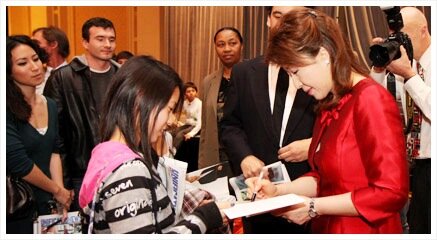
Unification Church Member in Wisconsin Writes to Rev. In Jin Moon

December 28, 2009

The following is a letter sent from a Unification Church member to In Jin Nim, graciously thanking her before the New Year for her work as a spokesperson for our Heavenly Parent, and giving her support for the years to come.

Dear Pastor In Jin Nim,

Greetings from the frozen tundra of the mid-west, Wisconsin. Joy and peace to you and your family in this Holy season of Christmas and the glorious celebration of the Coronation ceremony anniversary and God's Day with True Parents.

Thank you for Lovin' Life Ministries and the heartfelt effort that you are pouring into us in America. We have had many leaders in our movement for America, but I have not felt the heart of a pastor until you have taken the helm for America under our True Parents. The essential aspect of a pastor is the parental heart to the people for whom one is responsible. As I listen to your sermons week after week, I am awed by the grace with which you make yourself completely vulnerable to us through having the video presentation available, uncensored, for all the family members to watch.

You form, make and deliver your sermons from your heart connection with Heavenly Father, True Parents, and us. From the experiences of life, past and present, from the vision of future hope and the multitude of ways in which God has spoken and continues to speak to you in his creation in the works of his hands and in the relationships with family, with people close in heart and people more casually met, you allow God to talk to us. The Sunday sermon is a time for God to be present to his congregation in a particular way, where we are gathered as a community and He seeks to give his word, LIVE, through His spokesperson.

In you, Heavenly Father has a spokesperson who is an aspect of His feminine heart, mind, and spirit. In you, Heavenly Father is seeking for us to experience the embrace of a mother's heart as family members. The directive responsibility, the goal oriented force, is substantially carried through the communication of the heart. It is the heart that is primary, that is seeking to honor and elevate, to embrace and comfort, to encourage and to challenge, to heal and to strengthen the spirits of the seasoned and the fresh so that there may be a realization of the great work that True Parents have done in the creation of Blessed Central Families.

To me you have made a bridge for the crossing over and joining of the life experiences of our family members who have worked with True Parents, to those born into the lineage and not knowing what it is. In your family, which shares themselves with us so graciously and are an extension of the love and life the vitality and power True Parents have created in you, we experience the joy and hope of a world where we are one family. The substantial blessing of your oldest son to someone not Korean is a concrete example of the harmonizing of the races to realize we are a human race. The divinity is there from the Creator.

The way Satan has divided us, and seeks to keep us divided and small minded and insular and self centered and smug in our righteousness has been shown for what it is through the presence of your family and the heart of your ministry. What is exalted in Philippians is celebrated with us each Sunday.

I remember you shared with us many years ago that being in True Family is not everyone dressed up and smiling for the official family picture; that is not what it is like in the True Family. I have seven brothers and five sisters, and I know the reality of growing up in a family of many personalities and interests. I honor your family, all of the members for all the challenges and efforts that each has made in his or her own way. God is not finished with any of us while there is life in us.

As we are on the brink of a New Year, I pray that the unity in heart may flourish, that there may be a glowing ember in all hearts that fans into a flame of passion for all that is true and good and beautiful and that this true love will save us and save our world. That our young people can erupt as an explosion of pure love in all the corners of the world, exhibiting their talents and their gifts with everything offered to the glory of God.

I am not writing this as a state leader, nor am I as a foreigner, though I am. I am writing as a woman who has been taught the truth of men and women by the messiah, our True Parents. I am writing to say thank you for the hope that you have nurtured in me through your honest and forthright testimony to our True Parents, in word and deed.

Blessings and peace be with you in all the days ahead. ITN.

MN 

Notes On Judas Possible Attitude Leading To His Betrayal Of Jesus

In Jin Moon
December 27, 2009
Unofficial notes by: Nathaniel Nitro

InJinMoon-091227-unofficial.jpg

This is today's sermon by In Jin Nim, I was lucky enough to have access with a laptop computer so I can type the highlight of her sermon. This is a rough transcription, as I type while she speaks... there's a lot of missed details, so please bear with this, but her words are deep enough for me to put me to tears, Merry Christmas and a Happy True God's Day

Jesus was not able to have his own family.

Jesus was not able to find a bride, all we have is the Holy Spirit, and we don't have a True Mother figure.

If Jesus will have a chance to find a wife, then he would probably start what True Father is doing, then started to Blessed couples of 36, and so forth, Jesus would may start the same, to build a kind of family to raise an awesome kids.

Universal Peace Festival / Global Peace Festival was a faith base organization, its goal is to establish an Abel UN.

How incredible True Parents are, what Jesus couldn't done 2,000 years ago he was able to. Because we don't have the Eve role, women came to be in a difficult role. With the four-position foundation that our True Fathers is teaching, we have God, man and woman are represented, children are represented, where every man and woman have the equal value, in position as a parent.

Christmas means gifts under the Christmas trees, but when I think about Jesus, he was such a lonely man, on his childhood, question of the nature of his birth, where everybody is looking at him, even if he started his ministry, trying to preach this wonderful love, compassion to really live as brothers and sisters, but at the end of the day when Jesus sleep he must be a very lonely man, no wife to received comfort at the end of the day, and no children to receive joy.

When I start thinking all the things that I have, then I think my life, it is a life of gratitude. If we really start mentally of making a list of what God has given us, then we should be thankful, so we need to praise God continuously his name with gratitude. When thinking about what Jesus have and what I have, we have to think about our understanding about ourselves, and the fact that we are blessed, we have the opportunity of being grafted to the true olive tree, then we have to understand how fortunate we are.

Those disciples have the opportunity to hear Jesus in real action, they must felt like they were the luckiest people on earth, then if they really understood the true mission of Jesus Christ then they could understand what he truly want to build. Maybe they just saw Jesus as a trouble maker making trouble where ever he went maybe some people look at him like that. Somebody also maybe doesn't like Jesus proclaiming what he was.

We need to look at things with our spiritual eyes.

The Bible talks about the second coming of Jesus, because Jesus was not able to fulfill completely his mission. Now we are living with the living Messiah, we are the luckiest people because our Father didn't come and go without finding a wife, for the first time in history our True Father found our True Mother and together they could be our True Parents, imagine the people living together with Jesus, if Jesus could find his bride.

Could we allow those non-believers just to come and go without having this opportunity to experience living with the living messiah, receiving engrafting to the true olive tree, through the blessing. True Parents were giving blessing people for many many years, could we just let those unbelievers just come and go?

Judas was probably feeling too familiar with Jesus and looked at him as a man, forgetting his providential mission, his spiritual eyes started to close, Jesus was not an average pastor, he saw Jesus as out of control, this is the time we start looking without spiritual eye, we started looking with our physical eyes. When we see True Father he is an old man, he needs help going up the stage, if we concentrate on the physical eyes on what our True Father is doing we can easily end up like Judas; this is why he betrayed Jesus. Because we start looking with our physical eyes not with our spiritual eyes. Whenever we are going through a difficult time we need to clearly know in a way there is only one True Parents and only one, eternal True Parents and children's job is to inherit their love. We need to rejoice in the fact that we have our True Parents with us. A lot of people are saying when True Father ascends to the spirit world what will happen, everybody know the spirit world; if Father will go then he will be more with us more than we have him now; all we have to do is to pray and consult him, he can be everywhere.

When we are confronted of difficulties all we do is to confront with our True Parents, our job and responsibility is to reach to all our brothers and sisters to engraft with our True Parents, we have to be a confident Unificationists, we have to have a grateful heart.

Let us all assess ourselves this year-end, to welcome our New Year. We need more encouraging words with our sibling, between husband and wife, between parent and child, we need to encourage each other with dignity, so if we can't utilize and exercise this words, to say each other with your spouse, if you can't say this with each other how can you say it to your children. There is room for growth, there is room for understanding, but there is to be a two way street, now when we are ending this year, we need to take time to assess ourselves. When we have True Parents we only have one way to go, to welcome our True Parents in our home, how to welcome God in our home, we need to always prepare ourselves our home to always welcome God and True Parents in our home.

If we can see and have the opportunity to have a relationship with our True Parents privately, I was moved by them, whom I call father and mother, I understand what obstacles they have to overcome, what burdens they have to go through.

In this sense we are the luckiest people.

This years Motto:

The era of proclaiming the victory of absolute sexual ethics, the right of true love, true life and true lineage in the realm of the Cosmic Sabbath of the Parents of Heaven and Earth 

Judas Possible attitude leading to his betrayal of Jesus

In Jin Moon
December 27, 2009
Lovin' Life Ministries

InJinMoon-091227.jpg

Good morning, everybody. Did everyone have a lovely Christmas? We here at Lovin' Life Ministries felt that we should celebrate this Sunday together with our congregation and keep the spirit of Merry Christmas going on to the New Year. We prepared a Christmas celebration for all of you.

As Dave Hunter said earlier, this is the fortieth week of Lovin' Life, and I feel that our Heavenly Parent has truly guided us throughout this last year and allowed us to complete forty weeks so that we can be well poised for a brand-new year with all of the wonderful victories and surprises that we can look forward to.

In retrospect, this year has not been the easiest one. There have been a lot of changes along the way and a lot of different obstacles. But we know that our True Parents and our Heavenly Parent have always been with us, always encouraging us. So despite all the trials and tribulations that we've had to go through, I feel that we as a family have grown stronger and that heartistically the country is really united together with our True Parents.

Recently in Las Vegas there were more than 1,100 people gathered to receive our True Parents, and in True Parents' mind the Las Vegas event was a very important one -- not only because Father wants to inject a little bit of Heaven in what is known as Sin City and turn that Sin City into the Shining City on a hill. But he also wants to usher in a whole new era of the Global Peace Festival, together with the new chairman, Dr. Hyung Jin Moon.

We've done good work under the banner of the Family Federation and of different types of organizations such as the Global Peace Festival and the Universal Peace Federation. Sometimes along the way our identity as a faith-based organization has been lost. True Parents are really leading the way in reemphasizing our identity and at the same time encouraging all of us to work together with other faiths and look at them as siblings so that we can truly create the world peace that we're all longing for and live on earth peacefully as one family under God. It was wonderful to see the ministers wholeheartedly embracing our True Parents.

As is my father's custom, he had a prepared text that was supposed to be a ten-minute speech. But because he sees himself as the grandparent and the True Parent of humanity, my father feels like he wants to share so much of his heart in a very short amount of time. So whenever I see my father, he's almost desperate to convey his heart to the people because he doesn't know when he will see them again. So he gave a lot of love. I think Father was very pleased that the message that True Parents are here -- the breaking news, as I call it -- was really taken to heart by a lot of brothers and sisters who were there and also by a lot of clergy and luminaries in religion. They really looked at Father not just as a great man, and not just as somebody who has tirelessly worked for peace, but they looked with their spiritual eyes, seeing our True Parents as the messiah that they are, the Lord of the Second Advent.

In my line of work I meet a lot of entertainers, business people, and pastors and ministers. Sometimes they come up to me and ask, "Do you really believe that Rev. Sun Myung Moon is the messiah? Do you really believe that he is the Lord of the Second Advent? Do you really believe that he has come to fulfill Jesus' mission?" I very clearly respond, "Yes, I do. He is absolutely the messiah."

When we come together and celebrate Christmas, it is really a day when we should reflect about Jesus' life, when we should pray about Jesus' life, and when we should think about who Jesus was. Jesus has a very special place in my heart because he never had a chance to have a family of his own. Of course, when he came to earth as the Son of God, it was really our Heavenly Parent's intention for him to perfect himself as the great man that he was, to find that special someone whom he could call his eternal partner and wife, and together establish the first true family of humankind.

But because Jesus' life was cut short and he was crucified, he never had the chance to find a wife. Thus, he never had a chance to have that family. So when you look at the history of Christianity, the most prominent idea is the concept of the Trinity: God, Jesus, and the Holy Spirit. You have God as the Heavenly Parent, and you have Jesus Christ representing men of the world. But then you have the Holy Spirit, who was supposed to be manifested by the perfected Eve who should have been Jesus' bride. But because Jesus never had the chance to find a bride, all we've had was the grace of the Holy Spirit. We didn't have a person whom we could look to and say, "That is the True Mother, the true Eve, and together with our True Father, True Adam, they represent the True Parents of humanity."

If Jesus really had a chance to find a wife, then he would have probably done what our True Parents did. When my father first got blessed to my mother in holy matrimony in 1960, they immediately stood as the True Parents of humankind, and they blessed 36 couples, 72 couples, and so on. They started to bless the children of the world. If Jesus could have stood in the position of True Parents 2,000 years ago, he would have done the same. He would have started blessing many people, encouraging them and guiding them to build ideal families, the kind of families that would raise really awesome children. He would probably have encouraged the women to play an active role, not just in the education of children and in the home but probably in the life of faith as well. He would probably have worked hard together with his wife to show what true partnership was all about.

If there had been that true Eve 2,000 years ago, then the history of religion would not have been antagonistic toward women. It would not have been the kind of tradition that relegated women to be second-class citizens. It would have seen women not as taking part in the Human Fall and actually making Adam fall but as true sisters, true wives, and true mothers, having a position of honor and respect. History would have followed accordingly.

As a student of religion myself, I've often marveled at how incredible our True Parents are. Jesus never had a chance to do what he should have done 2,000 years ago. The lives of a lot of women have been very difficult in the context of a religious life because we didn't have the true mother or the true Eve role. But the great thing about True Parents is that, unlike the Christian tradition and the concept of the Trinity, God brings us home with the four-position foundation that our True Parents' teaching talks about. We have God, we have a man and a woman, and then it's an invitation to have children. Therefore, you have a four-position foundation at work, and all humanity is represented: Men are represented, women are represented, and children -- sons and daughters -- are represented. For the first time in history, it's no longer men above women and women being second-class citizens. Because of our True Mother's victory, women now have the dignity and the right to stand proud as daughters of God. For me, the fact that my mother can stand in such a position is a hope for my life and, I believe, hope for humanity.

For children, Christmas means a beautiful Christmas tree and many boxes of gifts waiting for them underneath that tree. But when I think about Jesus and when I think about my father and the kind of life that he's led for the past 90 years, I realize that Jesus was such a lonely man. There are biblical references to his having had a very difficult childhood. He did not have the best relationship with his parents. In fact, there was a big question mark regarding the nature of his birth.

Imagine Jesus Christ growing up in an environment where everybody was looking at him with many questions in their eyes. It must have been incredibly difficult. Then even after he completed his wandering years and started his ministry, he was trying to preach about love, forgiveness, and having compassion for each other, truly practicing love in his daily life, encouraging his disciples and everyone else to see themselves as brothers and sisters. When Jesus laid down to sleep at the end of the day, he must have been a very lonely man, hoping to find that wonderful wife whom he could call his own.

Many of us here, looking at our lives -- children, careers, and different responsibilities -- might feel weary. But sometimes when I'm feeling that so much of the world is on my shoulders, I simply think about how lonely Jesus Christ must have been without a family. But I do have a family -- not only Father and Mother, but five beautiful children that I can call my own as well as my brothers and sisters and all of you. When I think about all the things that I do have, then I realize that my life needs to be a life of gratitude.

When we start thinking about all the things that God has put in our care, if we start mentally making a list of everything that has been given to us, and how God blessed us over the years, despite the difficulty, despite the hardships, we cannot help but sing and praise God's name and be grateful. Psalms 34:1 says that we should praise God every day of our lives and we should praise his name continuously by articulating our gratitude. So when I think about what Jesus did not have and what I do have, I realize that no matter how difficult a situation might be, we have to go back to the basics of our understanding of God as our Heavenly Parent and of ourselves being children of our True Parents.

The fact that all of us are blessed means we have been given an opportunity to graft onto the original olive tree, which many people have been waiting for. I've often wondered, if people 2,000 years ago really understood the value of Jesus Christ and saw him as the Son of God, the King of Kings, as the messiah, as the Lord, then they would have understood how incredibly lucky they were. They would have understood that out of all the people in human history, they were the lucky ones to have the opportunity to experience Jesus in the flesh, to hear his words with their own ears, and to feel his words with all their hearts.

If those people really could understand who Jesus was, they must have felt that they were the luckiest people on earth. Of course, if they fully understood the mission of Jesus Christ, then they would have looked forward to the blessing and to the time when they themselves would have a beautiful spouse and a chance to build an ideal family.

But just as some people felt that Jesus was so precious and so special, there were a lot of people in his day who did not understand who he was. I'm sure there were hundreds of people who just simply didn't care who he was. Maybe they saw him as a troublemaker because crowds followed him wherever he went. Maybe they saw him as a poor preacher talking about love all the time, hanging out with his disciples. Maybe some of the career politicians looked at him and said, "Why doesn't he do something valuable with his life?" Maybe some people looked at Jesus like that. And we know that some people simply did not like Jesus because he was proudly proclaiming that he was the Son of God.

I often say that when God sends his representative, God is not sending his prophet to us to make us feel comfortable. God is not sending prophets and great teachers just to tell us that what we are doing is great. Of course, they might do that along the way, but they're here to tell us what God wants us to hear. And when Jesus was alive, God wanted people to understand that the good news was here, that the Son of Man was here, and they needed to wake up to the fact that he was going to share with them words of truth that were going to cleanse their souls, give new meaning to their lives, and substantiate the true love of God by helping them build ideal families of their own.

This was the message that God wanted to give to Jesus' people in his time. The ones who were open spiritually, the ones who could see Jesus as something more than a man and understand him as a gift from Heaven to this world were the ones who could appreciate his value. But many people never knew how precious he was. He came and he went, without these people -- who were born in the luckiest time back then. They were a hand's distance from Jesus, but he came and went, and they did not know who he was.

So we know that Jesus had to come again. The Bible promises that the Lord of the Second Advent will come again. Why was this promised? This was promised because Jesus didn't have the chance to fulfill his mission; he didn't have a chance to build a family.

Fast-forward 2,000 years, and here we are. We are living in a time when the messiah is here, when the Lord of the Second Advent is here. So we are the luckiest people because our Father did not come and go without finding a wife, without having the opportunity to build an ideal family, a true family. For the first time in history, our True Father, Rev. Sun Myung Moon, found our True Mother, Mrs. Hak Ja Han Moon, and together they could be the True Parents.

Imagine the people who were there at the time of Jesus, the unbelievers as well as the believers, now up in heaven, looking at all of us, saying: "These people are the luckiest people in history. I thought I was lucky 2,000 years ago, but I did not have a chance to be blessed. I did not have a chance to graft onto the original olive tree and substantiate the true love of God by inheriting God's love and having children that we can call our own." Those people are looking at all of us, saying, "These people are so incredibly lucky, luckier than all of us, because not only are they simply being cleansed by the truth, being given new life by the words of our True Parents, but they're actually being blessed. They're being grafted onto this original olive tree, and they're exercising the opportunity to substantiate something in this world that they can call their own."

So if we really think about it, we are so blessed, brothers and sisters. We are really, truly the lucky ones. So what should we, the lucky ones, do with so much blessing? If we just revel in our own blessing, the fact that we're living at a time when the Lord of the Second Advent is here, if we're reveling in how lucky we are that we got the blessing, and if we're just giddy because we have blessed children, we need to ask ourselves: What about the rest of the world? What about the nonbelievers? What about the people who do not know? Are we going to let the rest of humanity come and go when our True Parents are here with us, when God is asking the world to experience the breaking news, to see ourselves as children of God, to become one family under God through cross-cultural, international marriages that my father has been officiating for many years?

This blessing is so beautiful in that we're not talking about just Koreans marrying Koreans. We're not talking about just Europeans marrying Europeans. We're not talking about Jews marrying Jews, or Christians marrying Christians. This is an invitation where it doesn't matter what heritage or cultural background we come from. By understanding that we are sons and daughters of God, we are looking at each other as someone with eternal value, someone divine and therefore uniquely beautiful and incredibly special.

When we can come together in holy matrimony by recognizing God as our Heavenly Parent, then we're doing something that goes beyond ourselves and our own happiness. We are actually pledging ourselves to our Heavenly Parent and to humanity, our brothers and sisters, before we think about ourselves. In so doing, we are living for the sake of others -- practicing, not just talking; not just believing.

Those of us who have been blessed for quite some time know that blessing is not an easy thing. I always used to chuckle in French class: the infinitive blesser means to strike or hit. I felt like the day I got blessed I got smacked by Heavenly Father. Many times that's what it feels like. But let's concentrate on the significance of what is taking place, that we have a chance to not just experience true love, but a chance to substantiate true lineage. It's an incredible opportunity that we should encourage other brothers and sisters all around the world to participate in.

When we have this added blessing of understanding who our True Parents are and really seeing them for who they are, then we need to encourage the rest of the world to open up their spiritual eyes. Sometimes it's the people who are the closest to Jesus or the closest to our True Parents who forget how special they are. It's the area right underneath the lamp that's the darkest.

I've often thought about Judas. He must have been moved, and he must have been inspired. He must have been touched by Jesus Christ to want to be his disciple. Why did he sell Jesus out? How can you love somebody as a great teacher, see somebody as a messianic figure, and then one day decide to sell the Son of God for a chunk of change?

Judas probably started feeling too familiar with Jesus and maybe started looking at him more as a man, forgetting his providential position or why God sent him to all of us. I think his spiritual eyes started to close. Maybe Jesus was not your average pastor. He did things to shock people; he spent time with the untouchables. And maybe Judas, looking at that, had questions in his heart and started to judge Jesus as a man with a weakness when he got so angry at the temple and threw things across the room. Perhaps he saw Jesus as being out of control.

These are some of the ways that we start looking with our physical eyes and forget that we need to remind ourselves that Jesus Christ is the Son of God, that our True Parents are the True Parents of humankind. When we look at my father physically, he is an old man. He's past 90 years of age, and he needs help to come onstage. But when we look at our True Father with spiritual eyes, we realize that he is not like a 90-year-old man. He is a shining figure, and he is truly the new light that we've been waiting for.

If we concentrate on the physical things of what our True Parents are doing and we compare them with society's norms or the physical world norms, we can easily end up just like Judas, not realizing that we have to keep our spiritual eyes open each and every day of our lives to fully understand what True Parents are all about.

We who have the blessing to truly come close might be tempted with all these questions because we start looking with our physical eyes, not our spiritual eyes. We may become that dark area underneath the lamp, not realizing that the lamp has always shone brilliantly above us.

Whenever we are going through difficult times, brothers and sisters, we must tap into our own divinity and our own relationship with Heavenly Parent. We must clearly know that there is only one True Parents and there will always be one True Parents. Our True Parents will be eternal, and the True Children's job is to inherit their love and to be great sons and daughters of God, our Heavenly Parent.

So we need to be joyful, we need to be grateful, and we need to rejoice in the fact that we have our True Parents here with us. It doesn't matter where they are or where they go. A lot of people are saying, "When Father ascends to spirit world, then what will happen?" Anybody who believes in the spirit world knows that when Father ascends to the spirit world, he will probably be more with us than he is now, becoming more accessible to each and every one of us. All you have to do is simply pray, meditate, commune with the divinity within, and our Father will be with you every step of the way.

As our church is transitioning into a new chapter and now into a new year, thinking about the year that has come to a close, I feel that this is a wonderful opportunity for us to reflect about everything that has taken place and be grateful because at the end of the day, when we go through suffering, as long as we can come out of it with a grateful heart, then we learn some of the most valuable lessons because they come in the midst of suffering and hardship, in the midst of trials and tribulations. Whenever we are confronted with difficulty, the only thing we need to do is concentrate on True Parents. The only thing we need to do is to remind ourselves of True Parents, and how incredibly blessed we are to have them in our lives now. Understanding how valuable they are, we have the job and responsibility to go forth and reach out to the other brothers and sisters who are waiting for the opportunity to know True Parents in their lifetime.

So do not be shy about who you are. We all need to be confident Unificationists. That's the only way our children will be confident Unificationists. We have to have a grateful heart for the blessings that we have been given.

When I think about Psalms 34:1, it's a great reminder about the importance of speech. I have often talked about words as vehicles of emotion. When we're trying to raise ideal families, in a husband–wife relationship many times words can get in the way of creating a wonderful environment for the children. So at the close of the year, looking forward to a brand-new year, to a wonderful time with our kids, we have a wonderful opportunity to think about how we are going to use our words to create that beautiful and loving environment so that our children will be inspired to be proud Unificationists and true sons and daughters of God. If the vehicles of emotion are being hurled between husband and wife, between siblings, between parent and child, we cannot create a harmonious environment.

This might be a good time to encourage parents to please work it out quietly and respectfully with the children in the house. This might be a good opportunity for the children to think about how you're going to communicate effectively with your parents, with respect and with honor, and giving them the dignity of who they are as your parents. This might be a great opportunity for the siblings to look at each other and say, "Maybe this new year can be a year of growth when we can help each other become better people. Maybe our words of encouragement could help us achieve things that we never thought possible."

I know when I was growing up and my sister said, "Sister, you did that so well," it gave me an incredible boost. Or I looked at my sister and said, "Dear Sister, you did that so well. Your essay on Homer was absolutely profound. You are such an incredible writer." We can have more encouraging words between siblings, more empowering words between husband and wife.

When my father is talking about Pacific Rim being the era of women, that is not an invitation for women to mistreat or abuse our husbands. If we have a chance to play an active role in the family and in our homes, we need to treat each other with dignity. If we cannot use and exercise this vehicle of emotion in the proper context of respect and honor to each other, how can we call ourselves adults worthy of taking care of and raising our younger ones to be great people?

This might be a great time to look at your spouse and say to each other, "If we truly understand the divinity within, there is no room for violence in our relationship. There is no room for abuse within our relationship. But yes, there is room for love for understanding, and for growth." If both spouses can adhere to that, there is nothing that this couple cannot accomplish in their lifetime. But it has to be a two-way street.

Now that we're coming to the end of the year, let's all take stock of where we have been and where we are, and think and pray about where we want to go. I feel that with our True Parents there is only one way to go, and that is preparing a home where we can proudly invite God into our daily lives every day.

I look forward to being the kind of family where God can come and dwell whenever he or she would like to spend time with me. I would think that all of you would want the same. So understanding how incredibly lucky and blessed we are, I am hoping that we can close this year with a grateful heart, truly articulating our thanks with our words of thanksgiving to our Heavenly Parent and to our True Parents, who have truly been the guiding light in all of our lives.

To see my father continually teaching, continually sharing, continually digressing because he has so much that he wants to share -- I don't know about you, but I cannot help but be moved by this man. I cannot help but be moved by this woman whom I call my mother. They are truly extraordinary human beings. Many of us know them just in public, but for those of us who know them intimately and privately, we realize how incredible they are because we can see all the things they have to overcome and all the mountains that they've had to climb, but still never giving up. And our Mother is still always smiling, always giving, and always embracing.

We have been given True Parents as gifts to the world by our Heavenly Parent. I cannot think of anyone who is more worthy of our respect and love. So let us look forward to the new year with a grateful heart. I am terribly thankful for all of your support during the 40 weeks that we've shared together. I'm hoping that, just as I've come to know you a little bit more, some of you have gotten a taste of how incredible our True Parents are through some of the stories that I could share.

Please continue, please stay on track, and please know that you are the luckiest people in history. God bless. Thank you.

Notes:

Psalms, chapter 34

0: A Psalm of David, when he feigned madness before Abimelech, so that he drove him out, and he went away.

1: I will bless the LORD at all times;
his praise shall continually be in my mouth.

2: My soul makes its boast in the LORD;
let the afflicted hear and be glad.

3: O magnify the LORD with me,
and let us exalt his name together!

4: I sought the LORD, and he answered me,
and delivered me from all my fears.

5: Look to him, and be radiant;
so your faces shall never be ashamed.

6: This poor man cried, and the LORD heard him,
and saved him out of all his troubles.

7: The angel of the LORD encamps
around those who fear him, and delivers them.

8: O taste and see that the LORD is good!
Happy is the man who takes refuge in him!

9: O fear the LORD, you his saints,
for those who fear him have no want!

10: The young lions suffer want and hunger;
but those who seek the LORD lack no good thing.

11: Come, O sons, listen to me,
I will teach you the fear of the LORD.

12: What man is there who desires life,
and covets many days, that he may enjoy good?

13: Keep your tongue from evil,
and your lips from speaking deceit.

14: Depart from evil, and do good;
seek peace, and pursue it.

15: The eyes of the LORD are toward the righteous,
and his ears toward their cry.

16: The face of the LORD is against evildoers,
to cut off the remembrance of them from the earth.

17: When the righteous cry for help, the LORD hears,
and delivers them out of all their troubles.

18: The LORD is near to the brokenhearted,
and saves the crushed in spirit.

19: Many are the afflictions of the righteous;
but the LORD delivers him out of them all.

20: He keeps all his bones;
not one of them is broken.

21: Evil shall slay the wicked;
and those who hate the righteous will be condemned.

22: The LORD redeems the life of his servants;
none of those who take refuge in him will be condemned. 

The Power of Human Spirit

In Jin Moon
December 20, 2009
Lovin' Life Ministries
Chicago, IL

Good morning, Chicago. It's lovely to see all of you on this beautiful Sunday morning. We are delighted to be here with all of you. And thank you for giving the band such a warm welcome. I'm sure the band was very much inspired by all of your enthusiasm, just as I am.

I wanted to start off this morning by letting everybody know that our True Parents are very much here with us in spirit. They wanted so much to be here for yesterday's 14th True Family Values Award Banquet, but Chicago had to make do just with me. I felt a little bit sorry about that. But our True Parents were very curious as to how things went and very much wanting to send their love to the Chicago members, letting you know that they're very much with you, always praying about you and always thinking about you. Truly, like the true parents they are, they are always thinking about us as their children, and wondering how we are doing.

If I went on and on about the different people whom I met yesterday, it would have been like a seven-hour Hoon Dok Hae, so I had to make my report brief, but they were very happy and very encouraged by the event and the exciting things that are taking place in Chicago. They very much hope that the good work that you have done thus far will continue.

As I was meditating this morning, thinking about what I would like to talk about today with the congregation, a thought came to mind, very much an image of my father. A couple of days ago, I reread different people's testimonies of my father's trials and tribulations at Hungnam prison, the notorious North Korean concentration camp. I've often wondered what is it about my father that allowed him to survive in this incredibly difficult place for three years, where the majority of prisoners could not even live past six months.

I thought about how much difficulty my father would have had to endure -- the lack of food, the lack of proper clothing, sleep, and rest. But on top of that, I've often thought of how my father is a physical man just like all the others in prison. What was it about him that allowed him to keep on going, to keep on believing, to keep on dreaming? When I prayed about this, I realized that the reason that my father survived for almost three years in the Hungnam concentration camp is that he was able somehow to tap into the power of the human spirit -- the power of the human spirit that comes from God, our eternal Heavenly Parent. By understanding that he was a divine being, with a divine purpose and a reason for why he was living this life and going this course -- I believe that was the reason he was able to survive all the obstacles, all the trials and tribulations that he's had to endure in prison.

When I think about the great men and women of history, I realize that this theme, the power of the human spirit, runs throughout. Just as God works in mysterious ways, if we allow this remarkable power of true love to work in our lives, if we open up our hearts and truly believe -- and not be afraid to be vulnerable in front of God, our Heavenly Parent -- there is an incredible amount of energy that is just waiting to be unleashed deep within our hearts.

When my father speaks about the revolution of true love that is going to change the world and usher in this new time of world peace, he has often said that it must start from the heart. The people of the world -- the brothers and sisters, mothers and fathers, and children and parents -- have to tap into this thing called heart. My father has often talked about music being that universal language and love being that universal language. It's something that we all understand, we can all experience, and we can all feel without having to learn to speak French, for instance. A French person can understand the Lovin' Life band just as profoundly as can an English-speaking audience. A German in the audience can understand love just as profoundly as a Japanese person in the audience, if we just open up our hearts and allow ourselves to feel.

When I think about the power of the spirit and how it has miraculously worked in many great men and women's lives, one person comes to mind, Dr. Anne Brooks. She is a phenomenal woman in my mind. She comes from not the best nuclear family setting; she actually comes from a family where her mother was an alcoholic. Because of her addiction, Anne's mother could no longer take care of Anne, and she was sent to live with her father. But because her father was a naval officer and constantly traveling, he could not take care of her. He ended up sending her to a Catholic boarding school.

Anne Brooks arrived there at a tender age, feeling so unwanted and unloved. A child doesn't fully understand all the things that adults are concerned with. A child can't understand why she can't live with her mother any more, can't understand why she can't live with her father, and why she's sent to a boarding school with hundreds of others girls that feel exactly the way she does -- unwanted and unloved.

Here Anne was, determined to make the best go of it. She was trying her best. When she was 11, one profound moment changed her life. She was running from one classroom to another. Going up the stairs, she passed a Ladies Room, and the door was open. As she ran past, she realized someone was crunched over in the corner. Anne didn't want to fling the door open and disturb the person, so she quietly watched. She realized that the person was a nun who taught at the school and she was wiping the toilets while saying a prayer. She was doing it with such meticulous attention that Anne was alarmed, seeing her teacher on all fours in this bathroom, cleaning it with a piece of rag.

She ran to the nun and pleaded with her to get up. The sister got up and said, "What's the matter?" Anne replied, "What are you doing? You're not supposed to be on the floor cleaning the toilet. Let somebody else do it." The sister gazed into Anne's face with her huge, loving brown eyes, looking at her with such profound love and with such profound understanding of humanity. She spoke the words that cleansed this young girl's heart forever. "Anne, it's my honor and privilege to make what is dirty pristine and clean for all of you. It's my honor to take care and love you. I look at you as children without parents because your parents are not here to take care of you. It's my honor and duty, and out of love I do this. Why would I ask another person to do this when my knees and hands are just as good as any other person's?"

This 11-year-old child realized that this nun was living Matthew 25:35-40. Anne realized that the nun was looking at all the girls in the school as needing love and care, and in each and every one of those girls the nun saw Christ. Just as the Good Book reminds us to look at any needy person as Christ and love that person just as we would love Christ, this nun, crawling on all fours, was loving her students, loving her school, because she saw Christ in them. It was her honor and privilege to serve them so that they could be inspired by the show of love and appreciation that she could offer by making the Ladies Room a beautiful place.

Again and again, Dr. Brooks talks about this profound experience. "From then on I wanted to be like this sister. I wanted to make real the passage in Matthew, that a needy person has Christ in them." She converted to Catholicism when she was 13, and when she was 18 and graduated from high school, she decided to live as a nun.

But then something else happened in her life. As she was preparing to live a life in the convent, to take vows of poverty, she experienced excruciatingly painful cramps all over her body. The doctors gave her a dire assessment -- she had rheumatoid arthritis and would not be able to walk again, to be confined to a wheelchair for the rest of her life.

Dr. Brooks was so distraught and shocked. She said to herself, "Here I am, ready to give my life to Christ and God, and in the same year I'm struck with rheumatoid arthritis. What is God doing to me? Why is God doing this? Is there a God? Does he not love me? Does he not want me? Am I not his daughter?" These questions plagued her mind.

But one day she realized that if God wanted her to go through this sickness, he must have a reason and purpose. She said, "Let me be my own miracle." Despite her friends' sympathy for her sickness, feeling sorry for her in her wheelchair, she was determined not to let that get her down. She was determined that God put her there for a reason, that if God had her in a wheelchair for a time, he must have a reason, and she was determined to find why. She was determined to make a miracle out of her own life.

She started an intense prayer condition that continued for two years. After two years she met Dr. John Upledger, the founder of the Clearwater Free Clinic. He said to her, "Don't you believe that you can get better?" She answered, "Yes, I believe I can get better. I believe in the miracles of God. I believe that good things will happen to me. But all the doctors I've met thus far have said there is no hope, no cure for me, that I will be confined in this wheelchair all my life."

Being a good Christian man, Dr. Upledger said, "Do you not believe that you will get better?" She answered, "Yes, I do believe." He held her hand and said, "If you believe, then you will get better." He spoke to her about his own experiences as a doctor, "You know, 90 percent of why people get better is that they believe that they can get better. That's the greatest obstacle a person has to overcome. The greatest obstacle is themselves and their own thoughts about their situation. But once they believe that good things are going to happen, that they are going to get better, that's the beginning of a recovery process that can be incredibly miraculous." He continued, "Many times our inability to believe is what allows things like stress to overtake our bodies, to make us more miserable than we need to be. We need to take time for ourselves, take time for deep meditation, time for prayer, to realize that our bodies are holy vessels that hold the divine, and it's our duty to be well so we can express this divinity to the world as unique and beautiful individuals."

So Anne started to believe. She started to meditate, to care about the kind of food she ate. She started to do physical therapy. Within a short time, she was able to gain mobility and could put aside the wheelchair. She visited Dr. Upledger, who by then was teaching at a university, to thank him for his encouragement. He said, "You know, you are somebody touched by God. In your own self-recovery I can see the power of God's spirit working in you. You healed yourself by tapping into this divine spirit. God has a reason why you are here, and I believe you need to be a doctor."

The odds of her being a doctor, coming from a nonacademic background, didn't seem too favorable, but she persevered and found a government program that completely paid for her medical degree if she committed to work in depressed area of the country. She thanked God for that program, and when she graduated she picked the fifth-poorest county in the United States, Tallahatchie County, Mississippi. There she started her ministry of healing. Through her ministry she touched hundreds and hundreds of people -- the untouchables, if you will. She cured people whom nobody wanted to cure. These people didn't have money to see a doctor, but they had love. Many times they couldn't pay for her services, but they brought flowers or a Kleenex box for her office.

By making these people better, she infused them with human dignity and inspired them to dream. She inspired them to look at themselves as something better than they were, just like the way Dr. Upledger saw in her a future great doctor. He encouraged her to heal herself, to go to medical school and become a great doctor.

Over the years a lot of people came to know Dr. Anne Brooks and visit her clinic. Soon different nuns came to work with her. One day a young sister asked, "You are such an awesome representative of God, and you have taken care of so many people. What is it that really drives you to be this incredible person? What is it that makes you such a phenomenal missionary?"

Dr. Brooks answered with a statement that rings true to me each day, whenever I think about her. She replied, "It is not a missionary's job, and it is not my job, to bring God to the people. You have to understand that each and every person that I treat already has Christ in them, already has God in them, already has this incredible power of love in them. I am bringing them nothing, but if I can be God's instrument, the only thing I am doing is helping them find God in themselves."

What Dr. Brooks is saying is that she has experienced the power of the spirit and God working mysteriously in her life. She was condemned to live life in a wheelchair for the rest of her life. Through her belief, and through actualizing the biblical passage of Matthew 25:35-40, that all needy people have God in them, she was living that passage by taking care of all these people, helping them find Christ within themselves, the divinity within themselves, reminding them of the power of the spirit that already resides in each and every one of us.

In her missionary work she was doing what Jesus Christ did and what my father has been doing for over 90 years. He's been reminding us that we are God's eternal sons and daughters and that we have an incredible power of the spirit that can transcend any trials and tribulations, any mountains put in our way. As long as we have the courage to believe, as Dr. Maya Angelou so eloquently said, we must have the courage to truly love, even when circumstances make it seem not worth believing.

When I think about Dr. Brooks and the profound impact that this one quiet woman had on hundreds of people through her own life experience, it's clear to me that she was an agent of change for all these people.

Another person comes to mind in whom the power of the spirit is continuing strong. That is none other than our dear brother Mr. Goto, who just came out of an imprisonment by deprogrammers in Japan for twelve years and five months. He was a dedicated member, and I think his parents were not too happy that he was not finishing his studies as an architectural student. They heard all the untrue rumors about our movement, and out of their fear for their son's well-being this poor family was victimized by a deprogramming organization, being literally robbed because they had to pay an incredible amount of money just to have these deprogrammers break Mr. Goto's faith. In Japan, deprogrammers demand anywhere from $10,000 to $100,000 from the parents.

I think those of us living here, enjoying our rights under the Constitution, don't fully comprehend what an insult this deprogramming activity is to human rights and what a violation it is of the religious freedom inherent in the constitution of Japan. Japan professes to have a democratic government, with a constitution placed there by General MacArthur after World War II. Article 20 clearly maintains the importance of religious freedom in Japan. Japan prides itself on being one of the superpowers of the world, but to date there have been over 6,000 cases of our brothers and sisters being taken against their will and physically abused.

Deprogrammers who understand the value of purity in our faith rape our sisters in order to break their faith. This has been going on for over 20 years, behind the scenes. The deprogrammers know that Japanese women who go through this type of physical abuse will not be inclined to talk about their suffering publicly, that they would suffer in silence. Our sisters who were raped suffered in isolation, and some have ended their own lives.

This deprogramming issue is alive, a scary phenomenon that is taking place as we speak. Our movement here in America enjoys the freedoms guaranteed to us by the First Amendment of the Constitution, which says that Congress shall make no laws respecting the establishment of religion or prohibiting the exercise thereof. Our movement has gone through persecution and misunderstanding and members have been kidnapped for deprogramming in the United States too, but under due process of law at least we had a chance to put up a good fight and do something about it.

In Japan, it's a different story. Not only do government authorities work in conjunction with the deprogrammers, but top clergy members and ministers of established religions collaborate to help break the faith of Unificationists. I believe it's our responsibility, as the American movement, to be aware of what's going on in Japan so that we can lend our support to encourage the White House, Capitol Hill, and the Japanese Embassy to do something about it because it is a violation of human rights.

I had the honor of welcoming Mr. Goto at Lovin' Life Ministries at the Manhattan Center, and I had a wonderful opportunity to talk to him about some of the experiences that he's had to endure. He told me his life story, about those twelve years and five months. Truly this is a man who symbolizes unbreakable faith. This is a man who was verbally abused, who was physically abused. Mr. Goto told how the deprogrammers would talk for hours on end about all the atrocities that were supposedly committed in the name of our movement, and all the lies and accusations made against my father and mother and the True Family. He said it was incessant, like Chinese water torture -- hours and hours every day, every day. Without adequate nutrition, the will to fight can grow weary sometimes.

I asked him, "How was it that you were able to go on?" He said, "It was my belief and my relationship with God." He believed that he would be released. He imagined that he would be released. And he knew that God was with him every step of the way. In knowing that God was with him, he was able to tap into his power of spirit and know that he is an eternal, divine being.

Those twelve years and five months were only a phase that he was going through, just the way a caterpillar has to go through a cocooning period, residing in a chrysalis before it can break free to become a beautiful butterfly. Mr. Goto envisioned his time of incarceration, where he had to survive on garbage scraps, as the time when God was cocooning him, preparing him for the day when he would be a beautiful butterfly.

I told him, "You are absolutely right. Your twelve years and five months of untold suffering is something that I cannot even begin to fathom or fully understand. But because of what you have gone through, in a mysterious way God has turned you into the greatest scholar of deprogramming material. You've gotten the equivalent of a Ph.D. in deprogramming. They fed you all the lies, all their perceived facts, so you are like a scholar who knows them better than anybody else. But having gone through this cocooning period, you are poised to be a voice for the voiceless, a face for the faceless. You now have a foundation to speak out against the injustices that are being committed, even as we speak, to our brothers and sisters in Japan. You have been unleashed as a beautiful butterfly, unleashed as an activist, and you have been anointed and touched by God to be that agent of change to deliver the message of what is going on, bearing witness to the injustices that are taking place and how we must come together and fight against these atrocities that are being committed in the superpower of Japan, even as we speak."

Mr. Goto has said to me time and again, "Actually, my incarceration has made me stronger, has made my faith deeper. It's very interesting to me, because when my captors finally realized after twelve years and five months that my faith never wavered, that my faith would never shake, and their tactics would never break me, they simply threw me out. They simply threw me out of the building where I was confined for such a long time with the clothes on my back and a pair of shoes. That was the most liberating moment of my life." He said that at that moment he felt God, he experienced God, he saw God, and he realized what God was preparing him to be. During the twelve years and five months, he probably had doubts, might have gone through incredible upheavals, and questioned God about why he was in that situation -- why me, God?

All of us ask God this question at some time, don't we? For me, being born in the True Family was not an easy thing. Being born into a public life is never easy. Sometimes so many things happen to you and need to be done by you that you feel overwhelmed and ill-equipped, and you feel not ready, not worthy. Many times I've asked God, "Why me? Why can't you find somebody better? Why can't you find somebody who wants to do this more than I do?" Whenever I pray to God like that, a voice would come back, "Why not you?" I'm sure when Mr. Goto prayed to God, "Why me?" God quietly answered back, "Why not you?"

I always say that life is a great gift and it's a wonderful opportunity to grow. But sometimes along the way God puts things in our path that are extremely difficult to overcome, different obstacles and things we have to work out in our attempt to build an ideal family, to deal with all the issues that arise in the family. Sometimes I'm sure all of you will be asking God, just like me, "Why me?" And if you sincerely and prayerfully converse with God, he will tell you what he told me, what he told Mr. Goto, and what he told Dr. Brooks. He will say, "Why not you? Because you are a precious child of God. You are a divine and beautiful specimen of a human being." Each and every one of us is hand-crafted with care and with a divine purpose. Why not us?

My boys are so into working out and looking good for the ladies, and I always remind them, "Please look good for God and please look good for the family." One of the things they like to do is be in top shape. Occasionally I've accompanied them to the gym and seen the different routines they have worked out with barbells, leg lifts, and bicep curls. It's interesting to me as a mother to watch.

If they're not working with a trainer, they are perhaps lifting the barbells, and one brother will keep adding one more weight, then another weight, until the other brother cannot go on any more and looks like he's going to faint. But they always say, "Three more. Or seven more. Count seven more." Or sometimes when they really want to be masochistic they say, "Twenty-one more." They're straining and look like they're about to die, but they keep on going because they want to be in top form.

When I see my children engaged in this strenuous, painful process of building muscles, what they are going through, what they are working toward is what I call the slow burn. Many times in our lives the difficulties that we go through in a husband–wife relationship or a parent–child relationship feels like a process of dying, like a slow burn. But then we need to remember where we're going and why we're here.

The Good Book in Proverbs 29:18 reminds us that where there is no vision, the people perish. But when we have a vision, an understanding of where we're going, an understanding of why we need to go through this process of the slow burn, we know it's because at the end of the day we're going to look like Arnold Schwarzenegger, in fine physical form. My children will go through that strenuous process because they want to be fit.

Likewise, as long as we have a vision of who we are as God's sons and daughters and where we are going -- that is, having the opportunity to build something so phenomenal like an ideal family and to leave something beautiful behind, like these beautiful sons and daughters that have been bestowed upon us and put in our care -- we realize that whatever we're going through in terms of helping them grow up into beautiful sons or daughters of God is a process as well. It might be difficult, but if we can do our job and inspire these young people to become internally excellent as well as externally excellent, then we are leaving the world in good hands, leaving it with these heavenly blossoms.

Do you know what Moonie means in Korean? In the English-speaking world, Moonie is a derogatory term, but in Korean moonie means "beautiful design." Our children are going to be like beautiful designs in the world -- eternal, absolute, uniquely beautiful beings who are going to help usher in a new millennium of peace. They are going to grow up and build ideal families and continue the process, so our grandchildren and great-grandchildren can continue on and revel in this new era of peace.

Chicago is a profoundly providential state. Father came here 33 years ago and prophesied that a black man would sit in the White House. Lo and behold, we have a black man sitting in the White House. Yesterday, at the 14th True Family Values Award Ceremony I witnessed something electrifying: not just the wonderful performance of the Lovin' Life Band, but the Soul Children of Chicago. They were phenomenal. When I see a group of children enthused and inspired by the power of the spirit to stay away from gangs, away from drugs, away from addictions -- basically saying, "I am a divine human being and my life is going to be a living testament, a living prayer for God and humanity" -- there is something incredibly beautiful about that. Not only can Chicago give birth to the first black president of the United States but Chicago can be the catalyst through which True Family Values become a reality in the United States.

My mother always told her children, "To dream is the first step, and the rest is up to you." This is something I have challenged and encouraged my children to do: to dream. I tell them, "You have to think of things that people think are impossible." It was an impossibility for Dr. Brooks to walk again, let alone become a doctor. It was an impossibility, when Dr. Martin Luther King was preaching his "I Have a Dream" speech, for a black man to be elected to the Oval Office. But with the good works of the civil rights movement, with the slow burn they've had to go through, now a black man is sitting in the White House. With the slow burn that Dr. Brooks and her sister nuns went through, she has given new life and touched hundreds of children all around the world.

I believe that all of us sitting here in the room are just waiting to unleash our divinity on the world and be the luminous lights that God wants all of us to be. The only thing we need to do is to decide today that we are going to be that agent of change. Just as I encourage and implore my children to reach for the moon, I also remind them, "Not only do you want to reach the moon, but you're already a Moon! Your grandfather is the Reverend Moon, and he gives you kisses and hugs, and encourages you, and Mother Moon gives you hugs and kisses and encourages you to dream. You've already touched the moon, so reaching the moon is just the natural process of who you will become in the future."

Brothers and sisters, please encourage your children to dream, and please encourage your children that they have within them everything that they need to become great. They have the power of the spirit flowing in their veins, as long as they are willing to decide to believe. When they decide to believe and tap into this power of the human spirit, there is nothing that they cannot overcome, that they cannot accomplish. I can only expect great things to come out of Chicago; I can only expect great things to come out of our American movement.

Just as the Bible reminds us in Luke 1:47, "Let us rejoice in the Lord," here at Lovin' Life we are all about celebrating life. We realize that trials, tribulations, difficulties and suffering are part of the process, the cocooning period through which God is preparing us before unleashing us into the world as beautiful butterflies, so we accept it with a grateful heart, with an understanding that God wants us to be His eternal sons and daughters.

So believe, brothers and sisters, in our own power of the spirit and know that our Heavenly Parent is working with us each and every day. The only thing we need to do is turn our life around, decide to be that agent of change, and give everything of ourselves wholeheartedly. Then there is nothing that we cannot accomplish. Then the world peace that my father has so envisioned, has so dreamed about, is just around the corner.

So God bless, and have a wonderful week. Thank you

.

Notes:

Matthew, chapter 25

1: "Then the kingdom of heaven shall be compared to ten maidens who took their lamps and went to meet the bridegroom.

2: Five of them were foolish, and five were wise.

3: For when the foolish took their lamps, they took no oil with them;

4: but the wise took flasks of oil with their lamps.

5: As the bridegroom was delayed, they all slumbered and slept.

6: But at midnight there was a cry, `Behold, the bridegroom! Come out to meet him.'

7: Then all those maidens rose and trimmed their lamps.

8: And the foolish said to the wise, `Give us some of your oil, for our lamps are going out.'

9: But the wise replied, `Perhaps there will not be enough for us and for you; go rather to the dealers and buy for yourselves.'

10: And while they went to buy, the bridegroom came, and those who were ready went in with him to the marriage feast; and the door was shut.

11: Afterward the other maidens came also, saying, `Lord, lord, open to us.'

12: But he replied, `Truly, I say to you, I do not know you.'

13: Watch therefore, for you know neither the day nor the hour.

14: "For it will be as when a man going on a journey called his servants and entrusted to them his property;

15: to one he gave five talents, to another two, to another one, to each according to his ability. Then he went away.

16: He who had received the five talents went at once and traded with them; and he made five talents more.

17: So also, he who had the two talents made two talents more.

18: But he who had received the one talent went and dug in the ground and hid his master's money.

19: Now after a long time the master of those servants came and settled accounts with them.

20: And he who had received the five talents came forward, bringing five talents more, saying, `Master, you delivered to me five talents; here I have made five talents more.'

21: His master said to him, `Well done, good and faithful servant; you have been faithful over a little, I will set you over much; enter into the joy of your master.'

22: And he also who had the two talents came forward, saying, `Master, you delivered to me two talents; here I have made two talents more.'

23: His master said to him, `Well done, good and faithful servant; you have been faithful over a little, I will set you over much; enter into the joy of your master.'

24: He also who had received the one talent came forward, saying, `Master, I knew you to be a hard man, reaping where you did not sow, and gathering where you did not winnow;

25: so I was afraid, and I went and hid your talent in the ground. Here you have what is yours.'

26: But his master answered him, `You wicked and slothful servant! You knew that I reap where I have not sowed, and gather where I have not winnowed?

27: Then you ought to have invested my money with the bankers, and at my coming I should have received what was my own with interest.

28: So take the talent from him, and give it to him who has the ten talents.

29: For to every one who has will more be given, and he will have abundance; but from him who has not, even what he has will be taken away.

30: And cast the worthless servant into the outer darkness; there men will weep and gnash their teeth.'

31: "When the Son of man comes in his glory, and all the angels with him, then he will sit on his glorious throne.

32: Before him will be gathered all the nations, and he will separate them one from another as a shepherd separates the sheep from the goats,

33: and he will place the sheep at his right hand, but the goats at the left.

34: Then the King will say to those at his right hand, `Come, O blessed of my Father, inherit the kingdom prepared for you from the foundation of the world;

35: for I was hungry and you gave me food, I was thirsty and you gave me drink, I was a stranger and you welcomed me,

36: I was naked and you clothed me, I was sick and you visited me, I was in prison and you came to me.'

37: Then the righteous will answer him, `Lord, when did we see thee hungry and feed thee, or thirsty and give thee drink?

38: And when did we see thee a stranger and welcome thee, or naked and clothe thee?

39: And when did we see thee sick or in prison and visit thee?'

40: And the King will answer them, `Truly, I say to you, as you did it to one of the least of these my brethren, you did it to me.'

41: Then he will say to those at his left hand, `Depart from me, you cursed, into the eternal fire prepared for the devil and his angels;

42: for I was hungry and you gave me no food, I was thirsty and you gave me no drink,

43: I was a stranger and you did not welcome me, naked and you did not clothe me, sick and in prison and you did not visit me.'

44: Then they also will answer, `Lord, when did we see thee hungry or thirsty or a stranger or naked or sick or in prison, and did not minister to thee?'

45: Then he will answer them, `Truly, I say to you, as you did it not to one of the least of these, you did it not to me.'

46: And they will go away into eternal punishment, but the righteous into eternal life."

The Constitution of Japan

November 3, 1946

PREFACE

We, the Japanese people, acting through our duly elected representatives in the National Diet, determined that we shall secure for ourselves and our posterity the fruits of peaceful cooperation with all nations and the blessings of liberty throughout this land, and resolved that never again shall we be visited with the horrors of war through the action of government, do proclaim that sovereign power resides with the people and do firmly establish this Constitution. Government is a sacred trust of the people, the authority for which is derived from the people, the powers of which are exercised by the representatives of the people, and the benefits of which are enjoyed by the people. This is a universal principle of mankind upon which this Constitution is founded. We reject and revoke all constitutions, laws ordinances, and rescripts in conflict herewith. We, the Japanese people, desire peace for all time and are deeply conscious of the high ideals controlling human relationship and we have determined to preserve our security and existence, trusting in the justice and faith of the peace-loving peoples of the world. We desire to occupy an honored place in an international society striving for the preservation of peace, and the banishment of tyranny and slavery, oppression and intolerance for all time from the earth. We recognize that all peoples of the world have the right to live in peace, free from fear and want. We believe that no nation is responsible to itself alone, but that laws of political morality are universal; and that obedience to such laws is incumbent upon all nations who would sustain their own sovereignty and justify their sovereign relationship with other nations. We, the Japanese people, pledge our national honor to accomplish these high ideals and purposes with all our resources.

CHAPTER I: THE EMPEROR

Article 1:

The Emperor shall be the symbol of the State and the unity of the people, deriving his position from the will of the people with whom resides sovereign power.

Article 2:

The Imperial Throne shall be dynastic and succeeded to in accordance with the Imperial House Law passed by the Diet.

Article 3:

The advice and approval of the Emperor in matters of state, and the Cabinet shall be responsible therefor.

Article 4:

The Emperor shall perform only such acts in matters of state as are provided for in this Constitution and he shall not have powers related to government. 2) The Emperor may delegate the performance of his acts in matters of state as may be provided for by law.

Article 5:

When, in accordance with the Imperial House Law, a Regency is established, the Regent shall perform his acts in matters of state in the Emperor's name. In this case, paragraph one of the preceding Article will be applicable.

Article 6:

The Emperor shall appoint the Prime Minister as designated by the Emperor shall appoint the Chief Judge of the Supreme Court as designated by the Cabinet.

Article 7:

The Emperor shall, with the advice and approval of the Cabinet, perform the following acts in matters of state on behalf of the people: (1) Promulgation of amendments of the constitution, laws, cabinet orders and treaties. (2) Convocation of the Diet. (3) Dissolution of the House of Representatives. (4) Proclamation of general election of members of the Diet. (5) Attestation of the appointment and dismissal of Ministers of State and other officials as provided for by law, and of full powers and credentials of Ambassadors and Ministers. (6) Attestation of general and special amnesty, commutation of punishment, reprieve, and restoration of rights. (7) Awarding of honors. (8) Attestation of instruments of ratification and other diplomatic documents as provided for by law. (9) Receiving foreign ambassadors and ministers. (10) Performance of ceremonial functions.

Article 8:

No property can be given to, or received by, the Imperial House, nor can any gifts be made therefrom, without the authorization of the Diet.

CHAPTER II: RENUNCIATION OF WAR

Article 9:

Aspiring sincerely to an international peace based on justice and order, the Japanese people forever renounce war as a sovereign right of the nation and the threat or use of force as means of settling international disputes. 2) In order to accomplish the aim of the preceding paragraph, land, sea, and air forces, as well as other war potential, will never be maintained. The right of belligerency of the state will not be recognized.

CHAPTER III: RIGHTS AND DUTIES OF THE PEOPLE

Article 10:

The conditions necessary for being a Japanese national shall be determined by law.

Article 11:

The people shall not be prevented from enjoying any of the fundamental human rights. These fundamental human rights guaranteed to the people by this Constitution shall be conferred upon the people of this and future generations as eternal and inviolate rights.

Article 12:

The freedoms and rights guaranteed to the people by this Constitution shall be maintained by the constant endeavor of the people, who shall refrain from any abuse of these freedoms and rights and shall always be responsible for utilizing them for the public welfare.

Article 13:

All of the people shall be respected as individuals. Their right to life, liberty, and the pursuit of happiness shall, to the extent that it does not interfere with the public welfare, be the supreme consideration in legislation and in other governmental affairs.

Article 14:

All of the people are equal under the law and there shall be no discrimination in political, economic or social relations because of race, creed, sex, social status or family origin. 2) Peers and peerage shall not be recognized. 3) No privilege shall accompany any award of honor, decoration or any distinction, nor shall any such award be valid beyond the lifetime of the individual who now holds or hereafter may receive it.

Article 15:

The people have the inalienable right to choose their public officials and to dismiss them. 2) All public officials are servants of the whole community and not of any group thereof. 3) Universal adult suffrage is guaranteed with regard to the election of public officials. 4) In all elections, secrecy of the ballot shall not be violated. A voter shall not be answerable, publicly or privately, for the choice he has made.

Article 16:

Every person shall have the right of peaceful petition for the redress of damage, for the removal of public officials, for the enactment, repeal or amendment of laws, ordinances or regulations and for other matters; nor shall any person be in any way discriminated against for sponsoring such a petition.

Article 17:

Every person may sue for redress as provided by law from the State or a public entity, in case he has suffered damage through illegal act of any public official.

Article 18:

No person shall be held in bondage of any kind. Involuntary servitude, except as punishment for crime, is prohibited.

Article 19:

Freedom of thought and conscience shall not be violated.

Article 20:

Freedom of religion is guaranteed to all. No religious organization shall receive any privileges from the State, nor exercise any political authority. 2) No person shall be compelled to take part in any religious acts, celebration, rite or practice. 3) The State and its organs shall refrain from religious education or any other religious activity.

Article 21:

Freedom of assembly and association as well as speech, press and all other forms of expression are guaranteed. 2) No censorship shall be maintained, nor shall the secrecy of any means of communication be violated.

Article 22:

Every person shall have freedom to choose and change his residence and to choose his occupation to the extent that it does not interfere with the public welfare. 2) Freedom of all persons to move to a foreign country and to divest themselves of their nationality shall be inviolate.

Article 23:

Academic freedom is guaranteed.

Article 24:

Marriage shall be based only on the mutual consent of both sexes and it shall be maintained through mutual cooperation with the equal rights of husband and wife as a basis. 2) With regard to choice of spouse, property rights, inheritance, choice of domicile, divorce and other matters pertaining to marriage and the family, laws shall be enacted from the standpoint of individual dignity and the essential equality of the sexes.

Article 25:

All people shall have the right to maintain the minimum standards of wholesome and cultured living. 2) In all spheres of life, the State shall use its endeavors for the promotion and extension of social welfare and security, and of public health.

Article 26:

All people shall have the right to receive an equal education correspondent to their ability, as provided for by law. 2) All people shall be obligated to have all boys and girls under their protection receive ordinary education as provided for by law. Such compulsory education shall be free.

Article 27:

All people shall have the right and the obligation to work. 2) Standards for wages, hours, rest and other working conditions shall be fixed by law. 3) Children shall not be exploited.

Article 28:

The right of workers to organize and to bargain and act collectively is guaranteed.

Article 29:

The right to own or to hold property is inviolable. 2) Property rights shall be defined by law, in conformity with the public welfare. 3) Private property may be taken for public use upon just compensation therefor.

Article 30:

The people shall be liable to taxation as provided for by law.

Article 31:

No person shall be deprived of life or liberty, nor shall any other criminal penalty be imposed, except according to procedure established by law.

Article 32:

No person shall be denied the right of access to the courts.

Article 33:

No person shall be apprehended except upon warrant issued by a competent judicial officer which specifies the offense with which the person is charged, unless he is apprehended, the offense being committed.

Article 34:

No person shall be arrested or detained without being at once infomed of the charges against him or without the immediate privilege of counsel; nor shall he be detained without adequate cause; and upon demand of any person such cause must be immediately shown in open court in his presence and the presence of his counsel.

Article 35:

The right of all persons to be secure in their homes, papers and effects against entries, searches and seizures shall not be impaired except upon warrant issued for adequate cause and particularly describing the place to be searched and things to be seized, or except as provided by Article 33. 2) Each search or seizure shall be made upon separate warrant issued by a competent judicial officer.

Article 36:

The infliction of torture by any public officer and cruel punishments are absolutely forbidden.

Article 37:

In all criminal cases the accused shall enjoy the right to a speedy and public trial by an impartial tribunal. 2) He shall be permitted full opportunity to examine all witnesses, and he shall have the right of compulsory process for obtaining witnesses on his behalf at public expense. 3) At all times the accused shall have the assistance of competent counsel who shall, if the accused is unable to secure the same by his own efforts, be assigned to his use by the State.

Article 38:

No person shall be compelled to testify against himself. 2) Confession made under compulsion, torture or threat, or after prolonged arrest or detention shall not be admitted in evidence. 3) No person shall be convicted or punished in cases where the only proof against him is his own confession.

Article 39:

No person shall be held criminally liable for an act which was lawful at the time it was committed, or of which he had been acquitted, nor shall he be placed in double jeopardy.

Article 40:

Any person may, in case he is acquitted after he has been arrested or detained, sue the State for redress as provided for by law.

CHAPTER IV: THE DIET

Article 41:

The Diet shall be the highest organ of the state power, and shall be the sole law-making organ of the State.

Article 42:

The Diet shall consist of two Houses, namely the House of Representatives and the House of Councillors.

Article 43:

Both Houses shall consist of elected members, representative of all the people. 2) The number of the members of each House shall be fixed by law.

Article 44:

The qualifications of members of both Houses and their electors shall be fixed by law. However, there shall be no discrimination because of race, creed, sex, social status, family origin, education, property or income.

Article 45:

The term of office of members of the House of Representatives shall be four years. However, the term shall be terminated before the full term is up in case the House of Representatives is dissolved.

Article 46:

The term of office of members of the House of Councillors shall be six years, and election for half the members shall take place every three years.

Article 47:

Electoral districts, method of voting and other matters pertaining to the method of election of members of both Houses shall be fixed by law.

Article 48:

No person shall be permitted to be a member of both Houses simultaneously.

Article 49:

Members of both Houses shall receive appropriate annual payment from the national treasury in accordance with law.

Article 50:

Except in cases as provided for by law, members of both Houses shall be exempt from apprehension while the Diet is in session, and any members apprehended before the opening of the session shall be freed during the term of the session upon demand of the House.

Article 51:

Members of both Houses shall not be held liable outside the House for speeches, debates or votes cast inside the House.

Article 52:

An ordinary session of the Diet shall be convoked once per year.

Article 53:

The Cabinet may determine to convoke extraordinary sessions of the Diet. When a quarter or more of the total members of either House makes the demand, the Cabinet must determine on such convocation.

Article 54:

When the House of Representatives is dissolved, there must be a general election of members of the House of Representatives within forty(40) days from the date of dissolution, and the Diet must be convoked within thirty(30) days from the date of the election. 2) When the House of Representatives is dissolved, the House of Councillors is closed at the same time. However, the Cabinet may, in time of national emergency, convoke the House of Councillors in emergency session. 3) Measures taken at such session as mentioned in the proviso of the preceding paragraph shall be provisional and shall become null and void unless agreed to by the House of Representatives within a period of ten(10) days after the opening of the next session of the Diet.

Article 55:

Each House shall judge disputes related to qualifications of its members. However, in order to deny a seat to any member, it is necessary to pass a resolution by a majority of two-thirds or more of the members present.

Article 56:

Business cannot be transacted in either House unless one-third or more of total membership is present. 2) All matters shall be decided, in each House, by a majority of those present, except as elsewhere provided for in the Constitution, and in case of a tie, the presiding officer shall decide the issue.

Article 57:

Deliberation in each House shall be public. However, a secret meeting may be held where a majority of two-thirds or more of those members present passes a resolution therefor. 2) Each House shall keep a record of proceedings. This record shall be published and given general circulation, excepting such parts of proceedings of secret session as may be deemed to require secrecy. 3) Upon demand of one-fifth or more of the members present, votes of the members on any matter shall be recorded in the minutes.

Article 58:

Each House shall select its own president and other officials. 2) Each House shall establish its rules pertaining to meetings, proceedings and internal discipline, and may punish members for disorderly conduct. However, in order to expel a member, a majority of two-thirds or more of those members present must pass a resolution thereon.

Article 59:

A bill becomes a law on passage by both Houses, except as otherwise provided for by the Constitution. 2) A bill, which is passed by the House of Representatives, and upon which the House of Councillors makes a decision different from that of the House of Representatives, becomes a law when passed a second time by the House of Representatives by a majority of two-thirds or more of the members present. 3) The provision of the preceding paragraph does not preclude the House of Representatives from calling for the meeting of a joint committee of both Houses, provided for by law. 4) Failure by the House of Councillors to take final action within sixty(60) days after receipt of a bill passed by the House of Representatives, time in recess excepted, may be determined by the House of Representatives to constitute a rejection of the said bill by the House of Councillors.

Article 60:

The budget must first be submitted to the House of Representatives. 2) Upon consideration of the budget, when the House of Councillors makes a decision different from that of the House of Representatives, and when no agreement can be reached even through a joint committee of both Houses, provided for by law, or in the case of failure by the House of Councillors to take final action within thirty(30) days, the period of recess excluded, after the receipt of the budget passed by the House of Representatives, the decision of the House of Representatives shall be the decision of the Diet.

Article 61:

The second paragraph of the preceding Article applies also the the Diet approval required for the conclusion of treaties.

Article 62:

Each House may conduct investigations in relation to government, and may demand the presence and testimony of witnesses, and the production of records.

Article 63:

The Prime Minister and other Ministers of State may, at any time, appear in either House for the purpose of speaking on bills, regardless of whether they are members of the House or not. They must appear when their presence is required in order to give answers or explanations.

Article 64:

The Diet shall set up an impeachment court from among the members of both Houses for the purposes of trying those judges against whom removal proceedings have been instituted. 2) Matters relating to impeachment shall be provided for by law.

CHAPTER V: THE CABINET

Article 65:

Executive power shall be vested in the Cabinet.

Article 66:

The Cabinet shall consist of the Prime Minister, who shall be its head, and other Ministers of State, as provided for by law. 2) The Prime Minister and other Ministers of State must be civilians. 3) The Cabinet shall, in the exercise of executive power, be collectively responsible to the Diet.

Article 67:

The Prime Minister shall be designated from among the members of the Diet by a resolution of the Diet. This designation shall precede all other business. 2) If the House of Representatives and the House of Councillors disagree and if no agreement can be reached even through a joint committee of both Houses, provided for by law, or the House of Councillors fails to make designation within ten(10) days, exclusive of the period of recess, after the House of Representatives has made designation, the decision of the House of Representatives shall be the decision of the Diet.

Article 68:

The Prime Minister shall appoint the Ministers of State. However, a majority of their number must be chosen from among the members of the Diet. 2) The Prime Minister may remove the Ministers of State as he chooses.

Article 69:

If the House of Representatives passes a non-confidence resolution, or rejects a confidence resolution, the Cabinet shall resign en masse, unless the House of Representatives is dissolved within ten(10) days.

Article 70:

When there is a vacancy in the post of Prime Minister, or upon the first convocation of the Diet after a general election of members of the House of Representatives, the Cabinet shall resign en masse.

Article 71:

In the cases mentioned in the two preceding Articles, the Cabinet shall continue its functions until the time when a new Prime Minister is appointed.

Article 72:

The Prime Minister, representing the Cabinet, submits bills, reports on general national affairs and foreign relations to the Diet and exercises control and supervision over various administrative branches.

Article 73:

The Cabinet shall, in addition to other general administrative functions, perform the following functions: (1) Administer the law faithfully; conduct affairs of state. (2) Manage foreign affairs. (3) Conclude treaties. However, it shall obtain prior or, depending on circumstances sudsequent approval of the Diet. (4) Administer the civil service, in accordance with standards established by law. (5) Prepare the budget, and present it to the cabinet orders in order to execute the provisions of this Constitution and of the law. However, it cannot include penal provisions in such cabinet orders unless authorized by such law. (7) Decide on general amnesty, special amnesty, commutation of punishment, reprieve, and restoration of rights.

Article 74:

All laws and cabinet orders shall be signed by the competent Minister of State and countersigned by the Prime Minister.

Article 75:

The Ministers of State shall not, during their tenure of office, be subject to legal action without the consent of the Prime Minister. However, the right to take that action is not impaired hereby.

CHAPTER VI: JUDICIARY

Article 76:

The whole judicial power is vested in a Supreme Court and in such inferior courts as are established by law. 2) No extraordinary tribunal shall be established, nor shall any organ or agency of the Executive be given final judicial power. 3) All judges shall be independent in the exercise of their conscience and shall be bound only by this Constitution and the laws.

Article 77:

The Supreme Court is vested with the rule-making power under which it determines the rules of procedure and of practice, and of matters relating to attorneys, the internal discipline of the courts and the administration of judicial affairs. 2) Public procurators shall be subject to the rule-making power of the Supreme Court. 3) The Supreme Court may delegate the power to make rules for inferior courts to such courts.

Article 78:

Judges shall not be removed except by public impeachment unless judicially declared mentally or physically incompetent to perform official duties. No disciplinary action against judges shall be administered by any executive organ or agency.

Article 79:

The Supreme Court shall consist of a Chief Judge and such number of judges as may be determined by law; all such judges excepting the Chief Judge shall be appointed by the Cabinet. 2) The appointment of the judges of the Supreme Court shall be reviewed by the people at the first general election of members of the House of Representatives following their appointment, and shall be reviewed again at the first general election of members of the House of Representatives after a lapse of ten(10) years, and in the same manner thereafter.

Article 80:

The judges of the inferior courts shall be appointed by the Cabinet from a list of persons nominated by the Supreme Court. All such judges shall hold office for a term of ten(10) years with privilege of reappointment, provided that they shall be retired upon the attainment of the age as fixed by law. 2) The judges of the inferior courts shall receive, at regular stated intervals, adequate compensation which shall not be decreased during their terms of office.

Article 81:

The Supreme Court is the court of last resort with power to determine the constitutionality of any law, order, regulation or official act.

Article 82:

Trials shall be conducted and judgement declared publicly. 2) Where a court unanimously determines publicity to be dangerous to public order or morals, a trial may be conducted privately, but trials of political offenses, offenses involving the press or cases wherein the rights of people as guaranteed in CHAPTER III of this Constitution are in question shall always be conducted publicly.

CHAPTER VII: FINANCE

Article 83:

The power to administer national finances shall be exercised as the Diet shall determine.

Article 84:

No new taxes shall be imposed or existing ones modified except by law or under such conditions as law may prescribe.

Article 85:

No money shall be expended, nor shall the State obligate itself, except as authorized by the Diet.

Article 86:

The Cabinet shall prepare and submit to the Diet for its consideration and decision a budget for each fiscal year.

Article 87:

In order to provide for unforeseen deficiencies in the budget, a reserve fund may be authorized by the Diet to be expended upon the responsibility of the Cabinet must get subsequent approval of the Diet for all payments from the reserve fund.

Article 88:

All property of the Imperial Household shall belong to the State. All expenses of the Imperial Household shall be appropriated by the Diet in the budget.

Article 89:

No public money or other property shall be expended or appropriated for the use, benefit or maintenance of any religious institution or association, or for any charitable, educational or benevolent enterprises not under the control of public authority.

Article 90:

Final accounts of the expenditures and revenues of the State shall be audited annually by a Board of Audit and submitted by the Diet, together with the statement of audit, during the fiscal year immediately following the period covered. 2) The organization and competency of the Board of Audit shall be determined by law.

Article 91:

At regular intervals and at least annually the Diet and the people on the state of national finances.

CHAPTER VIII: LOCAL SELF-GOVERNMENT

Article 92:

Regulations concerning organization and operations of local public entities shall be fixed by law in accordance with the principle of local autonomy.

Article 93:

The local public entities shall establish assemblies as their deliberative organs, in accordance with law. 2) The chief executive officers of all local public entities, the members of their assemblies, and such other local officials as may be determined by law shall be elected by direct popular vote within their several communities.

Article 94:

Local public entities shall have the right to manage their property, affairs and administration and to enact their own regulations within law.

Article 95:

A special law, applicable only to one local public entity, cannot be enacted by the Diet without the consent of the majority of the voters of the local public entity concerned, obtained in accordance with law.

CHAPTER IX: AMENDMENTS

Article 96:

Amendments to this Constitution shall be initiated by the Diet, through a concurring vote of two-thirds or more of all the members of each House and shall thereupon be submitted to the people for ratification, which shall require the affirmative vote of a majority of all votes cast thereon, at a special referendum or at such election as the Diet shall specify. 2) Amendments when so ratified shall immediately be promulgated by the Emperor in the name of the people, as an integral part of this Constitution.

CHAPTER X: SUPREME LAW

Article 97:

The fundamental human rights by this Constitution guaranteed to the people of Japan are fruits of the age-old struggle of man to be free; they have survived the many exacting tests for durability and are conferred upon this and future generations in trust, to be held for all time inviolate.

Article 98:

This Constitution shall be the supreme law of the nation and no law, ordinance, imperial rescript or other act of government, or part thereof, contrary to the provisions hereof, shall have legal force or validity. 2) The treaties concluded by Japan and established laws of nations shall be faithfully observed.

Article 99:

The Emperor or the Regent as well as Ministers of State, members of the Diet, judges, and all other public officials have the obligation to respect and uphold this Constitution.

CHAPTER XI: SUPPLEMENTARY PROVISIONS

Article 100:

This Constitution shall be enforced as from the day when the period of six months will have elapsed counting from the day of its promulgation. 2) The enactment of laws necessary for the enforcement of this Constitution, the election of members of the House of Councillors and the procedure for the convocation of the Diet and other preparatory procedures necessary for the enforcement of this Constitution may be executed before the day prescribed in the preceding paragraph.

Article 101:

If the House of Councillors is not constituted before the effective date of this Constitution, the House of Representatives shall function as the Diet until such time as the House of Councillors shall be constituted.

Article 102:

The term of office for half the members of the House of Councillors serving in the first term under this Constitution shall be three years. Members falling under this category shall be determined in accordance with law.

Article 103:

The Ministers of State, members of the House of Representatives, and judges in office on the effective date of this Constitution, and all other public officials who occupy positions corresponding to such positions as are recognized by this Constitution shall not forfeit their positions automatically on account of the enforcement of this Constitution unless otherwise specified by law. When, however, successors are elected or appointed under the provisions of this Constitution, they shall forfeit their positions as a matter of course.

THE CONSTITUTION OF JAPAN (November 3, 1946)

I rejoice that the foundation for the construction of a new Japan has been laid according to the will of the Japanese people, and hereby sanction and promulgate the amendments of the Imperial Japanese Constitution effected following the consultation with the Privy Council and the decision of the Imperial Diet made in accordance with Article 73 of the said Constitution.

Signed:

HIROHITO, Seal of the Emperor, This third day of the eleventh month of the twenty-first year of Showa (November 3, 1946).

Countersigned:

Prime Minister and concurrently Minister for Foreign Affairs
YOSHIDA Shigeru,

Minister of State
Baron SHIDEHARA Kijuro,

Minister of Justice
KIMURA Tokutaro,

Minister for Home Affairs
OMURA Seiichi,

Minister of Education
TANAKA Kotaro,

Minister of Agriculture and Forestry
WADA Hiroo,

Minister of State
SAITO Takao,

Minister of Communication
HITOTSUMATSU Sadayoshi,

Minister of Commerce and Industry
HOSHIJIMA Jiro,

Minister of Welfare
KAWAI Yoshinari,

Minister of State
UEHARA Etsujiro,

Minister of Transportation
HIRATSUKA Tsunejiro,

Minister of Finance
ISHIBASHI Tanzan,

Minister of State
KANAMORI Tokujiro,

Minister of State
ZEN Keinosuke.

The Books of Proverbs, chapter 29

1: He who is often reproved, yet stiffens his neck
will suddenly be broken beyond healing.

2: When the righteous are in authority, the people rejoice;
but when the wicked rule, the people groan.

3: He who loves wisdom makes his father glad,
but one who keeps company with harlots squanders his substance.

4: By justice a king gives stability to the land,
but one who exacts gifts ruins it.

5: A man who flatters his neighbor
spreads a net for his feet.

6: An evil man is ensnared in his transgression,
but a righteous man sings and rejoices.

7: A righteous man knows the rights of the poor;
a wicked man does not understand such knowledge.

8: Scoffers set a city aflame,
but wise men turn away wrath.

9: If a wise man has an argument with a fool,
the fool only rages and laughs, and there is no quiet.

10: Bloodthirsty men hate one who is blameless,
and the wicked seek his life.

11: A fool gives full vent to his anger,
but a wise man quietly holds it back.

12: If a ruler listens to falsehood,
all his officials will be wicked.

13: The poor man and the oppressor meet together;
the LORD gives light to the eyes of both.

14: If a king judges the poor with equity
his throne will be established for ever.

15: The rod and reproof give wisdom,
but a child left to himself brings shame to his mother.

16: When the wicked are in authority, transgression increases;
but the righteous will look upon their downfall.

17: Discipline your son, and he will give you rest;
he will give delight to your heart.

18: Where there is no prophecy the people cast off restraint,
but blessed is he who keeps the law.

19: By mere words a servant is not disciplined,
for though he understands, he will not give heed.

20: Do you see a man who is hasty in his words?
There is more hope for a fool than for him.

21: He who pampers his servant from childhood,
will in the end find him his heir.

22: A man of wrath stirs up strife,
and a man given to anger causes much transgression.

23: A man's pride will bring him low,
but he who is lowly in spirit will obtain honor.

24: The partner of a thief hates his own life;
he hears the curse, but discloses nothing.

25: The fear of man lays a snare,
but he who trusts in the LORD is safe.

26: Many seek the favor of a ruler,
but from the LORD a man gets justice.

27: An unjust man is an abomination to the righteous,
but he whose way is straight is an abomination to the wicked.

Luke, chapter 1

1: Inasmuch as many have undertaken to compile a narrative of the things which have been accomplished among us,

2: just as they were delivered to us by those who from the beginning were eyewitnesses and ministers of the word,

3: it seemed good to me also, having followed all things closely for some time past, to write an orderly account for you, most excellent The-oph'ilus,

4: that you may know the truth concerning the things of which you have been informed.

5: In the days of Herod, king of Judea, there was a priest named Zechari'ah, of the division of Abi'jah; and he had a wife of the daughters of Aaron, and her name was Elizabeth.

6: And they were both righteous before God, walking in all the commandments and ordinances of the Lord blameless.

7: But they had no child, because Elizabeth was barren, and both were advanced in years.

8: Now while he was serving as priest before God when his division was on duty,

9: according to the custom of the priesthood, it fell to him by lot to enter the temple of the Lord and burn incense.

10: And the whole multitude of the people were praying outside at the hour of incense.

11: And there appeared to him an angel of the Lord standing on the right side of the altar of incense.

12: And Zechari'ah was troubled when he saw him, and fear fell upon him.

13: But the angel said to him, "Do not be afraid, Zechari'ah, for your prayer is heard, and your wife Elizabeth will bear you a son, and you shall call his name John.

14: And you will have joy and gladness, and many will rejoice at his birth; 15: for he will be great before the Lord, and he shall drink no wine nor strong drink, and he will be filled with the Holy Spirit, even from his mother's womb.

16: And he will turn many of the sons of Israel to the Lord their God,

17: and he will go before him in the spirit and power of Eli'jah, to turn the hearts of the fathers to the children, and the disobedient to the wisdom of the just, to make ready for the Lord a people prepared."

18: And Zechari'ah said to the angel, "How shall I know this? For I am an old man, and my wife is advanced in years."

19: And the angel answered him, "I am Gabriel, who stand in the presence of God; and I was sent to speak to you, and to bring you this good news.

20: And behold, you will be silent and unable to speak until the day that these things come to pass, because you did not believe my words, which will be fulfilled in their time."

21: And the people were waiting for Zechari'ah, and they wondered at his delay in the temple.

22: And when he came out, he could not speak to them, and they perceived that he had seen a vision in the temple; and he made signs to them and remained dumb.

23: And when his time of service was ended, he went to his home.

24: After these days his wife Elizabeth conceived, and for five months she hid herself, saying,

25: "Thus the Lord has done to me in the days when he looked on me, to take away my reproach among men."

26: In the sixth month the angel Gabriel was sent from God to a city of Galilee named Nazareth,

27: to a virgin betrothed to a man whose name was Joseph, of the house of David; and the virgin's name was Mary.

28: And he came to her and said, "Hail, O favored one, the Lord is with you!"

29: But she was greatly troubled at the saying, and considered in her mind what sort of greeting this might be.

30: And the angel said to her, "Do not be afraid, Mary, for you have found favor with God.

31: And behold, you will conceive in your womb and bear a son, and you shall call his name Jesus.

32: He will be great, and will be called the Son of the Most High; and the Lord God will give to him the throne of his father David,

33: and he will reign over the house of Jacob for ever; and of his kingdom there will be no end."

34: And Mary said to the angel, "How shall this be, since I have no husband?"

35: And the angel said to her, "The Holy Spirit will come upon you, and the power of the Most High will overshadow you; therefore the child to be born will be called holy, the Son of God.

36: And behold, your kinswoman Elizabeth in her old age has also conceived a son; and this is the sixth month with her who was called barren.

37: For with God nothing will be impossible."

38: And Mary said, "Behold, I am the handmaid of the Lord; let it be to me according to your word." And the angel departed from her.

39: In those days Mary arose and went with haste into the hill country, to a city of Judah,

40: and she entered the house of Zechari'ah and greeted Elizabeth.

41: And when Elizabeth heard the greeting of Mary, the babe leaped in her womb; and Elizabeth was filled with the Holy Spirit

42: and she exclaimed with a loud cry, "Blessed are you among women, and blessed is the fruit of your womb!

43: And why is this granted me, that the mother of my Lord should come to me?

44: For behold, when the voice of your greeting came to my ears, the babe in my womb leaped for joy.

45: And blessed is she who believed that there would be a fulfilment of what was spoken to her from the Lord."

46: And Mary said, "My soul magnifies the Lord,

47: and my spirit rejoices in God my Savior,

48: for he has regarded the low estate of his handmaiden. For behold, henceforth all generations will call me blessed;

49: for he who is mighty has done great things for me, and holy is his name.

50: And his mercy is on those who fear him from generation to generation.

51: He has shown strength with his arm, he has scattered the proud in the imagination of their hearts,

52: he has put down the mighty from their thrones, and exalted those of low degree;

53: he has filled the hungry with good things, and the rich he has sent empty away.

54: He has helped his servant Israel, in remembrance of his mercy,

55: as he spoke to our fathers, to Abraham and to his posterity for ever."

56: And Mary remained with her about three months, and returned to her home.

57: Now the time came for Elizabeth to be delivered, and she gave birth to a son.

58: And her neighbors and kinsfolk heard that the Lord had shown great mercy to her, and they rejoiced with her.

59: And on the eighth day they came to circumcise the child; and they would have named him Zechari'ah after his father,

60: but his mother said, "Not so; he shall be called John."

61: And they said to her, "None of your kindred is called by this name."

62: And they made signs to his father, inquiring what he would have him called.

63: And he asked for a writing tablet, and wrote, "His name is John." And they all marveled.

64: And immediately his mouth was opened and his tongue loosed, and he spoke, blessing God.

65: And fear came on all their neighbors. And all these things were talked about through all the hill country of Judea;

66: and all who heard them laid them up in their hearts, saying, "What then will this child be?" For the hand of the Lord was with him.

67: And his father Zechari'ah was filled with the Holy Spirit, and prophesied, saying,

68: "Blessed be the Lord God of Israel, for he has visited and redeemed his people,

69: and has raised up a horn of salvation for us in the house of his servant David,

70: as he spoke by the mouth of his holy prophets from of old,

71: that we should be saved from our enemies, and from the hand of all who hate us;

72: to perform the mercy promised to our fathers, and to remember his holy covenant,

73: the oath which he swore to our father Abraham,

74: to grant us that we, being delivered from the hand of our enemies, might serve him without fear,

75: in holiness and righteousness before him all the days of our life.

76: And you, child, will be called the prophet of the Most High; for you will go before the Lord to prepare his ways,

77: to give knowledge of salvation to his people in the forgiveness of their sins,

78: through the tender mercy of our God, when the day shall dawn upon us from on high

79: to give light to those who sit in darkness and in the shadow of death, to guide our feet into the way of peace."

80: And the child grew and became strong in spirit, and he was in the wilderness till the day of his manifestation to Israel.  

Overcome Your Attachment

In Jin Moon
December 13, 2009
Lovin' Life Ministries

InJinMoon-091213.jpg

Good morning, brothers and sisters. How is everyone this morning? I'm delighted to see you once again on this lovely Sunday morning.

I think you've heard that True Parents are back with us in America, and next Wednesday we will be having a big rally in Las Vegas. So we look forward to spending a wonderful time with our True Parents there. For those of you who can attend, I very much encourage you to come if you can.

True Parents are so busy with the many different responsibilities they have to take care of, and yet America is very much in their hearts. Whenever they can, they want to make their presence felt here and to let the American brothers and sisters know that our True Parents are very much with us, actively guiding us and encouraging us to be the best that we can be. We are truly lucky. Not only are we are living at this incredible providential time when we can truly breathe, walk, and live with our True Parents, but it is truly a blessing for America to have them here to support, encourage, and propel us forward.

When I was thinking about what I would like to talk about this Sunday morning, a lot of topics came to mind, but one thing I realize time and again, whenever I spend time with True Parents is that not only is Father a religious man, a man of spiritual nature, but he is someone who very much loves music.

Even in the course of Hoon Dok Hae, he will digress and call out a name in the audience. It's always amazing to me how he knows everybody's names. Sometimes when Father calls a name, the look on that person's face is amazement: "Father remembers me!" Then Father will ask that person to stand and sing a song. By bringing song into the fellowship shared at a Hoon Dok Hae, which may go on for five, seven, nine, or fifteen hours, my father is receiving love from people and also sharing his love together with the members there.

Not only do you feel you're in the presence of a great teacher, but there's an immediacy of feeling very intimate with this man. I've talked to a lot of dignitaries who have met my father for the first time, and quite a few of them comment on the significance of having people sing. It's truly a family atmosphere, like coming together at Christmas around a hearth or a piano, singing together. They feel the love that's in the room. Music has that kind of power.

I've noticed time and again that my father understands the power of music, the universal language, as he has referred to it. In the early years of our church, especially in America, my father put a great deal of resources into the development of performing arts. When my father purchased the Manhattan Center in 1973, together with the New Yorker Hotel, he had great dreams of it becoming a cultural jewel, the true heartbeat of midtown Manhattan.

We here at Lovin' Life love to share music together with the congregation. By bringing the universal language into our lives, we can be on common ground and truly open up our hearts so we can experience the divine love of our Heavenly Parent, God.

Our movement is not the only one that understands the power of music. I've talked about Rumi, the most famous mystical poet of Sufism. The Sufi order understood the importance of music in worship, in terms of achieving an ecstasy or certain kind of union with the divine. They practiced what they called sama', a musical rendition. They would listen to music together. Many times this musical rendition would be accompanied by the recitation of love poetry or mystical poetry. These devotees would immerse themselves in a remembrance of God. By worshipping together in such a manner, they would achieve an ecstasy, or union, in which they felt totally one with the divine.

Rumi was very much the catalyst for this kind of worship. When Rumi was listening, going through this sama', many times he would involve himself in spontaneous movement. He liked to feel the music flow through his body, and he would start twirling around, maybe with his arms stretched out. So his devotees followed these spontaneous movements and later became known as the whirling dervishes because, in tune with the music, they would twirl in unison. It's quite a beautiful spectacle to witness. In that way they celebrated who they were in this world: mystical beings achieving divine oneness with the eternal one.

The passage I shared with you this morning is from Masnavi, Book 1. It's a huge collection of poetry that Rumi wrote for his disciples. This poem is considered the most significant poem in the Sufi Persian literature. It is often referred to as the Persian-language Qur'an. It has the prominent position of being something every poet should aspire to.

It's written in the Persian style. It's fascinating because Rumi wanted to teach his devotees through various allegories and stories that they were familiar with. He injected humor and insights, so that when they are read over and over, like a meditation, they convey something new every time. That's why I love Rumi so much. Not only does his poetry have a lyrical quality of almost being set to music, but it's like a mystical Eastern fan. As you continue to read it, meditate on it, and pray about it, it unfolds, bit by bit, and you realize that you're standing before a beautiful fan.

This passage in particular is quite profound. Here we are, in the middle of New York City, where people are so busy all the time. The hustle and bustle of New York is sometimes deafening. There are so many things going on, and everybody is so attached to careers, positions, or power. Sometimes you wonder, Is this the only thing that our lives are about?

I like to reread this passage from time to time because it reminds me that some people like to look at the whole and some people like to appreciate the part. But if you really think about it, what Rumi is getting at is that the lovers of the world have fallen in love with the wall that the light shines on. These lovers of the world make no attempt to understand where this light source comes from, fixating on and falling in love with the wall because the wall has a beautiful light reflecting from it, not realizing that the light source is the sun, up in heaven.

This is Rumi's way of reminding us that we get stuck on walls, on part of the picture. Maybe we get stuck on the importance of our careers or on our goals, forgetting where everything in our universe comes from. Sometimes we forget that the beautiful light that we see flickering on the wall, which we've fallen in love with and think is the epitome of what our life is all about, is a mere reflection of what is truly real and genuine, the sun up in heaven: that is, our Heavenly Parent, the eternal one, the loving one up in heaven.

Rumi is provoking us to reimagine and reexamine what we consider the great loves in our lives, our great attachments. He reminds us to see that everything we have, everything that we think might be the most important things, are merely wall reflections, and not to forget where those reflections come from, which is the sun and our Heavenly Parent.

When I was ruminating about this passage and thinking about my own life, thinking about the lives of others I have the opportunity and blessing to touch, I thought this Sunday would be a good time to share with you about an Italian movie. The title translates as The Bicycle Thief. It's a black-and-white movie made around 1940, a beautiful tale about a father and his journey into self-discovery, into realizing what is truly important.

This movie wonderfully captures how desperate a man's life can be when he suffers from certain attachments. It is the story of a man with a wife and two children who is very poor. He is standing in queue, hoping to get a job from the office that gives out jobs. So he waits in line every day. One day his name is called and the supervisor says, "Well, you can have this job, but you need a bicycle. If you have a bicycle, then there's an opening for you."

In this time of desperation, when he is confronted with his inability to provide for his family because he does not have a job, it's a ray of hope that appears -- if he has a bicycle. The movie starts with his wife giving up their bed linen to sell so they can purchase a bicycle. For this man, the bicycle represents hope. It almost becomes God in his life because he believes that through this bicycle he will have the life that he wants, the comfort that he wants, the security that he wants.

When he purchases the bike, then he goes to the supervisor and says, "Here I am, ready to work." His job is going around the city putting up posters that advertise different entertainment shows that are coming. He and his son are going around, and he is so happy, so thrilled that with his bicycle of dreams he will accomplish everything that he wants in his life.

But while he's on a ladder gluing up a poster, somebody comes and steals his bicycle. The man is confronted with the loss of his dream, the vehicle through which he was going to have a great life. The whole movie is about his desperation and obsession to get the bicycle back. He goes through trials and tribulations trying to retrieve the bicycle that symbolizes hope for him, that symbolizes a life that he wants so badly. He doesn't realize that the more obsessed he gets about this thing, the more attached he's becoming, and the more depressed, disappointed, and disillusioned he's becoming.

In the course of the movie he actually bumps into the thief who stole the bike and follows him back to his town, only to realize that the bicycle is not there. Toward the end of the tale, he is overcome with grief because he cannot get the bicycle back. The protagonist is totally lost without this symbol of hope. But ultimately he is confronted with the reality that he has his son, named Bruno, who has accompanied him everywhere throughout the movie. The boy, almost like his shadow, has never left his side.

Near the end of the movie, the father is in front of an amphitheater, sitting on the curb with Bruno. Then he realizes that there are bicycles everywhere that belong to people enjoying the festivities inside the stadium. His eyes start getting shifty, and he starts thinking and pacing. His heart starts racing, and, even though not a word is spoken, the audience knows what he's confronted with. He sees hundreds of bicycles lined up, and we hear his thoughts racing: "What if I take one? Maybe nobody will realize that it's gone. If somebody stole a bicycle from me, why can't I steal a bicycle from somebody else?"

All these conversations are taking place in his head, but the audience doesn't hear anything. The movie is shot in such a beautiful way that even without any words being spoken we understand what the man is going through. In between these conversations in his mind, we see him looking over sheepishly at his son, who is such a symbol of love and innocence. Yes, he knows his dad was unsuccessful in retrieving the bicycle, but he's so happy to be there with his dad. There's the beautiful face of his son, juxtaposed against the not-so-good thoughts in his mind.

When the father looks around the street, he sees one bicycle leaning against the entrance of the building, one bicycle, out of hundreds in rows, on a very quiet street, with almost nobody there. What does the man do? He looks at his son, gives him some money, and says, "Go, wait for Daddy over by the bridge."

In the midst of these conversations in his mind, the son has come to be in the subject position, representing his conscience. He has to disregard and dismiss his conscience before he can act on the conversations in his mind. The innocence and the beauty of the boy are dismissed; the man acts, grabbing the bicycle and fleeing. Somebody sees that the man has stolen the bicycle and calls out, "Bicycle thief!" A throng of people start chasing him down the street.

The son realizes it's his father on the bicycle. He starts running after everyone. The man is caught, and the crowd wants to throttle him. The little boy runs up, and he can't really say anything but just cry quietly, not understanding what's going on but knowing that something really bad has happened. He is hoping that he can help his father, hoping he can make all these people go away so he can be with his father again. He's just standing there, calling to his father, wanting to stand by him while these men are giving him a tough time.

One of the men happens to be the bicycle's owner, and he suggests that since he got his bicycle back, the crowd can let the man go. Besides, he can see the face of the son. The owner of the bicycle is feeling generous toward the thief because of this beautiful boy, and the embarrassment of having the boy witness the act of stealing a bicycle is probably hard enough. So the owner lets the father go. The movie closes with the father and the son walking off together.

The beauty of the final scene is the way these two figures depart together. It's the son who makes the first move to hold his father's hand. The son, representing the father's conscience and everything that is good in the father, is the first one to act and thereby forgive the father. Through his son, the father achieves redemption from what just happened. He receives salvation from being so attached to worldly things, so attached to something like the bicycle that drives him crazy throughout the movie, on this wild goose chase from one end of town to the other. This attachment to a symbol of, ironically, hope for him and everything that he wanted in life became his addiction, his obsession, his drug. He did not realize that the whole time the most important thing in his life, which was his child, was always with him.

Rumi, as well as other great teachers of Islam, always reminded followers that God was always as close as their jugular vein. God is always with us. Throughout the self-discovery experiment of the father, God is always there in the presence of the man's son. Everything beautiful and unique, everything unchanging, and everything eternal is in the love that he had for his son, just like God's unique, eternal, absolute, and unchanging love for the father.

In the midst of his obsession and his addiction, the father forgot that the beautiful flicker on the wall actually comes from the sun in heaven. He forgot, while he was engaged in this hunt, that the most important thing in his life is God and God's divine love and the greatest purpose in life is to feel and experience this unity with the divine that makes us feel truly like his and her eternal sons and daughters.

This is one of those movies that you cannot watch without a box of Kleenex. For entertainment's sake, movies like Mission: Impossible are filled with action. But when you're watching a black-and-white movie with not a lot of action and special effects going on, what's truly beautiful is the genuine interaction that takes place and the moments when nothing is being spoken but so much is being conveyed. These things make silent films and black-and-white films (and a lot of foreign films) very beautiful and poetic. This is certainly one of these movies that leave you feeling like everyone will be tempted with different attachments.

Buddhism teaches the middle way, learning how to let go of attachments. That's really the only way we can achieve happiness. In this movie, the attachment, everything that the man wanted, is in the form of a bicycle. Only after losing everything that he thought he wanted does he come to know what he truly had -- the beauty and love of his son.

As we go through our lives, I'm sure that just as I've been tested, my brothers and sisters will be tested, too. Maybe there will be a time we're attached to our careers, to our position, or our understanding of our own power. But we must realize that what we seemingly think is so important are mere flickers on the wall. It doesn't make sense to fall in love with the wall when we can have the real thing up in heaven.

Sometimes power might be a great attachment that comes in the form of a temptation. Maybe position might be a great attachment. But the most important thing we must remember is that if we truly understand that we are God's sons and daughters, if our lives are truly in God's hands and God is the God of love, always there, always practicing living for the sake of others, always living for our sake, then we have nothing to fear. It's all right to let go; it's all right to let God take the wheel every now and then.

I often tell my children, "Look, Mommy is here because your grandparents asked me to be here. But I do not want to be attached to anything that I'm responsible for while I have the opportunity to be a custodian, a steward of this great organization. It's my blessing and honor to serve. But if God says, 'In Jin, time to go to overseas,' I would gladly thank my Heavenly Father for the opportunity to have served." We must always remember that in front of God we come into this world naked and we will leave this world naked. Everything in between is just a blessing.

If you really think about it, nothing really belongs to us, anyway. So if God is asking you to step down, if God is asking you to go someplace else, you must not be so obsessed with your own attachments that you become like petrified wood or worse, actually go into a "victim" mode, feeling that the whole world is against you and that everyone is trying to make life difficult. Not really. Maybe God wants you to go elsewhere or wants you to try something new.

Just as God gives us a lot of blessing, sometimes he puts us to the test and says, "Okay, it's time to let go." When God asks us to let go, it's time to let go gratefully. When you can give to God truly with a grateful heart everything that he has given you already, then God will give you more and more blessing and love in the years to come.

Regardless of the difficulty of his situation, instead of fixating on the bicycle as his messiah, if the father could have remembered that truly the most important thing is to remember God, then he would have been at peace because he would have been grateful for whatever happened and would have looked at the glass as being half full instead of half empty. Sometimes by having a grateful attitude, you will find that many blessings will come your way, many unexpected and wonderful surprises.

The Bible reminds us in John 16:33 that "in me you may have peace; in life you may go through tribulations, but be of good cheer." Jesus reminds us, "Be of good cheer," meaning, "Be grateful for your lives because I have overcome the world." When Jesus says he has overcome the world, what he is talking about is that he has overcome all the attachments that most of us are suffering from in this world. He has overcome the world by concentrating on love -- divine love, the love of our Heavenly Parent.

My father often says that the Divine Principle is the eternal truth, but something even more powerful than our understanding of the Principle is love. In fact, love is the central axis of the universe. It is the primary language flowing through our veins that we understand instinctively. If we can truly tap into this circuitry of God, we will understand it profoundly.

My father reminds us that the most important thing in our lives is love. Rumi reminds us that the most important thing is the love of God, or the remembrance of God. Through his poetry -- the 26,500 verses that he wrote in Misnavi, Book 1 and Book 2 -- what he is encouraging us to do is to remind ourselves that it's the love of God that helps us transcend the attachments that we have in our world, and only then we learn how to let go and give ourselves to our Heavenly Parent.

The band sang, "With everything we will serve you and love you." If we approach life that way, it allows a foundation for God to work in mysterious ways. We came into this world naked and hungry, hoping we'd land in the arms of wonderful parents, and we will go back naked to the embrace of our Heavenly Parent. The only thing we need to concentrate on is building bridges of love, connections to these people sitting next to us, these people who are masterpieces of love, who are gifts from the divine.

What we need to realize is that we are here not just for ourselves but to do something wonderful. When my father imagines a peaceful world, it's a world where everybody is thinking about the other, it's a world where everybody is willing to love the other. Instead of being obsessed with our own attachments, when we practice living for the sake of others we are practicing the art of letting go of our individual wishes and priorities by putting the priorities of the other first. , When the parents really live and sacrifice for the sake of the children, that's what allows a family to be great.

If the children can truly return that love with gratitude, saying, "Mom and Dad, thank you for giving me life, for giving me this opportunity to be an eternal son or daughter of God, for giving me the opportunity of a lifetime to leave something beautiful behind," then the circuitry of true love will inspire that family to be an incredible one.

Now that we have our True Parents here, my father is putting emphasis on the word peace once again. Please think about how peace can be accomplished in your family. Peace has to start with the individual. We must have peace in our hearts. The first step in finding peace is knowing that God is our Heavenly Parent, realizing that we are his sons and daughters, and understanding that we have an opportunity to live our life for the sake of others, just because we want to be good people.

Our lives are really an invitation to practice compassion for each other, day in and day out, and, in so doing, become excellent men and women of God, not just internally but also externally. In that way, as every human being decides to be an agent of change, then we start affecting others around us, affecting our own families, inspiring brothers and sisters that this kind of world can be something tangible, real, not something that exists only in our imaginations.

Brothers and sisters, I bring you great love from our True Parents. They truly love America very much. Just as our True Parents have gone through so many trials and tribulations in their lifetimes, I'm sure all of you have gone through trials and tribulations, and me, too, in my own way. Let's remember to be of good cheer. Jesus Christ certainly overcame the world; by following his example and the example of our True Parents, we can do the same. Then we have great reason to be hopeful, great reason to be inspired, and great reason to be encouraged that we will have a great week, that we will love our families with all our hearts, and that we will really tackle this time, going forward with a grateful heart.

So God bless, and have a wonderful week.

Notes:

John, chapter 16

1: "I have said all this to you to keep you from falling away.

2: They will put you out of the synagogues; indeed, the hour is coming when whoever kills you will think he is offering service to God.

3: And they will do this because they have not known the Father, nor me.

4: But I have said these things to you, that when their hour comes you may remember that I told you of them. "I did not say these things to you from the beginning, because I was with you.

5: But now I am going to him who sent me; yet none of you asks me, `Where are you going?'

6: But because I have said these things to you, sorrow has filled your hearts.

7: Nevertheless I tell you the truth: it is to your advantage that I go away, for if I do not go away, the Counselor will not come to you; but if I go, I will send him to you.

8: And when he comes, he will convince the world concerning sin and righteousness and judgment:

9: concerning sin, because they do not believe in me;

10: concerning righteousness, because I go to the Father, and you will see me no more;

11: concerning judgment, because the ruler of this world is judged.

12: "I have yet many things to say to you, but you cannot bear them now.

13: When the Spirit of truth comes, he will guide you into all the truth; for he will not speak on his own authority, but whatever he hears he will speak, and he will declare to you the things that are to come.

14: He will glorify me, for he will take what is mine and declare it to you.

15: All that the Father has is mine; therefore I said that he will take what is mine and declare it to you.

16: "A little while, and you will see me no more; again a little while, and you will see me."

17: Some of his disciples said to one another, "What is this that he says to us, `A little while, and you will not see me, and again a little while, and you will see me'; and, `because I go to the Father'?"

18: They said, "What does he mean by `a little while'? We do not know what he means."

19: Jesus knew that they wanted to ask him; so he said to them, "Is this what you are asking yourselves, what I meant by saying, `A little while, and you will not see me, and again a little while, and you will see me'?

20: Truly, truly, I say to you, you will weep and lament, but the world will rejoice; you will be sorrowful, but your sorrow will turn into joy.

21: When a woman is in travail she has sorrow, because her hour has come; but when she is delivered of the child, she no longer remembers the anguish, for joy that a child is born into the world.

22: So you have sorrow now, but I will see you again and your hearts will rejoice, and no one will take your joy from you.

23: In that day you will ask nothing of me. Truly, truly, I say to you, if you ask anything of the Father, he will give it to you in my name.

24: Hitherto you have asked nothing in my name; ask, and you will receive, that your joy may be full.

25: "I have said this to you in figures; the hour is coming when I shall no longer speak to you in figures but tell you plainly of the Father.

26: In that day you will ask in my name; and I do not say to you that I shall pray the Father for you;

27: for the Father himself loves you, because you have loved me and have believed that I came from the Father.

28: I came from the Father and have come into the world; again, I am leaving the world and going to the Father."

29: His disciples said, "Ah, now you are speaking plainly, not in any figure!

30: Now we know that you know all things, and need none to question you; by this we believe that you came from God."

31: Jesus answered them, "Do you now believe?

32: The hour is coming, indeed it has come, when you will be scattered, every man to his home, and will leave me alone; yet I am not alone, for the Father is with me.

33: I have said this to you, that in me you may have peace. In the world you have tribulation; but be of good cheer, I have overcome the world."  

Power and Importance of Imagination

In Jin Moon
December 6, 2009
Lovin' Life Ministries

InJinMoon-091206.jpg

Good morning, brothers and sisters. How is everyone this morning? I am delighted to see you once again. We just had the Seventh Annual Ambassadors for Peace Awards Ball the other day and were delighted to have such distinguished guests together with us, along with lots of inspired young people. The crowd enjoyed great ballroom dancing, and I heard that quite a few people that I know very well in the audience really boogied down and had a great time. I was delighted to hear that our community can come out together like this in celebration of something wonderful, acknowledging the new chairman of the Universal Peace Federation (UPF), Dr. Hyung Jin Moon. We wish him the best in the years to come, and we know that under his leadership UPF will be taken to a whole new level. I am sure that the Ambassadors for Peace will continue to grow.

My father has never stopped dreaming about world peace ever since Jesus Christ appeared to him when he was a 16-year-old boy and asked him to fulfill Jesus’ mission. Even though he’s well past 90 years of age, not a day goes by, not a minute goes by when my father doesn’t think about what the word peace means to him. In the last years of his life, what he really wants to see is the reunification of the two Koreas. My family, including all my brothers and sisters, is working very hard to see that dream realized, and I know that all of you have been working so hard throughout the years. As a member of the True Family, I would like to thank you for all your efforts and all your sacrifice.

As I was thinking about what I would like to talk about this morning, coming from this wonderful ball where the theme of Generation Peace and the word peace was very much with us throughout the event, I considered the great men and women of history who have decorated and inspired our lives. I would have to start with my parents. When I think about their lives and about what makes them such a great man and woman, there’s one theme that runs through their lives, as well as throughout the lives of all the great people I have met. Everybody who becomes a great person and truly expresses his or her luminous divine light unto the world has a common theme. They, like my father and mother, have a spark of imagination. Webster’s dictionary defines imagination as the power or the act of creating mental images that have yet to exist or are yet to be experienced.

The various religious heritages encourage people to meditate and to visualize. For a lot of us who’ve gone through the flu season or some chronic illness, homeopathic-type doctors have encouraged us to do mental exercises, visualizing our body getting better. I’ve thought about this when I was in the hospital recuperating from an illness or when I was being fed chicken soup during a long bout with the flu. I tried my best to create mental images of wholeness, of a healthy body and wanting to be strong again.

Sometimes I would do little case studies on myself. When I got sick, I would try different methods, but I would always come back to creating mental images in my mind, visualizing where I wanted to be. In my four decades of life and self-discovery, I’ve learned that this process of imagination has an incredible efficacy rate in healing oneself from ailments.

I’ve also noticed that this ability to imagine is usually the spark or the inspiration that causes you to want to be something greater than you are. When I look at my father’s life and when I study his writings and speeches, I see a man who is so inspired because he can imagine the peaceful world that has yet to exist. He can imagine a world where all races, religions, and people of different cultural heritages come together and live together as one family under God, under the same Heavenly Parent.

My father can imagine a world where goodness is not something to strive for because you want some kind of reward or because you don’t want to be a bad person and thus avoid punishment. He can imagine a world where people are good people, “just because”: just because they know they are eternal sons and daughters of God. He imagines a world where there are no suicide bombers. He imagines a world where children are no longer killed as they go to school, wanting only to better their education and their lives. He can imagine a world where the two Koreas are no longer divided. My father can imagine a world where there is no more killing and no more hatred.

He sees, and in seeing he experiences a world that he knows can be a peaceful world, one that we can experience in our lifetime. From the moment my father was inspired by Jesus Christ, he had a dream, and he started to imagine, putting into mental images things that are yet to exist -- like his dream of finding an eternal bride, a woman who was not only beautiful on the outside but beautiful on the inside, who could be his eternal partner and stand together with him as the True Parents of humankind. My father dreamt that dream. He imagined what is yet to exist, but in imagining and in visualizing he could make that dream -- those mental images -- into reality.

My mother often told me that her mother married her father because a wise old woman in her village said, “If you two come together in matrimony and have a child, you will have the messiah. A messiah will be born in your lineage.” That is why my mother’s father and mother came to be together. Because my mother was born in the context of a patriarchal society, where the value of the son was more important than the value of a daughter, when my mother was born, her father was deeply disappointed. He had been promised a messiah and therefore was expecting a son. But God sent him a daughter. My mother grew up never knowing her father because he left my grandmother.

The same wise old woman headed a group of prayer ladies who ran a church that existed because its members believed that the messiah would come in their lifetimes, and it would be their duty to clothe and feed him, to support his ministry. Their whole purpose was to await the messiah and to be there for him as the main foundation for his ministry.

This lady came upon my mother when my grandmother took her to this church. There was something very precious and special about my mother. When this senior lady saw my mother, she felt compelled to pray. She had never done this before over a young girl she’d never met, but she felt overcome by the power of the Holy Spirit and felt that there was something unique and special in this child. I think she felt or imagined that this was an extraordinary woman in the making. In fact, I’m sure she experienced mental images of what my mother was going to be. So she offered a prayer, blessed her, and anointed her in the Christian tradition as a woman of God, someone who was born to do great things.

Even though my mother was very young and didn’t really understand the full significance of this prayer when she received it at eight years old, she kept this feeling, this dream that she was supposed to be a servant of God. In fact, she imagined her life to be that of someone like Mother Teresa, someone who would live her whole life for Jesus Christ and for the Lord, maybe not even marrying. This is how serious my mother was about her dream, her mental images of what she wanted to be. She kept this dream alive within her.

Of course, God works in mysterious ways. Her mother joined the Unification movement, and my father soon came to know her. My grandmother told me a story about the first time she brought my mother to the church. “Your father was talking to a group of brothers and sisters, but I think he felt something in the air. He looked up and saw this young girl. Then he prayed, murmuring, ‘Thank you, Heavenly Father, for sending such a lovely representative as your daughter.’”

My grandmother loved to tell me this story when I was growing up, that my father recognized something special in my mother. Of course, she grew up and became my father’s partner in marriage, and together they started their ministry as the True Parents of humankind in 1960. Since then they have worked tirelessly to bring peace.

My father and mother often told their children, “How do we create a world of peace? There are many ways to create peace. If we think about the family as the school of love, probably the most effective way to bring about peace is international marriage, with people from different backgrounds coming together in holy matrimony as eternal partners because they are committed to our Heavenly Parent, they are committed to humanity as brothers and sisters, and they accept that we belong to the same family under God.”

Over the years my father has blessed thousands of couples from opposite backgrounds -- from enemy countries of Japan and Korea, for instance. Because I grew up in the beauty of our international community, I never realized how deep is the hatred between Japanese and Koreans until I went to college and then started having kids. My mother was kind enough to find me a nanny to help take care of the kids while I was finishing my education.

When I encountered my Korean friends on campus and they realized that my children were being cared for by a Japanese nanny, their mouths dropped open. This was in the mid-1980s. I had no idea how deep the hatred was between Koreans and Japanese. These friends were from the educated elite of Korea. They came to study abroad at the best American university; they were the future movers and shakers of Korea. They said to me, “How can you allow your child to be raised by Japanese hands?” I said, “What are you talking about?” They said to me, “Japanese people used us as slaves for 40 years when they occupied our country. They stole and raped our women. They took our women and put them in brothels for the enjoyment of Japanese soldiers as they went about conquering different countries. How can you allow a Japanese person to raise your Korean child?” I said to my classmates, “First of all, I was raised not to see myself as a Korean. I was raised to be proud of my Korean heritage, but I was raised to be proud that I am the eternal daughter of God, that I am more than a single nation. I am not raising my child to be just a Korean boy; I am raising him to be a great son of this world, a great son of our community.”

I said, “We cannot hold our ancestors forever in all the things that have gone wrong. We are a new generation. We have to think about forgiving, and we have to think about how we are going to inspire our children to imagine a world of peace without being bogged down by a cultural heritage where deep-seated hatred between different countries exists. If we really want our children to be raised as one family under God, as people belonging to a worldwide community, as people who see the different nationalities as their brothers and sisters, we must concentrate on the fact that we all come from God. And despite what has gone on in the past, we must make the world a better place for our kids.”

I continued, “I am honored that Japanese hands can raise my kids. If Koreans hate Japanese and Japanese hate Koreans as much as they do, I am honored that that Japanese lady is willing to love my child, and not as a Korean. She is willing to love my child because she knows that my child is also a child of God, a son of God.”

I remember telling one particular friend, “If we cannot imagine a peaceful world, if we cannot believe in our own dreams of what our world can be, then we are just going to be mere receptacles from one generation to another, basically inheriting and not digesting the baggage of what came before. Maybe the baggage was old and tattered and full of hate, jealousy, and murderous thoughts, but we know who our Heavenly Parent is. Because we know who we are as eternal sons and daughters, we can be the agents of change that take this baggage of difficulty and transform it into blossoms of true love that can inspire, that can empower, that can encourage the new generation to want to live as if we belong to one family.” When I had that conversation with my classmate -- which turned into an ongoing conversation and we became lifelong friends -- I realized back then that the ability to imagine is really the spark that gets the engine going.

But then we need to do a little more. My mother always emphasized to her children, “To dream is the first step. The rest is up to you.” The great churches of Christianity have singled out three words that I love -- conceivebelieve, and achieve. My mother has always emphasized the importance of dreaming, envisioning a concept in your mind of what you want to do with your life. But then she encouraged us children to not only imagine, but through a lifetime of experience to turn our dreams into real images, real experiences. She said that the gulf between concept and belief is bridged by faith: “You must have faith in yourself. First your faith in God, but the next important thing is to have faith in yourself.”

She frequently told me that we can be our own worst enemy; we can be the one always making ourselves fail. But if we believe in God, then we must believe in ourselves because we are his children. We are divine, just like he is. If we believe that we are divine, then we realize we have infinite value, having qualities and characteristics like God’s, those of being eternal, unique, absolute, and unchanging. If we believe in that, then we can, with our sheer effort, dedication, and tenacity, achieve what we’ve long imagined. We can accomplish what we have dreamed.

Martin Luther King had a dream, too. He imagined a world where a white man and a black woman could walk down the street and not be stoned. I’m sure he imagined a world where one day black men and women would sit on the Supreme Court and be senators and congressmen, and maybe one day a black man would sit in the White House. Martin Luther King had this dream; he imagined this reality. He could see in his mind the images, that what he imagined could be accomplished. So he turned the impossibility into a possibility because he believed and because he had faith.

One of the greatest things that I know about my father and mother is that they are eternal dreamers, an incredible man and woman of imagination. They think out of the box. How many men from my father’s generation of Koreans would put their wife out front? It simply does not happen. My father is 90 years old, so take yourselves four generations back to the old provincial villages of Korea. No one from that generation would ever support a woman, let alone his wife, to be a worldwide leader. Nobody from his generation would encourage his daughters to go beyond being great wives. He encouraged us to get the best education, to be the best that we can be. In fact, both my parents challenged the daughters in the family to beat our brothers in everything they did -- in academics, in sports. It was relentless. But they pushed us because they believed that women had a role to fulfill in society, as well as in their families.

Think about a man who has the ability to imagine, to revolutionize the health industry of America. My father introduced ginseng to the American people in the 1970s. He introduced the importance of having more fish, more raw fish. Ninety percent of the best sushi that is served in America is provided by the True World Foods group. He thought outside the box. He thought about making Americans healthier when at that time the vogue was Burger King and McDonald’s.

At a time when nobody thought that water would be sold as a product, my mother championed the importance of having enough water in our diets. She gave an interview in the late 1970s to a prestigious women’s magazine in Korea. When the interviewer asked her, “How is it you are past middle age but you look so young?” my mother gave two answers. “The best way to keep your youth is to smile,” which she does so beautifully, “and to drink a lot of water.”

I remember back then when the interview first appeared, a lot of women were puzzled. We don’t really drink water in Korea; we drink barley tea or other teas. But here was this beautiful, elegant woman, a very youthful-looking woman, championing the importance of drinking water. When my father created a pharmaceutical company that produced ginseng extract and tea, it was on the advice of my mother, who said that one day water would be a very precious product, that we started bottling the spring water that we own in Korea, which continues to this day.

Again, she was a person who thought out of the box. Great men and women always do. They are ahead of everybody. When you grow up with parents like that, you realize it may not be a good idea to follow trends. In fact, when the trends are being followed, it’s already too late. You need to come up with original ideas.

When I became responsible for the American movement, there was a trend in a certain direction. But because my father and mother have trained me well, I want to imagine something different; I want to dream something a little different. Because my parents have taught me well, I want to think outside the box. When we first started Lovin’ Life Ministries, many people said it could not be done, not in Midtown Manhattan. “What are you thinking?” Nobody’s praying at the services.”

When we first started Lovin’ Life Ministries, I received many supportive e-mails, but the not-so-happy people who wanted to continue a certain trend that our movement was following said, “Where are the prayers? We need at least three prayers.” I said, “I believe that our life is a prayer, and I believe prayer can come in many forms. It can come in unison prayer, where we’re all crying together, shouting out, holding up our hands. But I also think listening to a beautiful song is a prayer. So we have three prayers. There are always more than three songs before the sermon.”

Then others told me, “When we come to church, we need to suffer. We need to feel the pain, to know how horrible we are, to feel guilty sometimes to get ourselves in shape and do better.” My take on it, having raised five kids, is that when you have that philosophy in your family and tell your kids that our job as eternal sons and daughters is to suffer, feel the pain, burn every day, and be serious and miserable, your children, if they are like my children, are not going to be inspired to imagine and dream.

I feel that the best way to inspire ourselves to want to do good is to realize how beautiful each and every one of us is. We are so beautiful because each and every one of us is a masterpiece of our Heavenly Parent. We need to celebrate this masterpiece, and we need to appreciate ourselves for being such a great gift to the world. All of you, all of us, have a wonderful ability to change the world. We are the masterpieces that God has created for each other.

One of my favorite poets is William Blake, of the Romantic Age, who was also a fabulous illustrator. Some of the artists who have come to appreciate his illustrations are calling him one of the greatest artists of England. He created collections of poetry that he called Songs of Innocence and Songs of Experience. One poem in particular I like to reread from time to time is the most famous and the most enigmatic poem in the collection Songs of Experience, which was published in 1794. Its title is “The Tyger.” When I feel the pressure and burdens of the world on me, I like to read this poem because it reminds me of the importance of imagination. It reminds me that we are all divine beings and that we have within our power this incredible creativity. In fact, it’s this wonderful creativity that allows us to be God-like, that allows us to be immortal.

It starts out, “Tyger, tyger, burning bright, In the forests of the night.” Why does an English poet, who knows the word tiger very well, spell tiger not with an I but with a Y? He goes on to talk about how the tiger is fearful, something that incites awe and wonder. He cajoles the reader into thinking about who made this tiger. In fact, the question is repeated throughout the six stanzas. Blake is provoking us, toying with us by continually asking.

Tyger! Tyger! burning bright, In the forests of the night.
What immortal hand or eye,
Could frame thy fearful symmetry?

In what distant deeps or skies
Burnt the fire of thine eyes?
On what wings dare he aspire?
What the hand dare seize the fire?

And what shoulder, & what art
Could twist the sinews of thy heart?
And when thy heart began to beat,
What dread hand? & what dread feet?

What the hammer? What the chain?
In what furnace was thy brain?
What the anvil? What dread grasp
Dare its deadly terrors clasp?

When the stars threw down their spears,
And watered heaven with their tears,
Did he smile his work to see?
Did he who made the Lamb make thee?

Tyger! Tyger! Burning bright
In the forests of the night,
What immortal hand or eye
Dare frame thy fearful symmetry?

Looking at the first stanza, you see that the first syllable is ty, and that the last syllable of the word symmetry is seemingly try. But if you look at the word right above it, you realize that the last word of the third line of the first stanza is eye. But because there’s the word eye, it pushes you to read symmetry as symmetr-eye.

The first syllable is ty, and the last syllable of the first stanza is try. So already you get the feeling that the tiger might not be an actual animal. In fact, Blake is giving us hints all throughout this poem that it might be a metaphor for something else. If he wanted it to be a tiger, he really should have spelled it with an I. The letter is missing, but the pronounced is very prominent. There is something about I, meaning me, in the syllable ty and in the syllable try that is repeated again and again.

Mythologically the fire or furnace has been linked to creativity. The fire burning bright -- when I read that I thought, if it were some kind of catharsis or purgation that is taking place, then the poet would have alluded to a termination as an end result, but there is no allusion to that. In fact, “burning bright,” such a present and active verb, is very powerful. It starts in the first stanza. In the sixth stanza it’s a fearful symmetry in that the sixth stanza mirrors exactly what the first stanza says, except one word. In the first stanza you have “Tyger, tyger, burning bright, In the forest of the night. What immortal hand or eye, Could frame thy fearful symmetry.”

Then in the sixth stanza you have the exact same thing, except that could changes to dare. “What immortal hand or eye, Dare frame thy fearful symmetry?” So you realize that something that is a could, something that can be imagined, a supposition, has become something that is actually there, that is actually done, that it may be actually completed.

A lot of scholars who have dissected this poem have said that it’s about good and evil. Some have ventured to say it’s a poem that elucidates the Old Testament prophets and their understanding of what the fire meant, namely the burning wrath of God. The tyger becomes God’s judgment unto the world of experience. Some have alluded to the idea that it might be totally scientific. They understand the poem to explain the astronomical explanations or questions of the universe.

But when I read the poem and see the fearful symmetry that exists in the beauty of how he constructed these six stanzas, I realize that when Blake is asking us who created the tyger, the answer he is seeking from us is that it’s Blake himself who created the tyger. The tyger is not an animal but something that was formed through the furnace of his creativity, something that came out of the forest of the night. It’s the burning bright, it’s the imagination, the spark of creativity that is burning bright that tied his imagination to his hands and his eyes. With his effort and his trying he created a masterpiece that not only shows how incredible God, our Heavenly Parent, is but also points to the fact that every man and woman is an artist who, just like God, has the power to create something beautiful.

Many scholars have looked at the third and fourth stanzas of this poem and suggested that the poet juxtaposes a lot of drama in the context of each stanza because he’s playing around with caesura, which is a pause like a rest within a line. In Stanza Three, “And what shoulder, & what art,” he breaks that line very abruptly, but in the next line he tones it down a little bit by saying, “Could twist the sinews of thy heart?” In the third and fourth lines he reverses that.

What you get when you look at the third stanza is a pattern like A, A, B, B. And in the fourth stanza we have C, C, D, D. But the rhyme is constantly changing. The third stanza, for example, is a trochaic spondee, but then the second one is iambic. The third line is iambic, but then it’s back to trochaic spondee. He plays with different rhymes and meters to create a tension of something being formed out of nothing. In the third stanza, you get the image of an artist as a sculptor with powerful shoulders, using physical exertion to create something beautiful. Then in Stanza Four comes the image of an artist as a blacksmith, where the art is chained to an anvil, being molded and shaped, just the way a blacksmith takes a hot rod of iron and bends and molds it to whatever he would like it to be. Under the white heat of creativity, something beautiful and awesome is being created.

In the fifth stanza Blake brings in an almost-cosmic drama of the stars spewing spheres and the heavens being drenched in glory. What he wants us to realize is that whenever we take part in creative imagination, we are engaging in something of cosmic proportion.

When I addressed the Ambassadors for Peace and encouraged them that our job is to inspire the young people, the children of the world, to aspire to greatness, it’s because I believe very strongly that there is no future without great kids. If we can ignite our ability to imagine and inspire young people to see themselves as something other than a “show me the money” generation who live for more than the pursuit of money, power, and their own glory, then we can truly be a phenomenal movement. We can almost guarantee a future when responsible young men and women, inspired by their own dreams and imagination of what they can be, come together as a family wanting more than anything to build a wonderful world of peace. In that way, I believe, my father’s dream can be realized.

William Blake provoked and cajoled us, asking in the fifth stanza, “Did he smile, his work to see? Did he who made the Lamb make thee?” Most academics know that the poem “The Tyger” is a sister poem of a poem called “The Lamb” in the collection Songs of Innocence. But we can also understand “the lamb” in a theological context. If the creator of the poem is asking, “Did he who made the Lamb make thee?” we can understand that to mean that he could be God. “Did he who made the Lamb make thee?” Did he who created Jesus Christ make you, “The Tyger,” the poem, or you, the reader?

But if that is what William Blake was asking, then he would have capitalized the letter in he. But he distinctly makes a point of not capitalizing the letter h, while he does capitalize the in Lamb. The way I understand it, “The Lamb” is the title of the poem that William Blake wrote in the Songs of Innocence. When he is cajoling and provoking the reader by writing “Did he who made the Lamb make thee?” he’s giving the reader a hint: “Look, it’s me, the artist. By tapping into my divinity, I am becoming immortal, just like God.”

Again, when the first syllable starts out with ty again, there’s the letter implicit in the first syllable. And also, at the end, the last word is symmetry. Implicit in the syllable try is the letter I. These are the hints that Blake gives us, saying, “It’s me, the artist, who has created the tyger, and the tyger is a metaphorical thing. It is not the scary creature, but the awesome and the wondrous poem that will allow me to be immortal, just like God, because I have tapped into this creativity that comes only from God.”

Just as William Blake through this poem reminds us of our own divinity, I want to encourage the congregation to remind ourselves -- and I will remind myself -- that we are all divine. Just as a poem like “The Tyger is wondrous and powerful in its symmetry,” we can be incredibly powerful in what we do by deciding to become agents of change, by deciding to imagine what most people do not want to imagine; by wanting to believe what most people are not ready to believe; and by wanting to be what maybe a lot of people think we cannot be.

We can imagine and we can believe by having strong faith. We need faith in those times when we are believing because life is wonderful, but also difficult. The Bible reminds us in II Timothy 2:12, “If we endure hardships, we will reign with him.” Meaning, if we can actually go through this difficult process of creativity, this hot, burning furnace where our shoulders are worn weary, where we are exerting incredible effort because we want to create something beautiful, we are like that sculptor and that blacksmith, exerting everything we have in order to create something beautiful.

But if we can have faith and endure, just as the Good Book reminds us, then we will be looking into the face of the beautiful word achieve. Everything that we dreamed, everything that we imagined can and will be accomplished with our effort, our determination, and our faith.

Brothers and sisters, I’m hoping that on this Sunday morning you can think about all your loved ones seated around you and really love each other as divine human beings, as masterpieces of art that have been handed to you from God, to share and delight in. Here at Lovin’ Life Ministries we want to celebrate our life. We want to celebrate our own divinity. We want to celebrate everything that we can be, and everything that we will be.

Just as my father dreamed for 90 years that world peace will be accomplished, we here at Lovin’ Life already imagine. We are already dreaming. We are already believing. This means the world of peace is just around the corner.

God bless you, and have a great week.

Notes:

2 Timothy, chapter 2

1: You then, my son, be strong in the grace that is in Christ Jesus,

2: and what you have heard from me before many witnesses entrust to faithful men who will be able to teach others also.

3: Share in suffering as a good soldier of Christ Jesus.

4: No soldier on service gets entangled in civilian pursuits, since his aim is to satisfy the one who enlisted him.

5: An athlete is not crowned unless he competes according to the rules.

6: It is the hard-working farmer who ought to have the first share of the crops.

7: Think over what I say, for the Lord will grant you understanding in everything.

8: Remember Jesus Christ, risen from the dead, descended from David, as preached in my gospel,

9: the gospel for which I am suffering and wearing fetters like a criminal. But the word of God is not fettered.

10: Therefore I endure everything for the sake of the elect, that they also may obtain salvation in Christ Jesus with its eternal glory.

11: The saying is sure: If we have died with him, we shall also live with him;

12: if we endure, we shall also reign with him; if we deny him, he also will deny us;

13: if we are faithless, he remains faithful -- for he cannot deny himself.

14: Remind them of this, and charge them before the Lord to avoid disputing about words, which does no good, but only ruins the hearers.

15: Do your best to present yourself to God as one approved, a workman who has no need to be ashamed, rightly handling the word of truth.

16: Avoid such godless chatter, for it will lead people into more and more ungodliness,

17: and their talk will eat its way like gangrene. Among them are Hymenae'us and Phile'tus,

18: who have swerved from the truth by holding that the resurrection is past already. They are upsetting the faith of some.

19: But God's firm foundation stands, bearing this seal: "The Lord knows those who are his," and, "Let every one who names the name of the Lord depart from iniquity."

20: In a great house there are not only vessels of gold and silver but also of wood and earthenware, and some for noble use, some for ignoble.

21: If any one purifies himself from what is ignoble, then he will be a vessel for noble use, consecrated and useful to the master of the house, ready for any good work.

22: So shun youthful passions and aim at righteousness, faith, love, and peace, along with those who call upon the Lord from a pure heart.

23: Have nothing to do with stupid, senseless controversies; you know that they breed quarrels.

24: And the Lord's servant must not be quarrelsome but kindly to every one, an apt teacher, forbearing,

25: correcting his opponents with gentleness. God may perhaps grant that they will repent and come to know the truth,

26: and they may escape from the snare of the devil, after being captured by him to do his will.  

A Smile Can Start A Revolution Of Heart

In Jin Moon
November 29, 2009
Lovin' Life Ministries

Instead of a scripture reading, Rev. In Jin Moon showed a short film called "Validation" before the start of her sermon. This film is a story of a parking garage attendant named Hugh Newman, who instead of just stamping validation tickets, takes the…

Instead of a scripture reading, Rev. In Jin Moon showed a short film called "Validation" before the start of her sermon. This film is a story of a parking garage attendant named Hugh Newman, who instead of just stamping validation tickets, takes the opportunity to validate people by greeting them with a huge smile and paying them sincere compliments. Newman's simple determination to make people smile starts a "revolution" throughout the country and world. But as the story progresses, Newman meets Victoria, who seems incapable of smiling and being happy, despite Newman's countless attempts to the contrary. Later we learn that Victoria was incapable of smiling because of her mother's sadness. But it is Newman, who through a chance encounter, changes the mother's perspective and gets her to smile, which in turn, changes Victoria's life to one of happiness and countless smiles. www.youtube.com/watch?v=Cbk980jV7Ao

Good morning, brothers and sisters. I hope that everyone had a wonderful Thanksgiving holiday. I had a wonderful time with my family up in Boston. My children played this video, Validation, for me, and it left me with such a warm and fuzzy feeling. So I thought instead of Scripture readings this morning, why not try something new and put all of you in a warm and fuzzy mood?

Truly Thanksgiving is a very special holiday. It’s really the one time in the year that I can be the grand chef in my family. Through my efforts and through the help of my new daughter-in-law, we were able to prepare a fantastic feast. We try to do each dish with a great deal of love and care. I think it really shows when you cook with that much love. When your children bite into that food, they can feel the love and they can experience the love. The feeling that you have at the end of the meal -- even though you feel like stuffed turkeys -- is so satisfying, spending it with loved ones and people that you care about. I hope all of you had a wonderful holiday as well.

As I was thinking about what to talk about, after such a beautiful holiday like Thanksgiving, I thought this video was quite profound in that the importance of a little thing like a smile can really cause a revolution of heart that can change people’s lives. Even though it’s such an amusing little clip, there’s a profound story behind it: that little things matter, that one person can make a huge difference, and that something as insignificant as wanting to share some word of encouragement, some words of empowerment, or some words of support can really transform people’s lives.

For those of us who are mothers in the audience, we understand the meaning of the word validation. This is what we do in the family. Our children literally line up in front of us, just like they were lining up in front of Mr. Newman in the video, because children want to feel like they are seen and heard, and they want to experience your grace through the words that you speak or through simple acts of kindness such as a hug or holding their hand when they are insecure. It’s that kind of loving environment that becomes almost like a security blanket through the difficult years of a child’s life and helps the child find his or her own way, on his or her road of discovery in becoming a beautiful young lady or gentleman.

For those of us who have kids, especially mothers, we go out of our way to be there for our children. We’re always thinking of how to inspire these munchkins to see their own worth, their own value. One of the things I saw when I was shopping for the Thanksgiving holidays was a mother who had two children with her. There was an older child, maybe seven or eight, and a younger child, perhaps two or three years old. The mother was very much doting on the younger child. The older one was helping the mother, being very efficient in terms of picking out the right vegetables. They were going down the shopping list. The older girl seemed like a really mature young lady.

Her younger sister was a bit rambunctious, but no matter what the child did, the mother was always smiling and loving. But to the dependable, responsible older sister, the mother was quite official, basically saying, “Get this; get that.” I was watching this interaction between the mother and the two daughters. The older daughter was looking through baskets of apples, trying to pick the best ones. She called out, “Mom, Mom!” but the mother did not hear because she was busy with the little one and went about her own business gathering other things for the shopping cart. I saw the responsible and dependable daughter start getting a bit flustered. Her voice got a little higher and more strained. Finally the daughter couldn’t take it any more, so she dropped all the apples on the floor, stomped her feet, and called, “Mom!” When that happened, then the mother’s attention went to the older girl.

When I saw the girl’s face and how she needed to express herself just to get her mother’s attention, I realized that many times we tend to forget the good ones in the family. The squeaky wheel gets the oil; the squeaky wheel gets the attention. But when there’s a good child, a dependable child who is so responsible, it’s almost as if the parents turn off to that one so they can give more attention to the squeaky wheel. Over time the good one, the dependable one, might feel unappreciated, unvalidated, uncared-for, feeling the need to act out in order to get the parents’ attention.

Those of us watching this might say to ourselves, “Well, maybe the mother could have been fairer in the way she loves her children. Maybe the older daughter could have been more understanding of the mother, because it’s so difficult to take care of the younger one.” But regardless of how you see this picture, when you walk away from this scene, you have to say to yourself, “It doesn’t really matter where you are in life, whether you’re the good child, or the boisterous child, or the seemingly excellent child, or seemingly troubled child.”

It doesn’t matter who we are. Fundamentally we all want to experience love, and we all want to feel love. When we’re talking about how we are in terms of our own relationship with our parents, there’s nothing that gives us more confidence than a parent’s love. There is nothing that makes us feel more insecure and worthless than not having a parent’s love.

Watching this video, you see the story unfold and realize that Mr. Newman is such a phenomenal human being in his little job of validating people’s worth, reminding them how beautiful they are, how wonderful they are, how incredible they are. He was minding his own business and trying to make a difference in his little cubbyhole. But he was able to make a difference in his world because he put his heart into what he did. He put his heart into loving somebody else, empowering somebody else, taking care of somebody else.

As we see the story unfold, he comes across a lovely lady named Victoria who does not know how to smile. He is almost like a deer caught in the headlights. He sees his love and wants to get to know her. And just as he was so successful in making everyone else smile, he wants to make her smile just as much. But when she does not return his affection, then you see him degenerate into a sad and miserable creature. But even in the midst of his own suffering, he somehow finds the strength to put himself out by concentrating on that lovely couple who wanted to be photographed. And by concentrating on how beautiful they were as a couple, even if he didn’t have anyone to love, he took many beautiful pictures of people.

As I always say here at Lovin’ Life Ministries, God works in mysterious ways. Here he was, a lonely man, wanting love from a woman named Victoria who did not know how to smile. But by focusing on the happiness of the other couples and by wanting to capture something beautiful for them, he came across a crippled and sick woman in a wheelchair. Just as he helped people over the days and weeks to realize how incredible each and every one of them were, he did the same thing for this sick and lonely woman by making her feel like she was finally seen. She was no longer like the invisible tree that everybody walked past; she became a person. Mr. Newman saw this woman for what she was, for her true worth, and that was as a child and a daughter of God.

He listened to her, and by listening to her, he was tapping into the heart of another human being, allowing the other person to feel the incredible feeling of being understood, of being heard. That person was no longer the invisible tree, no longer the voice that had no sound. Suddenly your heart and soul and who you are have a sound that can be heard and understood. That kind of feeling is incredible.

Because he not only saw her as that incredible daughter of God with a divinity within her that could truly transform her sick body into a happy one, and because he heard her heart and made her feel like she was someone so valuable, someone worth his time, she could feel alive again. She could feel like her life had a purpose, that she is a beautiful person who can make another person happy because she is that special someone.

By expressing through his words and actions of kneeling down beside her, holding her hand, and expressing to her how beautiful her eyes were, how beautiful she was, Mr. Newman made her feel like there’s nothing more precious than her in the world. I think we as human beings need to have a Mr. Newman in our lives. We need to feel the magic of Mr. Newman in the context of our own relationships within the family. Husband and wife need to feel like they are seen, like they are not an invisible tree.

I recently got an e-mail from a Japanese couple, and the wife shared a story about a wonderful moment with her husband. As you know, we are in the midst of a unity condition that everybody in the American movement is engaged in, watching Lovin’ Life Ministry every week. One week I shared about my relationship with my own husband, especially about how happy I was when he finally picked up the vacuum and started vacuuming without my having to remind him. It was a simple gesture of not taking me for granted, not thinking that since I was his wife he had a free vacuuming service built in. He made me feel like I wasn’t the invisible person who goes about our home and puts it in order, someone who will tidy up at the snap of a finger. Just that simple gesture of deciding to pick up that vacuum made him tremendous in my eyes, showed effort on his part, and conveyed to me that I wasn’t invisible and taken for granted.

In this e-mail, the wife shared with me that her husband, after seeing that sermon, was on his knees on the kitchen floor, scrubbing. Japanese men don’t do things like that. She said he looked so adorable. And better than adorable, he looked incredibly sexy. There he was, crawling on all fours, scrubbing the kitchen floor, and his wife is thinking, “I’ve never seen my husband more sexy than he is now.”

She did something that is so unlike a Japanese wife. Not only did she think it and absorb it in her being, she actually articulated what she was feeling: “You are really sexy.” Then the husband was so shocked. Most Asian couples don’t even say, “I love you,” but to hear the word sexy coming out of his wife’s mouth, he thought, “What’s gotten into both of us?” So the husband was amazed. She didn’t tell me what happened afterward, but I think we can pretty much figure it out!

This is the power that Mr. Newman is showing to all of us, the power of allowing the other person to know that he or she is not invisible. When we take each other for granted, we become each other’s invisible tree. I remember in kindergarten that this was a joke in the classroom. Because his classmates would not acknowledge him, one boy would literally bump into people and say, “I am the invisible tree,” meaning, “You don’t see me, but I’m going to make you feel me.”

In a marriage, or many times in a family relationship, we treat each other like an invisible tree. We don’t see each other. How many times does a child walk into the kitchen, “Hi, Mom,” and doesn’t even see the mom, no eye contact, just goes straight to the table, eats something, then “Bye, Mom,” and out the door, right? Many times the children don’t see the father or mother, or each other. In that way we take the most important thing, the family, for granted.

Just as this mysterious power of trying to make people smile did wonders for Mr. Newman and his environment, if we exhibit the willingness to see each other as something other than an invisible tree, as something that we all are, eternal sons and daughters of God, treat each other with that respect and see value in each other, then this mysterious thing called the power of true love can take place.

Better than just recognizing the other person is the ability to exercise and practice listening to each other. The power that comes from the ability to listen is a strong one. When children are crying out because they need your affection, what they’re basically saying is, “Listen to me. I need you.” Of course when you’re a child you don’t have the vocabulary to articulate your wants, needs, and desires, so you tend to use sheer volume to get attention. Many times it’s when children stop talking to you that you know you really have to make an effort to take the time to listen to them, to really listen to their heart, to make them feel understood, to make them feel like whatever they’re going through, you are going to be right there and will always be there, assuring them that whatever needs to be worked out, you’re going to work it out together.

As difficult as life can be, just a child’s knowing that he or she can depend on a parent to listen is an incredibly powerful thing. I think too often in the family setting we parents are too busy telling our children what to do, or in a religious context teaching our children how they need to be in order to be God’s children. But often the best way to teach is not verbal indoctrination. Sometimes the best way to teach is by taking that time to listen to what the child has to say and by asking rhetorical questions or using the Socratic method, using questions to encourage a response so that the child has to think through what he or she is feeling.

When I’m looking at the audience and thinking about the American movement as a whole, I see that we’ve done a phenomenal job of putting together workshops and telling people our truth and our understanding of this incredible gift called the Divine Principle. But one of the things that I would like to see in our movement is not just the ability to teach but also to encourage the ability to listen to one other. There is a whole lot of wisdom that we can gather from among ourselves. The more we listen to each other, then the more we can realize what needs to be addressed, what strengths and weaknesses we can work on. In so doing, we make progress and at the same time make people feel like they’re heard and that they are part of the process. If we can get to the point where we can express our truth in a loving way so that we can change our environment -- our immediate environment called the family, or the different relationships we have with different people -- then we can create the wonderful and peaceful world that my father has been talking about for so many years.

When my father says that the family is the building block, or the cornerstone, of a great society and world, he is absolutely right. When you look at this video of Mr. Newman, you realize that the beautiful young girl cannot smile because of something that happened in the context of her family. She grew up with a mother who stopped smiling herself.

Maybe her mother was so sick that she forgot how beautiful the sky was; maybe she forgot how wonderful her daughter was. Maybe she forgot how wonderful it was to still live, albeit in a wheelchair, and be there for her child. Maybe she was so consumed in her own suffering and physical hardship that she forgot to see the beauty that was all around her. She did not realize that because she was complaining, and because she decided not to see the blessings in her life, she was condemning her daughter to a life without smiles. If she could have told herself that just gazing upon her daughter’s beautiful face was blessing enough for each day and take life one day at a time, then she would have given her daughter a beautiful smile, the gaze of her beautiful blue eyes, and she would have been smiling all along.

This video is a great reminder for the parents in the audience. Are we smiling enough? Are we smiling enough when we look at our children? Am I smiling enough to my spouse? Am I smiling enough to my neighbor? We don’t see ourselves, so we don’t see the effect that we have on other people. But the most important thing in our lives is raising decent families and great kids. So this is a simple reminder to know how to be thankful for the things that we do have. Nobody can have it all.

When I was in college, there was a great deal of pressure to be superwoman: to be a great mother, to be a great career woman, to have it all -- fabulous career, fabulous family, fabulous kids. Something’s got to give; you can’t do it all. That’s what I realized. Sacrificing myself for the sake of my kids is the sacrifice of one individual. But I have within my hand the possibility to raise five fantastic kids, and that’s worth it.

If we can smile a little bit more, if we can see the eternal value that the members of our family have in each of them, if we can take the time because we truly love them to listen to whatever they may have to say and be willing to work through the difficulties of life, then the heart can be warmed. When you see the beauty of people and take the time to hear what their heart has to say and make them feel understood, and then on top of that express in your words and actions just how much they mean to you, then that is the beginning of this incredible true love revolution that my father is talking about.

Dr. Maya Angelou once said that it takes great courage to love. I always say that it takes a little bit more than courage; it takes a decision first. You have to decide to love. It does take effort, but let’s make that decision to love, to see your spouse as an incredible eternal being, to listen to your children, when they’re going through some difficult times and you’re fed up to here, and to express to them how much they mean to you.

So instead of a father looking at his son and saying, “He’s a grown man. I can no longer hug my son,” how wonderful it would be to give it a try? And as difficult as it is for you or me, coming from a certain cultural background, to express those simple words, “You are really sexy,” go ahead and decide to do it. Have the courage to express exactly what you’re feeling for the other person. See the magic happen in your lives, and see it happen in your relationships.

Please know that God, our Heavenly Father, has always been there, always encouraging us. The Bible tells us in John 15:14 that God is asking all of us to love each other as he loves us. Let’s think for a moment, How does our Heavenly Parent love us? He sees us not as an invisible tree. He sees us as his children, as his eternal sons and daughters. I don’t think there is anybody in the world who is a better listener than our Heavenly Parent. How many prayers has he heard? How many cries has he heard? How much laughter has he heard? He has heard it all, and he and she still continue to listen to our hearts whenever we decide to open our hearts to him and her.

Through his grace and through her grace, we feel the love that God shows us in our daily lives. It may not be a grand miracle of a fantastic cake appearing before you just as you want to bite into a chocolate cake. Many times he articulates his love to us in the small details of life. It’s in the simple things that we frequently overlook, that we take for granted, where you and I can find God. It’s in the simple beauty of the blue sky that we see his majesty. It’s in the beautiful intricacies of a flower blooming that we see how incredible his artistry is: or better yet, when we look at the beauty of our children. That has got to be the greatest gift that God has given to us.

In our community, our True Parents have taught us the importance of true love, true life, and true lineage. To know that we and our children are part of God’s lineage, if that’s not a blessing, I don’t know what is. So parents, we need to make sure that we are smiling every day, and that we are showing our children how incredible they really are.

This is a great time for children to also appreciate their parents and smile back. Instead of going in and out of the kitchen without ever having eye contact with your mother, what about stopping there for a minute and giving her a hug, looking at your mother or father and saying, “You know, I really love you. Thank you so much for taking care of us.” It’s in these little things that great families are made. It’s based upon this kind of foundation that’s laid day in and day out that we can see our children blossom into fantastic specimens of true people who can usher in the peaceful world that we’ve been waiting so long for.

Whenever I talk about my father’s dream of building a peaceful world, I remind you of the word peace. When you take it as an acronym, it’s a reminder for us that God is our eternal Heavenly Parent, P, that we are his and her Eternal sons and daughters; and that we really need to be an Altruistic person like Mr. Newman, thinking about others, really taking care of others, just because. By exercising this wonderful thing called Compassion, by taking care of other people, by exercising our kindness, we are allowing God’s mysterious magic to happen in our lives. In so doing, we can raise Excellent men and women of God -- not just externally excellent but internally excellent.

I’m hoping that you can go back to your homes with a warm and fuzzy feeling. Please remember this video, and please remember to smile. Remember how powerful your smile, your beautiful face, and your beautiful words are for your family, your friends, and your community.

God bless, and thank you very much.

Notes:

John, chapter 15

1: "I am the true vine, and my Father is the vinedresser.

2: Every branch of mine that bears no fruit, he takes away, and every branch that does bear fruit he prunes, that it may bear more fruit.

3: You are already made clean by the word which I have spoken to you.

4: Abide in me, and I in you. As the branch cannot bear fruit by itself, unless it abides in the vine, neither can you, unless you abide in me.

5: I am the vine, you are the branches. He who abides in me, and I in him, he it is that bears much fruit, for apart from me you can do nothing.

6: If a man does not abide in me, he is cast forth as a branch and withers; and the branches are gathered, thrown into the fire and burned.

7: If you abide in me, and my words abide in you, ask whatever you will, and it shall be done for you.

8: By this my Father is glorified, that you bear much fruit, and so prove to be my disciples.

9: As the Father has loved me, so have I loved you; abide in my love.

10: If you keep my commandments, you will abide in my love, just as I have kept my Father's commandments and abide in his love.

11: These things I have spoken to you, that my joy may be in you, and that your joy may be full.

12: "This is my commandment, that you love one another as I have loved you.

13: Greater love has no man than this, that a man lay down his life for his friends.

14: You are my friends if you do what I command you.

15: No longer do I call you servants, for the servant does not know what his master is doing; but I have called you friends, for all that I have heard from my Father I have made known to you.

16: You did not choose me, but I chose you and appointed you that you should go and bear fruit and that your fruit should abide; so that whatever you ask the Father in my name, he may give it to you.

17: This I command you, to love one another.

18: "If the world hates you, know that it has hated me before it hated you.

19: If you were of the world, the world would love its own; but because you are not of the world, but I chose you out of the world, therefore the world hates you.

20: Remember the word that I said to you, `A servant is not greater than his master.' If they persecuted me, they will persecute you; if they kept my word, they will keep yours also.

21: But all this they will do to you on my account, because they do not know him who sent me.

22: If I had not come and spoken to them, they would not have sin; but now they have no excuse for their sin.

23: He who hates me hates my Father also.

24: If I had not done among them the works which no one else did, they would not have sin; but now they have seen and hated both me and my Father.

25: It is to fulfil the word that is written in their law, `They hated me without a cause.'

26: But when the Counselor comes, whom I shall send to you from the Father, even the Spirit of truth, who proceeds from the Father, he will bear witness to me;

27: and you also are witnesses, because you have been with me from the beginning.