Father and Col. Pak Awarded Honorary Doctorate

Susan Fegley Osmond
November 15, 1984

After the ceremony, Mother and Col. Pak are joined by members of their family.

After the ceremony, Mother and Col. Pak are joined by members of their family.

Over 500 people filled the United Nations Delegates' Dining Room on November 15, 1984, when Father and Col. Pak were each awarded the honorary degree of Doctor Honoris Causa from the Catholic University of La Plata in Argentina. Mother accepted the award on Father's behalf.

Dr. Nicolas Argentato, the rector of the Catholic University of La Plata, said in his speech at the ceremony that the degree of Doctor Honoris Causa is the highest academic award the university can offer. Dr. José Alberto Bonifacio, dean of the faculty of social sciences at the university, explained the significance of the honorary doctorate and why it was awarded in these two cases:

The Catholic University of La Plata is one of a select group of institutions which began to offer private university education in our country more than 20 years ago.

The greatest force supporting this work is found in the values which motivate us: the Christian ethic and the doctrine of the Catholic Church, which concentrate on the education of young people, inspiring them with love, truth, and justice; the conception of the unity between science and faith as a path which must be constantly deepened; and the active striving for the development and integration of our people so that Latin America can rise up out of her prostration, as her liberators long ago desired.

In recognition of these principles, the Catholic University of La Plata has honored with the title Doctor Honoris Causa extraordinary personages in their respective fields who have supported decidedly the values which we uphold.

Therefore, in this ceremony, Reverend Sun Myung Moon and Mr. Bo Hi Pak are being recognized. It is appropriate to mention their accomplishments in a variety of fields. In the field of media and communications, they have established newspapers and other periodicals as well as organizations which contribute to the development of the media and of people. Most especially, they have shown great concern in the service and proper representation of the nations of Latin America.

In the academic field, it is proper to recognize the persons honored today in their support of the acquisition of greater understanding of the possibility of the unity of the sciences by means of the International Conference for the Unity of the Sciences, as well as the Professors World Peace Academy. In this respect, these organizations allow scholars and academics the opportunity to dedicate their time, energy, creativity, and knowledge to formulate vital solutions toward peace, coexistence, and understanding between all men and women. This is truly a remarkable goal.

In another area, the humanitarian vision of Reverend Moon and Mr. Pak are clearly shown in their realization of the need to give immediate help to populations struck by catastrophes, particularly in Latin America.

Finally, although we realize that this list is certainly not complete, we should mention the Association for the Unity of Latin America (AULA), which has as its goal the integration of the nations of the area, inspired by the ideals of San Martin, Bolivar, and Artigas, who thought long ago of the ideals of the Great Nation which we still desire.

In light of these achievements and others, we have resolved to award the Degree of Doctor Honoris Causa to the Reverend Sun Myung Moon and Mr. Bo Hi Pak.

SunMyungMoon-841115a-2.jpg

Ambassador Josê Maria Chavez, permanent representative to the United Nations of the Organization of Spanish-Speaking Nations, commented in introducing the awards ceremony that Father was given the honorary degree because he has demonstrated that he is a "prophet of our time who has given us new vision and new promises." The ambassador called Father and Col. Pak "men of God with sterling quality," and said that he had studied Father's legal case and believed he was innocent. "I am convinced of his moral integrity." he added.

Mother expressed deep gratitude upon receiving the diploma of the Doctor Honoris Causa on behalf of Father. (Click here for her words.)

In his acceptance speech Col. Pak said that, as a man who was born in the remote countryside of Korea, the fact that he was now receiving this international honor was entirely due to his having met Rev. Moon in 1957 and his striving to emulate Father's example of service to humanity ever since. It is therefore to Rev. Moon, he remarked, that both honorary doctorates should be awarded.

Col. Pak said it was "highly significant that at the time when this North American government chooses to unjustly confine Rev. Moon in a prison, representatives of South America come here to honor him."

He spoke of Father's incarceration and his willingness to undergo this unjust treatment if, in Father's own words, it will help "the nation and the world survive and do God's will." Col. Pak also described the worldwide reaction to Father's imprisonment, particularly the emergence of the religious freedom movement.

Referring to the reaction of people in South America to Father's incarceration, Col. Pak quoted a letter sent to Father after he entered the federal prison in Danbury. The author was a distinguished journalist from South America:

Thank you, Reverend Moon, for having elected to go to jail. Thanks to God, you are in jail in spite of the fact that you could have avoided it. You could have shortened your term merely by capitulating to the government. Or, you could have won the government's mercy by keeping silent about injustice and government abuses. But you did not choose this path. We are proud of your decision to choose suffering instead of bending your principles.

Col. Pak said that people all around the world are protesting the injustice dealt to Father. "Rev. Moon is a man of destiny," he declared:

He is determined to live out his destiny, regardless of the sacrifices demanded of him. I am convinced of one thing, however, and that is this. When he comes out of the prison, he will not come out just as a religious leader, founder of a church and a movement. He will come out as a man of history and an indomitable world figure.

In conclusion, Col. Pak thanked the university for recognizing Father and himself through this award. He pledged to do his best to live up to that honor in the coming years.

Highlights of 1984

Highlights of 1984

Founder's Address to CARP Convention

Sun Myung Moon
November 4, 1984
Seoul, Korea
Delivered by Chung Hwan Kwak [Rev. Moon was in Federal prison in Danbury CT.]

SunMyungMoon-841104.jpg

I welcome you all. Although I am in prison in Danbury, more and more Christian leaders are coming to support us. Korea, the location of this conference, is the country in which I dedicated my youth to God's providence.

I appreciate your hard work. I know all you have done to fight evil, such as the rallies in West Berlin, and so on.

The precursor of CARP, called the Seunghwa Christian Student Association, was created on December 31, 1954. In the early 1960s, its name was changed to CARP. The first nationwide CARP organizations appeared in Japan and Korea in the mid-1960s. Now we have CARP organizations in more than 70 countries.

The first motivation which impelled me to create CARP came from the fact that most college students are young. They do not depend on their past, but live for the future. They admire righteousness and long for truth and beauty. Their minds have the most appropriate foundation for receiving God's message.

My second motivation was my realization that God's ultimate providence should not be restricted to Christianity and its denominations. God's ideal should be fulfilled in every aspect of culture. For this purpose, God's will should be introduced to college students as the new inheritors of culture. This task is more urgent now than at any other time, in view of the rise of communism.

My final motivation for creating CARP was to overcome the confusion which prevailed in the aftermath of the world wars. Today we know that traditional value systems are losing their effectiveness, but we have no new value system that can cope with contemporary world problems. At this point in time, God wants to offer the ultimate value system.

Both God and humankind hope to build a unified ideal world of peace. Before this can be accomplished, there should be a unified ideal nation. Before the nation, there should be a unified ideal tribe, which should be preceded by a unified ideal family. Ultimately, however, without an ideal individual, we cannot have such a family. The Messiah is such an individual. The ideal world should transcend ideal nations; it should be multinational, multiracial, and multi-religious.

What is the reality of the world now? Individualism prevails. The computer is becoming the master of its inventor. Broken families are everywhere. Religious conflicts are everywhere. Drugs, gambling, wars, atheism, and communism -- these are the realities of today.

Why is it that the traditional value systems have lost their efficacy? It is because religions, at their basis of understanding, could not prove the existence of God or know God clearly. Hence, they could not clearly answer the ultimate questions about life and the universe. As religions lost their traditional authority, materialism seemed to offer the only reliable way of perceiving reality. Dehumanization then followed. We need a new, true value system as a way out of this suffocating situation. This new value system should be based on the Ultimate Being. Also, we know what problems this new value system should be able to solve in today's world.

CARP members are the vanguard in the march towards the new world that everyone desires to reach. They are the inheritors of our internal and external tradition. The CARP movement is not aiming at temporary solutions to the realities of this time, but at remaking everything from the beginning.

God does not need your external appearance or your knowledge. God needs yourselves: your minds, your willpower, and your devotion. At every turning point in history, young people came forth to make a breakthrough. Look at young Gautama and young Jesus. I also started my public ministry in my mid-20s.

God is asking all of you to dedicate your youth to the greatest cause. You are now in command of the steering wheel of a ship that 4 billion people will board. Let us be the flag-bearers in the creation of the new culture in the dawning of the new age. Thank you.

Father in Danbury -- An Interview with Peter Kim

Angelika Selle
October 16, 1984
East Garden

Peter Kim

Peter Kim

Mr. Peter Kim (Korean name: Hol Yol Kim) joined the Unification Church in 1965. For two-and-a-half years he was a pioneer and church leader. In 1968 he transferred to the cultural department in Seoul as a magazine editor under Mr. Kwang Yol Yoo. It was in March 1970 that True Mother called him and asked him if he would come and help take care of Hyo Jin Nim, who was then a first grader. Mr. Kim has stayed with the True Family ever since. He says:

Being with Father and Mother and True Family is truly a privilege and a unique experience... Sometimes it's very difficult for me to judge situations from the True Parents' point of view, because my knowledge and experience are so limited. Usually we can't see beyond certain facts and realities. Many times Father's and Mother's desire and ideals involve something much deeper than the reality that appears on the surface.

Mr. Kim says that by now he has found a better way to deal with all the events that surround Father's family.

Yet without prayer and concentration on his mission that understanding would not have developed.

In the following interview, Peter Kim shares his observations of Father in prison.

Question: You were asked to organize visitors who want to meet with Father at Danbury. Can you describe your task there in more detail?

As an individual and also as a member of Unification Church I feel greatly responsible for Father's incarceration. I have rented a small condominium right there in Danbury, and my main function is to control the visitors -- both official and unofficial. Sometimes unofficial visitors come without telling me at all. For example, a member from England came there without telling anybody. He tried to cause some problem in the prison.

When that kind of situation occurs the prison calls me up immediately, since they know I am there. I bring the visitors to my apartment and we talk. I help them to understand clearly what's going on, what's best for Father, and eventually they understand and go away.

Of course, official visitors -- those who are on the visitor's list -- come, and I arrange appointments for them. I also coordinate for Mother and True Children to come whenever they want.

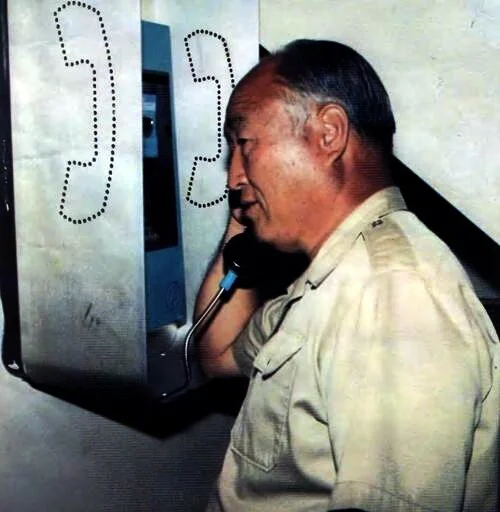
Father calling Mother from Danbury.

Father calling Mother from Danbury.

Question: Are you in contact with the prison authorities?

Yes, I deal with the prison authorities and officials a lot. But at the same time I feel I have another, internal, mission.

I go up there five days a week.

Tuesdays and Wednesdays are non-visiting days. The visiting-room officers work on Saturday and Sunday because so many visitors can only come on week-ends, so the officers take off Tuesdays and Wednesdays instead. Five days a week I go up there and stay with Father from 8:30 am to 3:30 pm -- the official visiting hours. Usually we stay through lunchtime, buy sandwiches from the vending machines, and share them together. Internally I consider it my mission to talk with those inmates who come out to the visiting room to meet their families and friends. The visiting room setup is just open like a restaurant, with chairs, desks and tables here and there. I'm concentrating on making friends with the people there because Father has to deal with them all the time.

I have been giving out Principle video tapes and Divine Principle books. In fact, one Divine Principle book was signed by Father for one inmate's family.

Question: So you give books to the visitors?

Yes, to the visitors. Inmates can't take any material into the prison. By doing this I can talk with their families and spend time with them. If Mother is talking with Father I spend my time that way. I talk with whoever is sitting around the room. I also find out more about what's going on in the prison that way, because as a visitor I can only hear Father and can only see the visiting room. But when I talk with these people they can give me more interesting stories and information. They are Americans and they know what's really going on among those inmates. Father may not be able to hear well because they are not going to talk in front of him openly. But most inmates know a lot of things because they talk together.

Question: Seeing Father in prison so often, what are your observations?

One basic thing I learned from many of the inmates is that Father has really humbled himself all the way to the bottom level. That's the example he set there. Of course, the inmates each have different assignments. Father's assignment as you know is setting up the tables, taking care of salt and pepper bottles and putting the napkins out and things like that. Father is very meticulous; he always cleans the table and whatever he does in his assignment is accurate and flawless. Also, he's always on time and he does work hard, and by doing that he sets an example. As you may know, he said that when he serves these people by setting things on the tables he feels like he's serving our members and all the people in the world. These prisoners represent the bottom level of mankind -- criminals. Serving these criminals is a condition through which Father serves all humankind. That's his determination.

Also he said that even though we have to pray in our life of faith, our members should work hard instead of investing a lot of time in prayer; since he's in prison he will do the main portion of praying. He will pray as much as possible so that our members can spend more time accomplishing their missions.

Father's personal locker (top) and Mr. Kamiyama's personal locker (bottom).

Father's personal locker (top) and Mr. Kamiyama's personal locker (bottom).

Question: What was Father's reaction toward the recent car accident in which two members died?

He received reports of the two members who died recently in that car accident in Florida and looked at the pictures of those members. [Michiko Koide and Eric Mahnken] Then he closed his eyes for maybe five minutes and was in really deep pain and agony. After that he prayed very hard. He just dropped everything. He said that because they were killed while on their missions they should be considered Unification Church martyrs. I just totally felt Father's love and care at that moment. I have learned that point about Father, particularly through this period in prison -- his sincere care and love for our members.

If Father knows somebody's name or has some experience of living with him or her, he's able to remember that person in depth and he can pray more about that person. He prays in general for all the members, but he particularly remembers those people he's most concerned about. Father doesn't want to remember somebody's shortcomings or small mistakes; he always tries instead to remember a person's good deeds or qualities. Whenever we talk about someone he immediately brings up their good points. Based on those good points he tries to characterize that person's spiritual life, what way that person should go and which areas would be good for that person to develop.

Question: Does Father have much interaction with his fellow inmates?

I think all of our members know that Father is a good pool player and a good Ping-Pong player. He plays pool and ping-pang often in the prison. But he doesn't talk a lot with the inmates. Father doesn't want to talk with people about small things. Mr. Kamiyama is there and sometimes acts as Father's spokesman.

The prison cafeteria. Every morning, Father sets up the salt and pepper shakers and the napkins.

The prison cafeteria. Every morning, Father sets up the salt and pepper shakers and the napkins.

Question: When Mother comes to visit, does Father talk with her all the time?

There is hardly any time for Mother to be alone with Father. Leaders like Col. Pak and Rev. Kwak come often. When there is time Father and Mother talk about their children a lot. During this time the children are gaining good experience because when they come and the leaders are not around, they occupy Father totally without any disturbance. Father gives them a lot of advice about how to deal with society, how important patience is when we deal with people, all kinds of internal guidance. Father's trying to train the children to adjust more to the world, for the sake of the future.

Father is especially proud of Jeung Jin Nim. She comes to the prison and everybody loves her there because she's such a bright, young, cute little girl. Jeung Jin Nim sits with Father and Mother, and sometimes she smiles and sings. That makes Father and Mother's meetings more natural, like a family gathering, instead of Father's meeting with people all the time with big piles of papers and newspapers and photo albums and all. When Jeung Jin Nim comes the atmosphere totally changes. She's such a sweetie! The visiting room is very large. She goes around and shakes hands with people, even with the visiting-room officer. When Jeung Jin Nim goes to him and says, "I like you," he can't say anything, he just smiles. Officers usually don't accept anything, even a cold drink, from the inmates or the people who come. But when Jeung Jin Nim brings some kind of soft drink like this they accept it because she is so sweet.

In the beginning, before the prison authorities and the inmates met Father, they had all kinds of imaginative ideas about what Father would be like -- he must just sit down like a meditating guru 24 hours a day or something. But then when they actually met Father and started dealing with him they found that Father was really humble. He is a sportsman, reads books, talks and smiles -- so by now they regard him as an excellent person, someone they respect.

There is one prison officer who works as the chef in the kitchen. This officer came to like Father and is supporting Father in many ways. One time Mr. Kamiyama and this man were talking about our Blessing and our marriages. The chef happens to be a single person even though he's in his mid-30s and he said: "Reverend, you know I have to wait: Reverend Moon has to pick my bride." He trusts Father completely. He says he doesn't have any confidence in choosing his own bride. Of course, he doesn't know Principle yet.

Father and Mr. Kamiyama pose in front of the prison building.

Father and Mr. Kamiyama pose in front of the prison building.

Question: We heard that Father and Mr. Kamiyama go to pray in the chapel early on Sunday mornings. Does anybody else pray with them?

Of course they pray there and do pledge service on Sundays. Quite a few inmates want to come to that service. Mr. Kamiyama told them, "Well, I appreciate that but we are speaking foreign tongues there, Japanese and Korean, so you won't have the foggiest idea what's going on. So don't come at this time. Some other time you can attend, but not Sunday morning prayer services." So that's why they don't come, but many expressed their desire to attend.

Also in the prison now there is a lot of debate and discussion going on over Bible scripture, especially between Catholics and Protestants, and Baptists and Methodists. People debate often there because they have a lot of free time. They read many books and sit around and talk about their faith and about the Bible.

One day Mr. Kamiyama and Father were sitting a little bit apart from the others. Mr. Kamiyama was reading Father's speech to Father, as he often does. Father is the one who is reading his speeches the most at this time, I think. He's reading his speeches at least a few hours a day. Anyway, Father and Mr. Kamiyama were sitting a little apart from this group. Father said to Mr. Kamiyama, "Go and debate with them. You know Bible stories, and you know the straight line that runs through the Bible stories, even though they are all branched out, so you go and talk with them." Mr. Kamiyama went to them. He brought his Japanese Bible of course, and sat there. "May I join you?" They answered, "OK."

They call Mr. Kamiyama "Kami," not in a bad way, but as a pleasant joke. They call Father "Full Moon" and Mr. Kamiyama "Half Moon." That's another term they call him, but not to tease him or anything like that. Sometimes they call among themselves, "Half Moon is coming." So Mr. Kamiyama said, "May I join you?" And they said "Okay Kami, come on."

He listened to their arguments. Later on he came up with Principle point of view of how to interpret this particular Bible story and this biblical person's mission. They all were shocked. "You? The Unification Church believes in the Bible?" They didn't know Unification Church doctrine was based on the Bible. So Mr. Kamiyama realized we have to study the Bible more and deal more with ministers. He always carries a thick Bible and talks with people. In one particular debate they had, they were arguing between Catholics and Protestants. Then Mr. Kamiyama came in later and gave the Principle point of view, and both sides agreed that it is the best answer. So Mr. Kamiyama is really happy and eager to do that. He's continuing every day.

Father's bunk (top) and Mr. Kamiyama's bunk (bottom)

Father's bunk (top) and Mr. Kamiyama's bunk (bottom)

Question: Is there a chance that Father comes out on weekends?

Possibilities for short furloughs do exist but Father hasn't been at Danbury long enough yet to be eligible.

Question: How does Father look?

He looks really healthy. One thing I noticed is that he hasn't been dyeing his hair. His hair is not totally gray, but a lot of gray streaks show. He looks basically very healthy. He's a little bit slimmer now. One of the inmates said he will help Father to lose some weight. He, Father and Mr. Kamiyama have been jogging about two miles a day for many weeks. Mr. Kamiyama and Father don't jog like young people, but they walk fast.

We must not forget our responsibility in this time in history and Father's suffering. Remember Father is always concerned about our physical and spiritual well-being. Let's do our best in fulfilling our mission while Father is praying for our success.

Absolute Values and the New Cultural Revolution

Sun Myung Moon
September 3, 1984
ICUS XII
Founder's Address
Washington DC

SunMyungMoon-840903-1.jpg

Delivered by Hyo Jin Moon (Reverend Sun Myung Moon was imprisoned at the Federal Correctional Institution in Danbury, Connecticut at the time.)

Honorable chairman, eminent professors and scientists, ladies and gentlemen:

I thank you for participating in the Thirteenth International Conference on the Unity of the Sciences. Even though we cannot physically be together, my heart is with you.

For 13 years I have addressed this assembly of distinguished scholars and have raised questions concerning the state of the world and the responsibility of the scientific and academic communities to solve global problems. While the specific contents of my addresses have varied from year to year, the underlying thematic focus has remained unchanged. This focus is essentially twofold, emphasizing the need for the unity of sciences and of knowledge in general, and the need for science to he guided by absolute values and purpose to assure the welfare of human existence.

God is the source not only of religious truth but also of scientific truth. As I said several years ago at the closing of one of our ICUS meetings, "God is not only the first preacher, but also the first scientist." I firmly believe this is a fundamental truth of the universe, and I have based my life's work on this assumption.

I Sought To Unify

As a minister of the living God, I have sought to enhance, clarify and unify all aspects of God's essential being as manifested in the whole of creation, both physical and spiritual.

The search for the meaning of life as well as the desire to enhance the material well-being of human existence have been the motivating forces behind my lifelong work, despite the many obstacles which have stood in my way since I began my mission at age sixteen.

One of the greatest tragedies now facing the pursuit of knowledge is the fragmentation of the academic disciplines. Such divisive specialization of science and knowledge, like the dismantling of a machine, ultimately paralyzes the function of the whole and prevents science from fulfilling its mission.

Whether we accept it or not, the world is one. It is erroneous to think that one discipline has a more complete view of reality than another, or to think that discoveries and advances in different areas are unrelated. All fields of scientific and academic study are intertwined each having a unique yet partial view of the whole of reality. It is to the advantage of total human progress and happiness that all fields of study harmoniously work together to form an integrated view of reality.

Unity with a Purpose

But the view of the unity of science and knowledge about which I speak does not mean simply reducing all knowledge to a single academic discipline. Instead, it is a unity grounded in a fundamental purpose. In science there are many fields, but each aims at the realization of human happiness.

Although fragmentation and divisiveness face the academic world today, there is an even greater menace -- a menace which turns our attention to the second ongoing theme of ICUS: the search for absolute values.

Despite the deep desire and diligent efforts of most scientists and scholars to establish peace and prosperity, poverty, Illiteracy, disease, strife and hostility still prevail in even the most advanced nations. Despite great advances in science and technology, humankind continues to suffer from sorrow, pain and distress.

SunMyungMoon-840903-2.jpg

Empty Promises

Many leaders are trying to eliminate this misery and to establish true peace and stability, but the world echoes with empty promises of peace. Neither democratic capitalism nor communistic socialism has solved world problems. Both have allowed secular humanism to reduce human existence to materialism and thus demean the value of life. The so-called free world has allowed this through impotence and a lack of direction; the communist world dictates this through its ideological materialism. Confusion grows as a sense of purposelessness permeates the world.

How has this come about? The main reason is that the standard of value which regulates human behavior has been undermined. As ethics and morality have lost their power, the standard of goodness has all but disappeared. Part of this loss is due to the misguided foundations of science. By attempting to be value-neutral, science has often excluded the questions of humanity and moral values in the process of its development.

Over time science has gradually fractionalized, each field becoming more specialized, analytical and materialistic, thus ignoring the questions of morality and values. Hence, human dominion over science has weakened to the point that no one can be sure of the fate of human existence on this planet.

New Values Needed

Another reason for the demise of values and morality is that past standards of value and morality no longer satisfy modern thinking men and women. New, reasonable morals and ethics must arise out of a new standard of values that is clear and applicable to the modern individual. This standard can only be derived from a transcendent, unified system of thought which unifies past and present secular and religious thought.

I have long been interested in the aims of religion, philosophy and science. As I have already stated, these conferences which I have initiated stem from these concerns. While religion has concerned itself with metaphysical and moral questions, science has limited itself to understanding the regularities of nature and the transfer of energy and motion in space and time.

It is true that science has contributed to the tremendous advances in knowledge during the last few hundred years. Nevertheless, science without a standard of value to guide it could lead to global destruction. In my view, the whole range of knowledge from theology to science has no meaning without an understood purpose and a standard of value directing this knowledge.

God-Centered Religion

I believe that this direction and standard of value can only come from God-centered religion. This should not be any surprise to those in the scientific community who are aware of the philosophical writings of many great scientists.

I have proclaimed in earlier addresses at ICUS that Unification theology and ideology can be the foundation of a new, unified thought system centered on God. This ideology states that human beings are intended to have value by nature of their very being. They are each meant to have a unique parent-child relationship with God.

Hence, all people are created to lead life with a definite value perspective in accordance with God's purpose of creation: the establishment of true love relationships. In fact, I propose that the absolute values which we seek are grounded in the absolute true love of God. It is on the foundation of true love that the values of absolute truth, beauty and goodness are formed.

My ardent wish is that all scientists and scholars develop their respective fields on the basis of a solid view of moral values, thus exalting human dignity by adopting a spiritual and unified method as well as a materialistic and analytical one.

Solutions to the world's problems can only come about through this holistic approach to human existence. Rather than the clash of fragmented approaches and ideals, a harmonious effort centered on effective wisdom and knowledge is required of the many distinguished scholars gathered at this conference.

I sincerely hope that this conference will contribute to the ideals which God intended to realize at the time of the creation, and to provide solutions to global concerns. May your efforts become a decisive, contributing factor toward the realization of the new cultural revolution culminating in a world of true love, goodness, peace and happiness.

Thank you very much. 

Founder's Address to the Fourth God Conference and the Youth Seminar on World Religions

Sun Myung Moon
August 11, 1984
Seoul, Korea

Read by Rev. Chung Hwan Kwak. [Rev. Moon was unable to attend. He was in Danbury prison]

Honorable Chairperson, distinguished scholars and clergy, participants in the Youth Seminar on World Religions, ladies and gentlemen:

I welcome you to Korea, the site of the fourth conference on God: The Contemporary Discussion, and the final destination of the third annual Youth Seminar on World Religions.

It is natural and appropriate for the God conference and the Youth Seminar to be convening together here in Korea. Korea has historically been a unique meeting place of the world's religions. Here, Buddhism and Confucianism took deep root, maintaining harmony with each other in the context of the native Korean Tan-gun tradition and Korean folk belief. This year of 1984 marks the 200th anniversary of the arrival of Catholicism, and the 100th anniversary of the arrival of Protestantism and the flourishing of Christianity in Korea.

Within our culturally homogeneous society, tremendous religious coexistence and cross-fertilization have occurred, and the precepts of these diverse religious traditions are embedded together in the people and society of the "Hermit Kingdom." From this soil has sprung the Unification movement, a movement seeking this unity-within-diversity on the worldwide level, striving to establish a world of love, sympathy and harmony based on the religious affirmation of the familyhood of all people under our common parent, God.

Blueprint of an Ideal World

To create the world of this ideal we must have an overall model or blueprint. An important Unification image is that of a mature or perfected person with unity of mind and body. The highest ideals and purposes spring from the mental and spiritual life of a person centered on God. The nervous system transmits the directives of the mind to the cells and relays information from the physical body back to the mind. When this exchange occurs smoothly we say that the individual is in harmony. The mental and spiritual life of humanity can be likened to the mind, and the economic life of humanity to the body. The spiritual ideals, aspirations, and love of God manifest socially through religion, and around this religious essence theology, philosophy, art and all culture revolve; their material base is the substantial reality, the life of all people. Religious thinkers and theological and philosophical thinkers, then, are a central nervous system, transmitting, interpreting and developing impulses from God for the whole body of humanity.

I view religious leaders and scholars as being of crucial importance for the betterment of the world and for the creation of a new cultural revolution. Throughout history such leaders have always been the vanguard of culture in the rise of Christianity and the world of Islam; with the Renaissance, the Reformation and the Enlightenment.

Today, however, along with the unprecedented success of science and technology we also have unprecedented modern problems. Religion often fails to speak to the realistic problems of the modern world, and those taking the lead in social change are often under the anti-religious banner of communism. But communism welcomes violence as the means for change; it ultimately denies God, turns against religions, and tries to restrict our perspective to the material world.

I know that many supporters of communism have high ideals and are working beyond the scope of nation, race and culture; but their energy and idealism must be complemented by God-centered thought and action. Accordingly, the world needs religious leaders and scholars as sacrificial pioneers. The God Conference, the Youth Seminar on World Religions, and all the activities of the International Religious Foundation exist as a forum and structure for the fulfillment of this ideal.

As individuals, you are called to a renewed dedication of yourselves and your disciplines to the world. As representatives of the world's religions, you are called to bring your churches, mosques, synagogues, shrines and temples into a cooperative unity for the sake of world peace and human freedom, centered on God. Many people ask what religions can do in this secular age. I answer. The world's religions must provide a stable, universal foundation of values upon which governments can build true peace and harmony, science and technology can be fully utilized for the happiness of mankind, and the world's cultures can be purified, shared and exalted.

Truly, the ideal I am espousing is nothing other than the Kingdom of God on earth. I see it as a realistic goal toward which we can realistically work. People have been telling me that I am too utopian. I recognize that I am extremely idealistic, but I have no alternative: God has called me directly, personally, to this task and responsibility.

I have been concentrating not only on teaching people about the ideal of God, but also on promoting the accomplishment of that ideal on earth. It is for this purpose that I have dedicated all of my activities, such as missionary work, education, challenges to communist ideology, the ecumenical movement, social services, etc. Among these, I put greatest emphasis on the ecumenical movement.

Inter-religious Harmony

A major problem that humanity faces today is the lack of spiritual unity, both within Christianity with its various denominations, and among and within each of the world's religions. Despite all efforts to the contrary, division and animosities among various religious groups continue. Religious wars are still waged, as they have for centuries. In spite of the various movements toward ecumenism, it remains true that religious arrogance, intolerance and bigotry are still prevalent among devout believers. Thus, although most religions have professed the same God and often even the same views for centuries, followers of those great religious traditions have continually persecuted and warred with one another.

We must realize that God is beyond denominationalism, doctrinalism and factionalism. God's purpose is, and always has been, to save the entire world, and not merely a certain race, nation or religious group. As religious people, we cannot help God in the task of salvation when there is fighting and animosity among ourselves. Many religious leaders are aware of this, but for numerous reasons it has been difficult to change that reality.

The essence of my teaching is that inter-religious harmony is a necessary condition for world peace. Since no single religion has manifested God completely, diversity and differences of religion have been inevitable. Yet, as many great religious leaders have taught, because we are all children of the same Heavenly Parent we are all brothers and sisters in the one great family, and inter-religious conflict and divisive hatred are unnecessary.

In my years of spiritual search and struggle I encountered God many times, and I also spiritually encountered the founders of all the world's great religions. I feel the continual presence and inspiration of God every day of my life. Without God, how would it have been possible for a man born in an isolated farming village in a small, oppressed and destitute nation to now be able to sponsor and address this august assembly of the world's religious leaders? I testify that the teachings of the Unification movement, its goals, and all its projects, are the result of God's direction to me. They are not my personal theory and activity; they are God's.

Parliament of World Religions In 1993

The International Religious Foundation is planning to sponsor a Parliament of World Religions in 1993. That Parliament will commemorate the 100th anniversary of the 1893 World Parliament of Religion held in Chicago in conjunction with the first World's Fair. Prior to the 1993 event, two preparatory meetings will be convened, one in mid-November 1985 near New York City, and the other sometime in 1989. Each of these gatherings will bring together more than 700 spiritual teachers, scholars, lay leaders, artists and young people. It is hoped that the three planned events will lead to other such programs in the future.

The 1993 Parliament of World Religions and the two preparatory meetings are designed to provide a new environment for global ecumenical contacts. The objective is to move toward disclosing the universal principles that underlie all life throughout the world and to promote with equal vigor the fullest diversity of its possible expressions. In so doing the Parliament will seek to advance and develop the aims of international peace and harmony for which the world yearns. Participants will be offered an opportunity to share their perspectives on our present spiritual condition and on the challenges of our present age.

The purpose of the Parliament will not be to legislate, either politically or doctrinally, but to promote mutual respect among the world's religions and to foster inter-religious cooperation on projects initiated by them. The overall theme will be the renewal of spirituality and the establishment of world peace under God, and a variety of other questions will also be discussed.

I thank you for coming. I hope this conference will be centered not on human thoughts about God but on God's original ideal. I truly believe that your study and discussion will bring about tremendous progress in bringing God's ideal into reality upon the earth.

Thank you.

The Fourth International Conference On God: The Contemporary Discussion

Reverend Sun Myung Moon
August 11, 1984
Hotel Lotte
Seoul, Korea

Honorable Chairperson, distinguished scholars and clergy, participants in the Youth Seminar on World Religions. ladies and gentlemen:

I welcome you to Korea, the site of the fourth conference on God: The Contemporary Discussion, and the final destination of the third Youth Seminar on World Religions.

It is natural and appropriate for the Conference and the Seminar to be convening together here in Korea. Korea has historically been a unique meeting place of the world's religions. Here, Buddhism and Confucianism took deep root, maintaining harmony with each other in the context of the native Korean Tan-gun tradition and the Korean folk belief. Christianity has flourished in Korea: 1984 marks the 200th anniversary of the arrival of Catholicism, and the l00th anniversary of the arrival of Protestantism. Within our culturally homogeneous society, religions have coexisted and cross-fertilized one another, and the precepts of these diverse religious traditions are embedded together in the people and society of the "hermit kingdom." From this soil has sprung the Unification movement, a movement seeking unity-within-diversity on the world-wide level, and striving to establish a world of love, sympathy, and harmony based on the religious affirmation of the familyhood of all people under our common parent, God.

To create this ideal world we must have an overall model or blueprint. An important Unification image is that of a mature or perfected person, with mind and body united. From the mental and spiritual life of a person, centered on God, spring ideals and purposes. The nervous system transmits the resulting directives of the mind to the cells, and relays information from the physical body back to the mind. When this exchange occurs smoothly we say that the individual is in harmony. The mental and spiritual life of humanity can be likened to the mind, the economic life of humanity to the body. The spiritual ideals, aspirations, and love of God are manifested through religion, around which theology, philosophy, art, and all culture revolve. Religious leaders and theological and philosophical thinkers, then are a central nervous system, transmitting, interpreting, and developing impulses from God for the whole body of humanity.

I view religious leaders and scholars as vitally important for the betterment of the world and the creation of a new cultural revolution. Such leaders have always been the vanguard of cultural development - in ancient China, India, Africa, the Middle East, and Greece; in the rise of Christianity and the world of Islam; in the Renaissance, the Reformation, and the Enlightenment.

Today, however, with the great success of science and technology, and the failure of religion to speak to the realistic problems of the world, those taking the lead in social change are often under the anti-religious banner of Communism. But Communism welcomes violence as the means for change; it ultimately denies God, turns against religions, and tries to restrict our perspective to the material world.

I know that many supporters of Communism have high ideals, not limited by the confines of nation, race, and culture; but their energy and idealism must be complemented by God-centered thought and action. Accordingly, the world needs religious leaders and scholars as sacrificial pioneers. The God Conference, the Youth Seminar on World Religions, and all the activities of the International Religious Foundation exist as a forum and structure for the fulfillment of this ideal.

As individuals, you are called to a renewed dedication of yourselves and your disciplines to the world. As representatives of the world's religions, you are called to bring your churches, mosques, synagogues, shrines, and temples into a cooperative unity for the sake of world peace and human freedom, centered on God. Many people ask what religions can do in this secular age. I answer: the world's religions must provide a stable, universal foundation of values upon which governments can build true peace and harmony, science and technology can be fully utilized for the happiness of mankind, and the world's cultures can be purified, exalted, shared, celebrated.

Truly, the ideal I am espousing is nothing other than the kingdom of God on earth. I see it as a realistic goal toward which we can realistically work. People have been telling me that I am too utopian. I recognize that I am extremely idealistic, but I have no choice: God has called me directly, personally, to this task and responsibility.

I have been concentrating not only on teaching people about the ideal of God, but also on promoting the accomplishment of that ideal on earth. It is for this purpose that I have undertaken all of my activities, including missionary work, education, challenges to Communist ideology, an ecumenical movement, and social services. Among these, I put greatest emphasis on the ecumenical movement.

A major problem facing humanity today is the lack of spiritual unity among and within each of the world's religions. Despite all efforts to the contrary, divisions and animosities among various religious groups continue. Religious wars are still being waged, as they have been for centuries. In spite of various ecumenical movements, religious arrogance, intolerance, and bigotry are still prevalent among devout believers. Thus, although most religions have professed the same God and often even the same views for centuries, followers of those great religious traditions have continually persecuted and warred with one another.

We must realize that God is beyond denominationalism, doctrinalism, and factionalism. God's purpose is and always has been to save the entire world, and not merely a certain race, nation, or religious group. As religious people, we cannot help God in the task of salvation when we fight among ourselves. This idea is not new, but for numerous reasons it has been difficult to achieve.

The essence of my teaching is that inter-religious harmony is a necessary condition for world peace. Since no single religion has manifested God completely, religious differences have been inevitable. Yet, as many great religious leaders have taught, because we are all children of the same Heavenly Parent we are all brothers and sisters in one great family, and inter-religious conflict and divisive hatred are unnecessary.

In my years of spiritual search and struggle I encountered God many times, and I also spiritually encountered the founders of all the world's great religions. I feel the continual presence and inspiration of God every day in my life. Without God, how would it have been possible for a man born in an isolated farming village in a small, oppressed, and destitute nation to be able now to sponsor and address this august assembly of world religious leaders? I testify that the teachings of the Unification movement, its goals, and its projects, are the result of God's direction to me. They are not my personal theory and activity, they are God's.

The International Religious Foundation is planning to sponsor a Parliament of World Religions in 1993. That parliament will commemorate the 100th anniversary of the 1893 World Parliament of Religion held in Chicago in conjunction with the first World's Fair. Prior to the 1993 event, two preparatory meetings will be convened, one in mid-November 1985 near New York City, and the other some time in 1989. Each of these gatherings will bring together more than seven hundred spiritual teachers, scholars, lay leaders, artists, and young people. It is hoped that the three planned events will lead to other such programs in the future.

The 1993 Parliament of World Religions and the two preparatory meetings are designed to provide a new environment for global ecumenical contact. The objective is to move toward disclosing the Universal Principles that underlie all life throughout the world and to promote with equal vigor the fullest diversity of its possible expressions. In so doing the Parliament will seek to advance and develop the aims of international peace and harmony for which the world longs. Participants will be offered an opportunity to share their perspectives on our present spiritual condition and on the challenges of our present age.

The purpose will not be to legislate, either politically or doctrinally, but to promote mutual respect among the world's religions and to foster inter-religious cooperation on projects initiated by them. A variety of issues will be discussed, but the overall theme will be the renewal of spirituality and the establishment of world peace under God.

I thank you again for coming. I hope this conference will be centered not on human thoughts of God but on God's original ideal. I truly believe that your study and discussion will bring about tremendous progress in accomplishing the ideal of God on earth.

Thank you

Message from Danbury Prison to the Religious Freedom Rally at Constitution Hall, Washington, D.C.

Sun Myung Moon
July 25, 1984

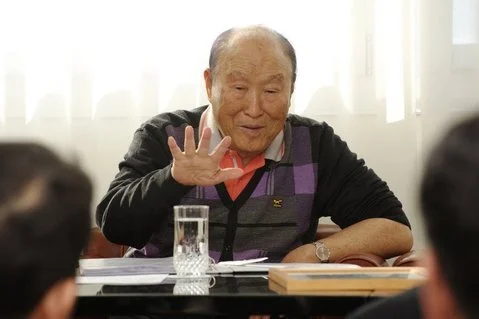
Sun Myung Moon, May 15, 2011

Sun Myung Moon, May 15, 2011

My beloved brothers and sisters under God:

I regret I cannot be with you tonight in person. But know that I am with you in spirit. Please accept my heartfelt congratulations for coming to the nation's capital to stand up for religious freedom.

From my earliest days as a teenager in the poverty-stricken land of Korea, I was driven in my quest for truth and my search for God. From that point on I have always felt so deeply the preciousness of religious freedom.

Even when I was arrested and beaten nearly to death by the North Korean communists, and later when I was sent to die in a communist concentration camp, I had no fear. I felt deeply that God was with me. I felt so close to God and had daily communion with Him for the three years I was in the death camp. I did not pray for God to come and rescue me. Knowing that my Father in heaven already knew my suffering, I spent every minute of the day reassuring Him that I would not be defeated by this suffering.

I am now in America and I am now in an American prison. In my twelve years of living in this country, I have never felt as close to God as I do now. I love America more than ever. If his will is being served by my imprisonment, then I am here in gratitude. When I serve my fellow prisoners their food or scrape the plates after dinner or scrub the kitchen floor, I am doing it for my Heavenly Father. I am serving His children. And I am serving America and the world. I am therefore doing my chores with joy.

I came to America in 1971 at God's command. God told me that America is His final hope, His precious jewel which He prepared for the final battle against the atheistic communism in the last days. However, America needs help. America is turning away from God. God cannot afford to lose America. God told me to go to America to wake people from their spiritual sleep before atheistic communism takes over the world.

You know that with such a mandate, I did not come to this country to win a popularity contest. I spoke out and I took a stand. I gave America every ounce of my soul. In the process, I became unpopular and have been persecuted and now I have ended up in a U.S. prison. This is no surprise to me, for I almost knew such a cross would come.

I thank God that my situation and that of Pastor Sileven and many others have become rallying points for religious freedom in the United States. God works in mysterious ways. Here in prison God can use me to awaken America more powerfully than ever before. America's religious communities must be united to preserve religious freedom. Our united effort alone, like this pageant, will ensure the survival of America.

Here in prison I will do my part. I encourage you to do your part. Together, we will awaken America. I am willing to suffer any indignity, to go any distance, to do any labor and to bear any cross. I am even willing to give my life if that will ensure that America and the world will survive and do God's will.

My prayers are always with you. Prayers from prison can be powerful. Tonight we mark a new beginning, yet our job lies ahead. Let us move forward together in the spirit of Jesus Christ and claim a glorious victory for America, for the world and for God.

God bless you and God bless America.